Stoicism as a Mass Phenomenon
In recent years Stoicism has grown so popular that it has become a mass phenomenon. Hardly a week goes by without the general press offering us a newly published Stoic synthesis just out in the bookshops, or a cursory analysis of the reasons for the return of this ancient philosophy. All sorts of Stoic podcasts circulate on the internet; youtubers, opinion leaders and great entrepreneurs claim to promote Stoic values, and the Greco-Roman classics of this school, such as Epictetus or Marcus Aurelius, find a place in bookshop windows for the first time.
In recent years Stoicism has grown so popular that it has become a mass phenomenon. Hardly a week goes by without the general press offering us a newly published Stoic synthesis just out in the bookshops, or a cursory analysis of the reasons for the return of this ancient philosophy. All sorts of Stoic podcasts circulate on the internet; youtubers, opinion leaders and great entrepreneurs claim to promote Stoic values, and the Greco-Roman classics of this school, such as Epictetus or Marcus Aurelius, find a place in bookshop windows for the first time. The Meditations of the philosopher-emperor is at present the most widely translated text of a Roman author into Spanish. In 2023 Arpa and Trotta brought us two new translations by David Hernandez de la Fuente and Jorge Cano Cuenca, respectively. For its part, Alianza Editorial has published, edited by Ignacio Pajon Leyra, a compilation of texts by Epictetus under the title The Art of Living in Difficult Times. These are very valuable works that join others already existing in our language.
The recovery of Stoicism is not a novel fact, but a trend that began at the end of the twentieth century with the publication of the work A New Stoicism, by Lawrence Becker. Becker knows the ancient Stoics very well and tries to adapt their thought to the modern world. To this end, he places the emphasis on ethics, since the remaining parts of the system (logic and physics) are difficult to transpose to the present day. The return of Stoicism was later stimulated by the pandemic episode that began in 2020. Today everything bearing the word ‘Stoic’ arouses considerable interest among broad sectors of the population. But what is the reason, or reasons, for this extraordinary renaissance?
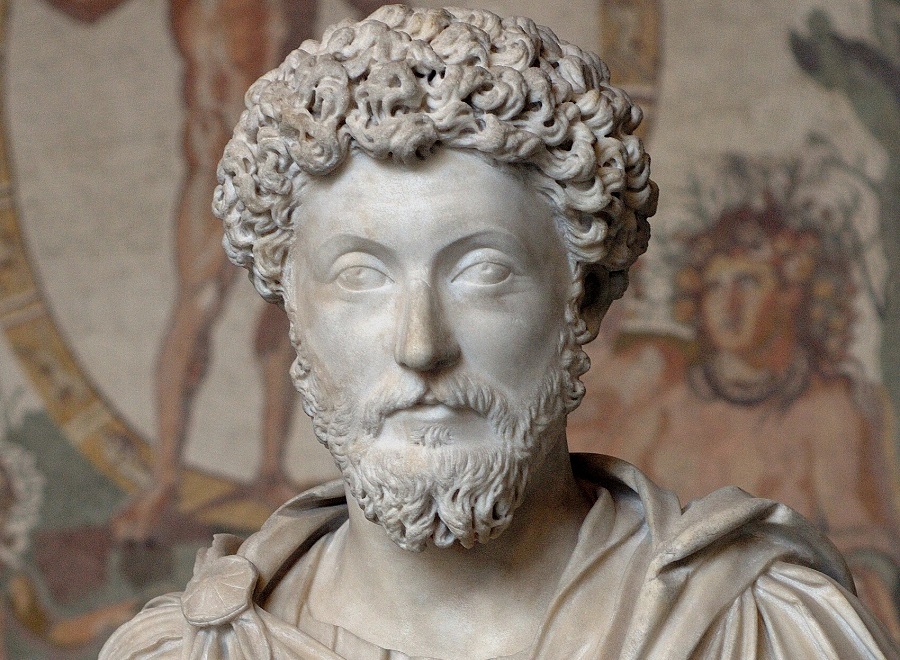
Bust of Marcus Aurelius, Glyptothek
What do we call Stoicism today?
This is a complicated question to answer. To do so we must distinguish at least two levels of discourse. On the one hand we have a more theoretical Stoicism, recovered by scholars who know well the principles of this school and its contribution in antiquity. Thus, for Becker, Stoicism consists of a series of ethical principles that can point out to us paths for living in a way more in accordance with our nature. Understanding what it means to live in accordance with nature is a core theme in Stoicism and constitutes the key to Becker’s book.
The mastery of our impulses, what William B. Irvine, another scholar who promotes Stoic values, considers “our evolutionary master,” is the foundation of the control of our desires. For this American philosopher, who develops these questions in On Desire or in A Guide to the Good Life: The Ancient Art of Stoic Joy, the greatest benefit of Stoicism today consists in the revaluation and revitalization of rationality in the face of emotional impulses that take on an ever more leading role. Only with the virtues of an animus magnus, as Cicero said, that is, with fortitude sustained by constancy, can the new Stoic take possession of his emotions and master them.
In general, this more theoretical Stoicism rescues from the ancient one almost all of its ethical values. Some have generated a certain controversy, since, in principle, they make up an ethics that grates with the spirit of our time. For example: both Becker and Irvine, but also other promoters of this movement such as Sellars, Gill or Pigliucci, maintain that the control of desires must be grounded in the acceptance of things as they are and not as we would wish them to be. This is a conclusion consistent with the Stoic principle known as the “dichotomy of control,” which requires us to distinguish those aspects of our lives that we can change because they ultimately depend on us and those others which, however, prove unalterable because they are not under our control. This doctrine, already held by the ancient Stoics, has been subjected to a strong critique for its supposedly conservative character. Later on I will refer to it in greater detail.
Another of the elements common to the neo-Stoic authors is the recovery for ethics of the concept of virtue, abandoned by the great majority of modern philosophies, but essential for understanding the ethics of antiquity. According to this doctrine, the ultimate end of the human being would be to behave in a virtuous and consistent manner throughout his life. But what does “behaving virtuously” or “living in accordance with nature” mean? In principle, they seem empty signifiers that need to be given content. The neo-Stoics try to do so, although among them there are nuances. Nonetheless, it is possible to discover some common elements that revolve around the development of the old classical virtues of prudence, justice, fortitude and courage in the face of adversity. So that the neo-Stoic treatises consist fundamentally of an attempt to discover -sometimes with a very precise casuistry- in what the practice of these virtues would consist today. Since their grounding is presided over by rationality, we are dealing with expositions that have a prescriptive aroma and are very critical of what they consider the perverse and debilitating emotional drift of the individual and of the communities into which he is integrated.
With the theory of the virtues, Stoicism recovers the controversial notion of human nature in order to offer a solid vessel for its doctrines. Properly human nature would serve as a pattern of conduct that allows us to distinguish between the actions beneficial to the human being and those that turn him away from a peaceful coexistence with himself and with others. But, once again, this concept requires a precise content that the neo-Stoics do not always provide in a clear-cut way.
In sum, we might say that neo-Stoicism comes formulated as a critique of some ethical proposals of modernity based on the predominance of the cultural over the biological or on the rise of individual identities and desires, which, in its judgment, have abandoned basic principles of the baggage of classical philosophy: knowledge as a way of ranking the different positions in society, the role of human nature as a limit on action and desire, or the value of imitation as against the modern centrality of the concepts of autonomy and emancipation. These principles would lay bare the limits of such proposals and of some values proper to the Enlightenment.
Alongside these texts of a more philosophical or academic cast, we find on the internet a multitude of voices that appeal to principles, doctrines or practices called Stoic. Let us look at some examples: for the American investor, entrepreneur and podcaster Tim Ferriss, Stoicism would be an operating system for succeeding in high-stress environments, a definition that centers on the psychological plane. And indeed Stoic doctrines have proved inspiring for some psychologists who defend the cognitive-behavioral paradigm, such as Donald Robertson, a Scottish therapist well known on social media for proposing the Meditations of Marcus Aurelius as the basis of his therapies.
Another declared reader of the emperor-philosopher is the most celebrated entrepreneur Elon Musk, owner of Tesla and Space X. A few years ago, Musk declared that reading the Meditations had changed his life. Since then he says he applies the principles of resilience and perseverance in all the actions he undertakes, faces problems with calm and serenity (sic), stays alert to opportunities and nurtures a long-term perspective without letting himself be seduced by daydreams or desires. For him the Stoic dichotomy of control is fundamental, since it helps him to accept what cannot be changed and to tackle what depends on oneself. Musk calls this way of proceeding a “pragmatic and strategic approach.”
The founder of Amazon, Jeff Bezos, defends an approach similar to those of Ferriss and Musk. His proposal, which he calls “Stoic leadership,” is summed up in two principles: focus on the customer and keeping calm under pressure.
At first sight, this corporate and business language seems alien to the Stoic vocabulary and, in part, it is. If among the more academic neo-Stoics one clearly perceives the interest in establishing a link between their ethical proposals and those of the ancient Stoa, this Stoicism of a corporate cast dispenses with any historical perspective and reduces Stoicism to the values of effort, tenacity, resistance to adversity, and a prudent and serene management of risk. Without doubt we are dealing with ‘virtues’ that a classical Stoic -and also a neo-Stoic- would be willing to recognize as their own, but all will to system has been lost. The theoretical support and the role of reason in Stoic ethics are replaced by the evidence of a successful experience.
This vulgarization of Stoicism nonetheless reveals two elements worth bearing in mind. The first is the ductility of this philosophy in adapting to different contexts, a factor that was already decisive in its expansion during antiquity. In Rome the triumph of this school was due fundamentally to its progressive accommodation to the Roman character and traditions. Its success today is proof of its capacity to adapt to societies quite different from those.
The second element we must take into consideration is that the core of Stoicism -in its two versions set out here- makes it possible to connect with certain classical values that in recent decades have been much contested, not only in the academic sphere, but also in the collective imaginary. Let us think of concepts such as human nature, merit or effort. They are classical postulates that modernity has attacked with ferocity without, it seems, a sector of society being willing to abandon them without discussion. Stoic language, some of its most typical principles and values, would be the channel through which to articulate a critique in the face of the progressive neglect of these concepts and against what they consider an exaggerated postmodern drift in favor of individualism and emotivism.

What do the critics of Stoicism say?
The Stoa already received strong criticism in antiquity. Its harsh competition with other schools of philosophy, such as Epicureanism or the skepticism of the New Academy sponsored by Arcesilaus and Carneades, fostered controversy over many elements of its system. One of the fields in which the discussion proved most intense was that of epistemology, where the assaults of the skepticism of Carneades were ferocious. A profound and detailed record of all these criticisms can be found in a splendid book recently published in open access by Salvador Mas Torres, professor of History of Ancient Philosophy at the UNED and a specialist in the philosophy of this period: Escepticos y dogmaticos. Estudios sobre la Academia Nueva.
Since neo-Stoicism does not adopt a defined position in the epistemological terrain, I will not focus on these criticisms. It is, as I have already indicated, in the terrain of ethics that this resurgence of the new Stoa has proved most fruitful, so I will focus exclusively on this domain.
As early as the first century B.C., Cicero devoted some of his treatises to reflecting on the principles of Stoic ethics. The Roman philosopher does not show himself opposed to many of them, as we shall see Epicureanism did, and still does. In fact he declares his sympathy above all for the conception of honesty or moral integrity as the supreme good of the school, for having always made a banner of a patriotism that the Roman Republic needed at that moment, and for having placed the duties of citizenship before personal desires and pleasures. Cicero’s criticisms are subtle and, if you like, a matter of detail, although they prove devastating when he refutes the model of the Stoic sage (On the Supreme Good and the Supreme Evil) as mechanical and alien to common sense.
Some of these criticisms have been reproduced in the present day. For their exposition I will divide them in two: on the one hand, those directed at the more theoretical or academic sector and, on the other, those that suspect the resurgence of reactionary ideas behind the Stoicism that I have here called “corporate.” I will begin with the former, since they possess a greater complexity.
The criticisms of the more theoretical aspects of neo-Stoicism likewise come from academic circles. Their defenders are philosophers or professors of philosophy who place themselves on the side of one of the rival schools of ancient Stoicism: Epicureanism. As is well known, Epicurean philosophy promotes pleasure -understood as the absence of pain- as the supreme good of the human being. From this disagreement with the Stoics numerous consequences for ethics are drawn, which were already recorded in antiquity.

In her work How to Be an Epicurean. The Ancient Art of Living Well, the professor of philosophy at the University of York, Catherine Wilson, devotes an entire chapter to contrasting the principles of Epicurean ethics with those of Stoic ethics. According to Wilson, the differences could be reduced to four distinct aspects:
1.- While the Stoic is a determinist and considers that some tragedies that occur in life are inevitable (for example, the premature death of people from illnesses such as cancer, or the existence of violence among human beings), the Epicurean thinks that these facts are fortuitous and, consequently, could be otherwise. We are dealing with the disjunction that Marcus Aurelius refers to as “providence or atoms”: the Stoics consider that reason, which orders nature, is providential, whereas the Epicureans believe that the world, constituted by atoms and void, is governed by chance. For Wilson, Stoic determinism ethically issues in a conformism with the evils that ravage the world, whereas the Epicureans open the door to change. Later on I will refer to the problems derived from Wilson’s position on this question.
2.- Stoic fortitude in the face of adversity, necessary in order to confront the inevitable existing evils, issues, in Wilson’s judgment, in an excessive moral rigorism. The combination of resistance to adversity, suffering and fulfillment of duty makes Stoicism a philosophy with a marked tendency toward bellicism. Hence, the author tells us, the military and police sectors find themselves more attracted to this philosophy than to Epicureanism, whose invocation of pleasure as the absence of pain would function as a drug against violence.
3.- The Stoic program of suppressing the emotions seems to this author rather unrealistic. For the Stoics, the emotions were something very much like illnesses that one had to block from the outset. This thesis seems consistent with the centrality that the Stoa granted to reason. But it is worth analyzing, as Wilson does, what space the emotions occupy in our life, or whether the emotions are not also part of human nature. This is a very old discussion, even within Stoicism, which in this respect is not a unanimous doctrine. Wilson’s Epicureanism, by contrast, considers the emotions as something positive or, at the very least, an important factor to which it is fitting to attend, since it is decisive in our lives.
4.- The last aspect that pits Wilson against the Stoics is that of the so-called “indifferents.” As is well known, the Stoics admit the existence of a single good – honesty or moral integrity- and declare the indifference of everything else. Other philosophies, such as Aristotelianism or Epicureanism, admitted what in antiquity were called “external goods,” that is, friends, family, wealth or pleasures. For Wilson, Stoic indifference issues in aberrant results such as comparing the death of a child with the breaking of a vase, as the Stoic philosopher Epictetus does. So that honesty, something in principle positive, turns the militants of this school into beings apathetic toward the world around them. In order to avoid the suffering derived from life’s losses, they clothe themselves in an almost inhuman coldness.
Seen in this way, some critics of Stoicism have proposed Epicureanism as a complement to or correction of the more rigid principles of the doctrine. Such is the case of the recent book by Charles Senard, Ser estoico no basta. Sabiduria epicurea para vivir el presente, published in Spanish by Rosameron.
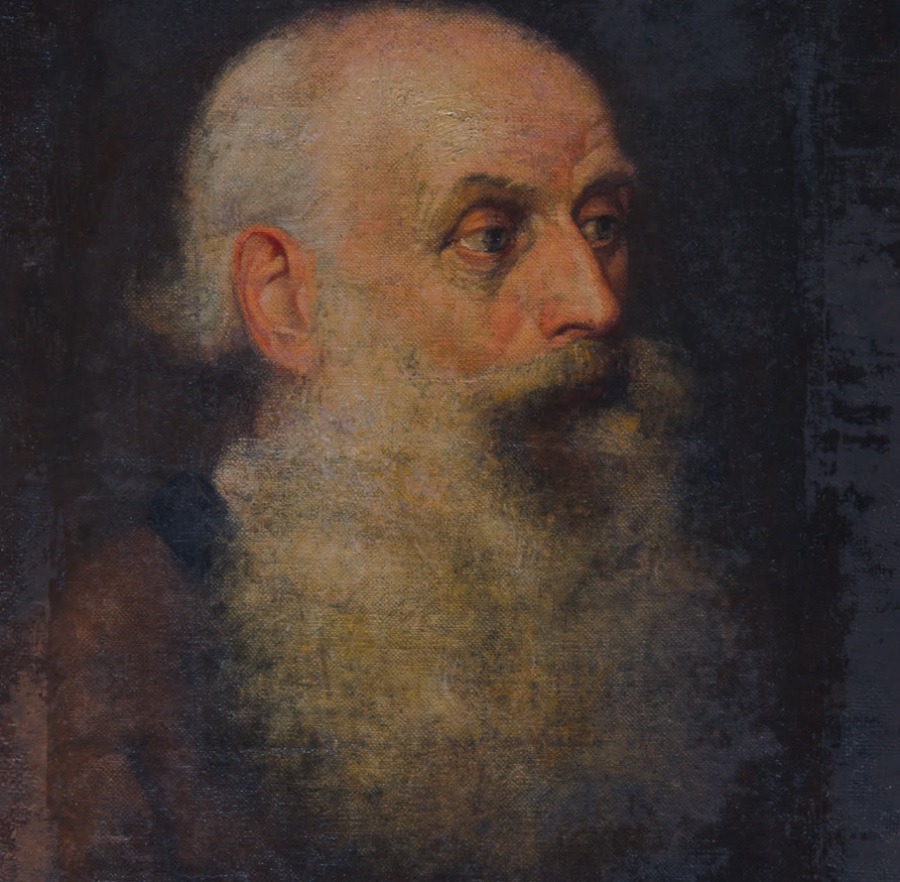
Head of the philosopher Epicurus. Venetian anonymous1670/1700
As may be observed, these are criticisms similar to those this school received in antiquity, which indicates that the neo-Stoics have recovered with considerable fidelity the core of the wisdom of the ancient Stoa. Now then, Wilson’s criticisms possess ingredients that the earlier versions did not have. They are criticisms that come from a “modern mentality,” if the reader will allow me to put it this way. I mean: these are criticisms made with the theoretical tools of modernity, with concepts, values and principles that are heirs of the Enlightenment.
I will refer to one in particular: the one that has to do with the opposition Wilson establishes between determinism and chance. The English professor presents the question as an alternative between forced Stoic necessity and Epicurean free will. Again, the subject is complex and extraordinarily interesting from the point of view of the evolution of ideas, since it constitutes what we might call the prehistory of our current concept of individual freedom. Unfortunately I cannot dwell on it. I would only like to point out that, in reality, providence and chance are, from the point of view of our possibilities of intervening in the events determined by them, two sides of the same coin. It is true that, for the Stoic determinist, events occur in accordance with a strict rational necessity. Now then, if our rational capacity were total, we could even predict the future, since we would deduce the causes of all of them. For the Stoic, Reason (with a capital letter, that is, perfect rationality) is providential. By contrast, for the Epicurean no rational order exists: everything happens by chance. But, just as in the case of the Stoics, random events do not admit any possibility of human intervention either, save that which comes from chance itself. They are as necessary as the rational ones. One might say that Stoicism is in this sense more hopeful, for it affirms that the greater the understanding of the rationality of nature, the greater the predictive capacity and, consequently, the greater the control. By contrast, chance proves wholly uncontrollable since, by definition, it lacks laws. Linking free will with chance does not seem, then, the most appropriate thing, although at present it proves effective in associating Stoicism with outdated and intransigent values and Epicureanism with more flexible values, more proper to our time.
This is the sense of the second set of criticisms, those made on a more general plane and foreign to strictly philosophical aspects. They are criticisms that suspect that behind the Stoic values defended by successful entrepreneurs one detects an attempt to generate a certain climate of social conformism around their business policies. Thus, when we are told “you must admit reality just as it is,” what is really being meant is “accept your working and living conditions, however precarious they may be, as something natural”; and when we are told “fulfill your duty, whatever position you occupy in society,” what is really being meant is “do not question that position and fulfill the duties associated with it without trying to modify them.” Conceived in this way, neo-Stoicism would not be a useful philosophy for those who find themselves dissatisfied with the world around them. Hence the fact that, as things stand today, it has great success among the socioeconomic elites.
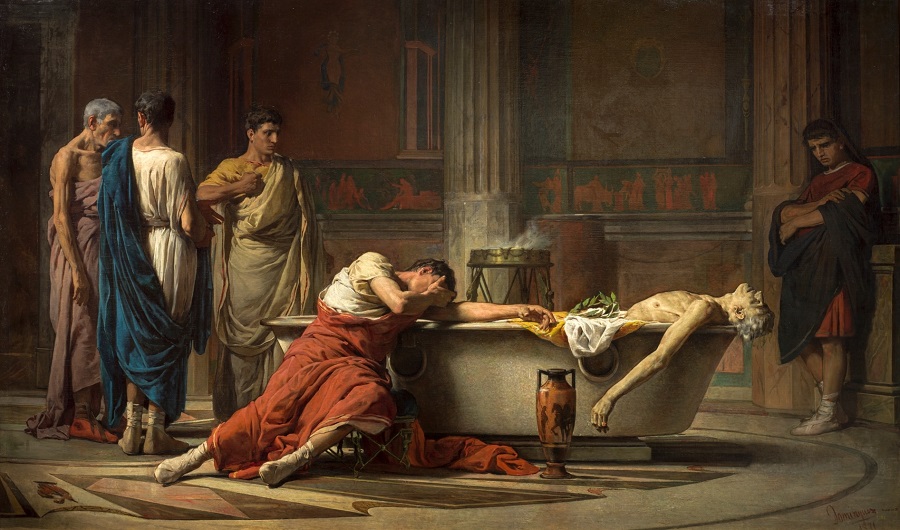
Seneca after Opening His Veins, Manuel Dominguez, 1871. Oil on canvas, Museo del Prado
Some final considerations (and a tentative answer to the initial question)
In general, the criticisms leveled at that special type of Stoicism which is the “corporate” one seem to me reasonable. Now then, we must bear in mind that this is a Stoicism made up of commonplaces, rather vague and imprecise, more than of the real doctrine this school teaches. On occasion, these same criticisms have been extended to the treatises of the more theoretical neo-Stoics and, in this case, they seem to me poor and out of focus. I will try to explain why, in order, finally, to offer an answer to the initial question about the causes of the current success of this movement.
Ancient Stoicism, like the rest of the Hellenistic philosophies, arose as a critical response to human conditions that were considered unsatisfactory. Its philosophy tries to turn the human being into a moral agent capable of attaining a life in harmony with nature. The first rule for achieving this objective consisted in knowing oneself. The Stoic understood that self-knowledge consisted in discovering the traits that define our biological and cultural life and that all of us humans share insofar as we are rational animals. The next step had to be that of understanding one’s own character and trying to live in accordance with human nature without betraying it. Therefore, the first thing a Stoic had to do was to examine the world and try to understand it, lending his assent to those questions that, according to his experience, present themselves to him as certain. He is not, then, a being dominated by sloth or resignation.
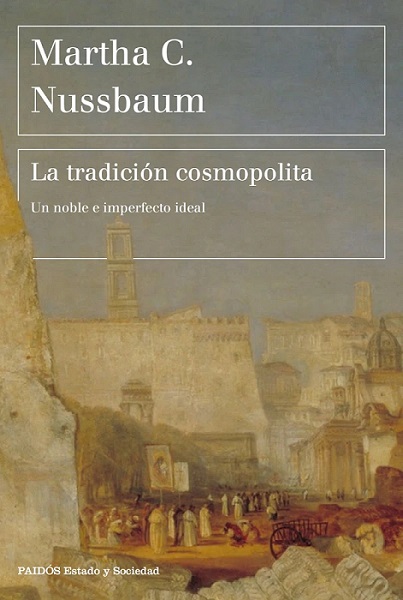
The accusations of conformism usually refer to its weak concern for the socioeconomic conditions that surround us. As Martha Nussbaum has pointed out in The Cosmopolitan Tradition. A Noble but Flawed Ideal, published by Paidos in 2019, the Stoic tradition neglected this important aspect in its writings. Supposing this were so, it is worth asking, on the one hand, whether that tradition had the instruments to show its concern for this aspect and, on the other, whether the neo-Stoics have corrected this lack.
To answer the first question it is necessary to adopt an open perspective. It is true that the ancient Stoic philosophers did not conceive as fundamental principles of their communities circumstances such as the establishment of adequate conditions -social, economic and cultural- for the exercise of individual freedom or of autonomy in decision-making. Nor did they consider relevant concepts that are indeed relevant for our societies, such as those of dignity or emancipation, although paradoxically some of these principles would be impossible without them. They were aware of the existence of inequalities, but they considered them natural. They never thought of curbing them, but rather of ensuring that those inequalities were not so serious as to produce destabilizing social conflicts. The example of slavery is very notorious. If the reproach toward Stoic philosophy is made from these presuppositions, Stoicism becomes a philosophy that is apathetic and cold before the suffering of the less favored. But, in my judgment, this criticism could be made to a greater or lesser degree of all the philosophies of antiquity.
The problem with this objection is that Stoicism is reproached for not being modern. Put another way: it is reproached for not giving an answer to difficulties that only in modernity have we posed in these terms. Now then, I believe that if a need is felt to return to Stoicism, it is because, despite being an ancient philosophy, it is capable of contributing some benefit to current thought. In order to perceive what these benefits might be, I propose as an exercise to pose the problem from the perspective of the ancient Stoics: what would they have said about the modern centrality of concepts such as autonomy of the will, dignity or emancipation? We can conjecture a plausible answer in view of the neo-Stoic treatises. They would probably say that our Western societies are founded on naive principles. How can one defend an autonomous will and at the same time aspire to love and be loved by our friends and relatives? Our bonds of dependence are infinite: we have parents who educate us and we grow up imitating them and imitating our teachers; we work in organizations that sustain themselves only with the joint participation of all their members. They would add that to all these conditioning factors it is necessary to add the biological ones, which make us more or less intelligent, more or less vital, fall ill or die prematurely. On many occasions, we will not be able to avoid the harms that derive from them. They would also tell us that the emancipatory ideal does not take human nature into account, which is not alien to violence and domination. Being aware of all these questions -they would conclude- will avoid the artificial violence generated as a consequence of trying to impose one’s own ideas on a reality that functions in accordance with its specific rules. Rules that we moderns have renounced understanding as what they are: firm and unappealable.
On the other hand, they would also tell us that when they affirm that riches, friends or health are indifferent, they mean that they have no relevance for attaining the supreme good, that is, moral integrity. But in no case are they indifferent for living a life in accordance with nature. Referring to external goods such as wealth, friends or health, Aristo, an ancient Stoic, affirmed that beyond the supreme good there was nothing worthwhile. Chrysippus, one of the fathers of Stoicism, replied to him that external goods were, indeed, indifferent for leading an honest life, but very relevant as indicators of the path toward virtue. That is to say, it is easier and more agreeable to be virtuous with friends than without them; with comforts than without them; with health than without it.
This was the position of the ancient Stoics and it is also that of the neo-Stoics, at least the more theoretical ones. And I believe that, in many of them, not only is there no conformism, but in their writings there beats a critique of present-day living conditions and, from the philosophical point of view, of some of the values proper to modernity represented by current ethical proposals. If I am not mistaken, the current success of Stoicism would be an indicator that the consensus around these values is not as solid as we believed. Whether this critique takes on a conservative character or not depends on the disposition of the neo-Stoic in question: one may understand the duties derived from one’s social position as an imperialist warlike ardor, or understand them as a contribution to the community in order to attain a balance among its different strata or social classes. Consider, for example, the duty to pay taxes or the duty to contribute to the sustenance of one’s country’s Social Security system.
Let the reader decide the space he wishes to grant to the principles of Stoic philosophy in his life, if indeed he wishes to do so. For my part, I content myself with having brought some clarity to this complex phenomenon.