George Berkeley. Matter Is an Illusion
The philosophy of George Berkeley can be summed up in a few words: matter does not exist. A radical and provocative claim that he tried to argue in his most important book: “Three Dialogues between Hylas and Philonous”, written when he was 28. Hylas is a Cartesian thinker who defends the existence of matter, while Philonous is Berkeley himself, who inspired the well-known principle: esse est percipi. This could be translated as: the world only exists if it is perceived.
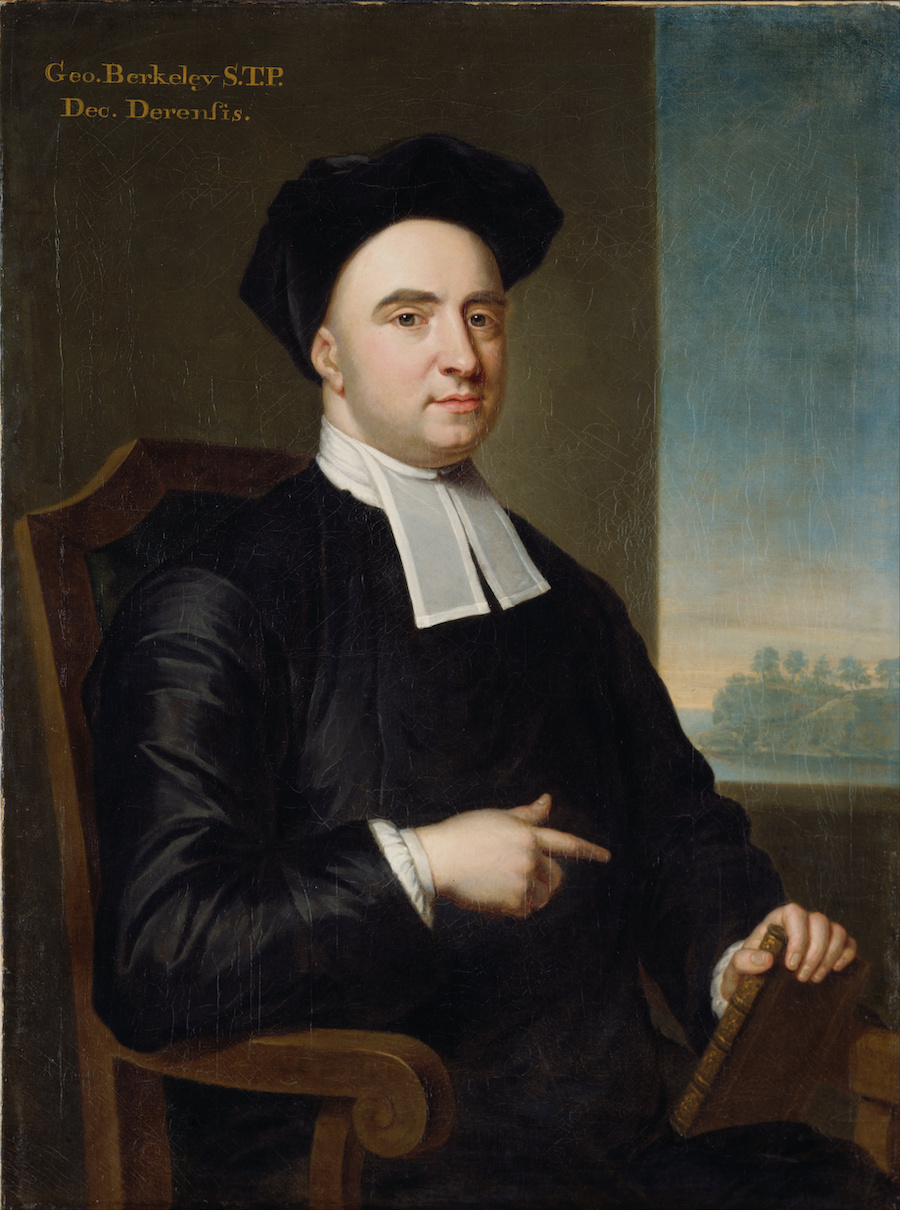
John Smibert – Bishop George Berkeley
The Anglican bishop George Berkeley, who emigrated to America, held that things lack substance and only exist if they are perceived
The philosophy of George Berkeley can be summed up in a few words: matter does not exist. A radical and provocative claim that he tried to argue in his most important book: “Three Dialogues between Hylas and Philonous”, written when he was 28. Hylas is a Cartesian thinker who defends the existence of matter, while Philonous is Berkeley himself, who inspired the well-known principle: esse est percipi. This could be translated as: the world only exists if it is perceived.
Berkeley was an Anglican bishop born in 1685 in Ireland. He studied at Trinity College Dublin and earned a doctorate in theology and Hebrew. Following his missionary vocation, he set sail in 1725 to cross the Atlantic. He wanted to found some schools in Bermuda, but he stayed in Rhode Island, where he bought a plantation. He did not hesitate to use slaves as the labor force of his estate. Seven years later, he returned to England and was named bishop of Cloyne.
Berkeley’s work, which carried empiricism to limits that today may seem absurd, has been highly influential in the history of philosophy. So much so that Bertrand Russell took the trouble to refute his thesis that things have no substance but merely physical properties.
No doubt Berkeley had read Locke, a contemporary of his, who held that ideas were generated from the observation of a material reality, perceived by the senses. This was denied by the Irish philosopher, who pointed out that abstract concepts are a fiction of the human mind.
According to his theses, we can only know the sensible qualities of things, the accidents and not the substance, to put it in Aristotelian terms. Philonous, his alter ego, sets out a series of examples to demonstrate that nothing has a material essence. He resorts to the sensations of cold and heat to convince us that those ideas only exist in our brain. He will argue that, if a man has one warm hand and one cold hand, on plunging them into lukewarm water, the warm one will feel cold and the cold one will feel warm. Therefore, heat and cold do not exist as objective ideas but are only the product of our perception.
The same happens with distance: when we are close to an object we see it as something large; when we move away, it turns into something tiny. Therefore, space and size are also something subjective.
In an attempt to contradict Newton’s physics, Berkeley will maintain that its laws are a mental construction, although he admits that they may be useful for predicting phenomena. But it is one thing for events to conform to a pattern and another for that pattern to be real and universal. Bodies are simply bundles of perceptions: magnitude, color, smell, touch, but they lack materiality.
Berkeley admits, however, the existence of science. But it will only be possible on the basis of pure perceptions, without the intervention of the understanding. Everything that is mediated by deductive logic deforms the sensations that are the basis of the scientific method, which is pure observation.
To ridicule Berkeley’s claims, Samuel Johnson kicked a rock and said: “I refute it thus”. A way of arguing that the rock not only exists in the mind, but can fracture a foot. In my view, Johnson’s example is not convincing, because that does not destroy the assertion that sensations are only subjective perceptions.
The question is why there exist objects that we all perceive in a similar way and with similar qualities if they lack substance. Berkeley was very aware of this difficulty, which he resolved with the affirmation that God has created the world and has willed that all men perceive the same sensations.
Another question of difficult answer lies in the fact that the existence of a tree cannot depend on individuals perceiving it. It is impossible to believe that this tree will not exist if it is not seen by anyone. Berkeley will also answer this objection: the tree exists because God is indeed seeing it.
If the world operates with an apparent logic, there is a certain order, and it is observable that there exists a principle of causality by which fire produces smoke, all of this is due to the will of the Supreme Being, who is the only substantial entity that explains everything that is and everything that happens.
Many philosophers have placed Berkeley as the founder of a subjective idealism, which is doubtful, since his conception is rather an extreme theism by which God intervenes in everything that happens in the world. Probably, this Irish bishop was, more than a radical thinker, a mystic.
Three Dialogues between Hylas and Philonous by George Berkeley
– George Berkeley. Matter Is an Illusion – – Alejandra de Argos –