Epicurus: Life, Thought and Works
Born on Samos in 341 BC, Epicurus founded in Athens a philosophical school grounded in friendship, sensory knowledge and the pursuit of a life free of fears. His thought, often misread as mere hedonism, in fact proposes an ethics of serenity: to live without pain or disturbance as the path to happiness.
Epicurus’s life began in 341 BC on the island of Samos. Although not by birth, the future philosopher was Athenian by lineage, for his parents, Neocles and Chaerestrate, came from there. Yet the first time he set foot in the great city of Philosophy he had just turned eighteen, and he had no chance to learn much of its life and customs, because he soon left for Colophon. After a prolonged period in the Ionian city, he returned to Athens, this time to stay. The year was 306 BC and our philosopher was already sliding down the inexorable slope of age, close to completing the fourth decade of his life. He was, then, no youngster. Resolved to settle there for good and not being convinced of the profit afforded by the philosophical schools existing at that moment, such as the Academy, the Lyceum or Cynicism, he was moved to found a school of his own. With this aim he acquired a small house surrounded by a little garden, or orchard (kepos, in Greek), and settled there with his three brothers, Neocles, Chaeredemus and Aristobulus. This presumably idyllic place served for years as the meeting center of a small philosophical community. In it there was no teacher offering lessons to his pupils while they took notes. It was rather a space in which the master cultivated friendship with people of similar character and identical interests.
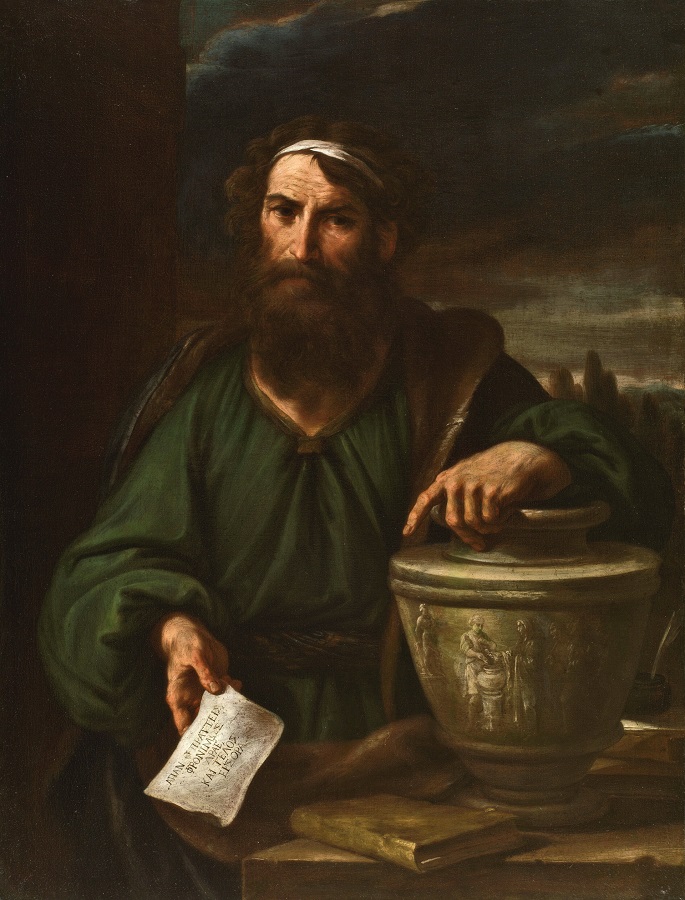
Portrait of the Greek philosopher Epicurus by the Italian artist Agostino Scilla in the 17th century.
Far from the Garden, Epicurus would never acquire much popularity. It has often been said that Christianity sought to destroy, almost to the point of succeeding, the doctrine and the honorability of this Greek thinker. There is truth in this, although the assertion is not entirely exact. The fact is that criticism of Epicurus grew fierce even before his death and continued unabated throughout Antiquity. The skeptic Timon of Phlius described him as “the last and the most shameless; the most ill-bred of living beings.” Many ancient philosophers regarded him as an ignoramus, a fool or simply a plagiarist of the works of Democritus and Aristippus. Our philosopher gave cause for these criticisms, although they contain a strong dose of injustice, as we shall see further on. In turn, the man from Samos spared no insults to his colleagues either: of Aristotle he used to say that he was a vulgar drug peddler, and his teacher Nausiphanes he branded as stupid for devoting himself to the study of rhetoric (Sextus Empiricus, Adv. Math. I, 1-4).
Like Plato, Epicurus despised rhetoric, but unlike him he considered that dialectic too consisted of little theoretical games leading only to the formulation of incredible constructions, such as the Ideas. It has sometimes been said that Epicurus was a kind of preacher, but this judgment does not seem very apt. Quite the contrary: his philosophy does not aim to win adherents in order to obtain some greater end, such as the good government of the city (Plato) or scientific knowledge (Aristotle). It consists of a friendly conversation that carries us gently toward happiness. In the Garden the dialogue between master and disciple was not engaged with the aim of having the latter become aware of an inner truth that must be unveiled through a maieutic dialogue, but with that of obtaining spiritual pleasure through an honest and measured conversation about the important aspects of life.
In the more than thirty years that Epicurus ran his school, he wrote an immense body of work which, regrettably, has been almost entirely lost. It is desolating to find that we preserve no more than small fragments of the thirty-seven books that made up his principal creation, the treatise On Nature. He wrote many more, likewise lost. Beneath the solidified lava of Vesuvius, archaeologists have managed to rescue some fragments of his works buried after the eruption of AD 79. Thanks to the tenacious labor of papyrologists, perhaps in the future we may enjoy some further text attributed to one who was undoubtedly among the most important philosophers of Antiquity. For now we must content ourselves with three of his letters transcribed by Diogenes Laertius in Book X of his Lives and Opinions of Eminent Philosophers: the Letter to Herodotus, in which his physics is set out in very condensed form; the Letter to Pythocles, where he enumerates hypotheses that try to explain celestial phenomena; and the Letter to Menoeceus, where Epicurean ethics is presented to us. In addition, Diogenes transcribed a set of forty sentences, known as the Principal Doctrines, of fundamentally ethical content. At the end of the nineteenth century, a very young German philologist, Karl Wotke, discovered in the Vatican Library a set of eighty-one aphorisms, also of ethical content, which reflect Epicurean doctrines. All of this forms a relatively small corpus which, joined to the indirect tradition, that is, to authors who refer to the doctrines of Epicurus, such as Cicero, Plutarch or Sextus Empiricus, nevertheless proves sufficient to know the basic features of the philosophy professed in the Garden.
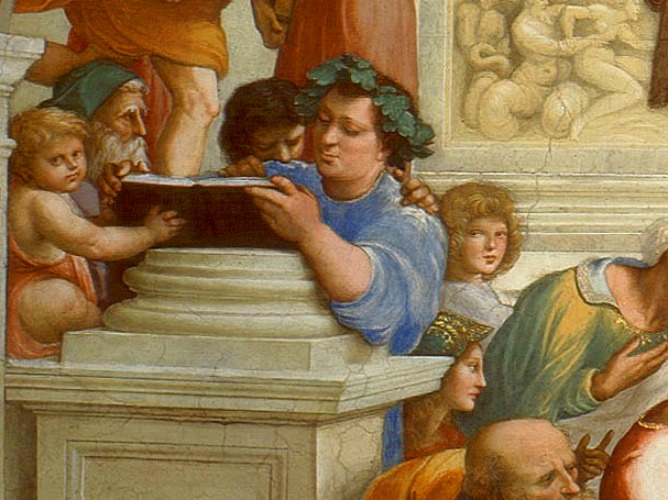
Epicurus. Detail in “The School of Athens” (1512), by Raphael.
What do we find in these texts? Above all, the doctrine of a philosopher who fights without quarter the erroneous beliefs that, generation after generation, persist in society concerning the gods, the destiny of souls and other aspects of life. As the French philosopher Gilles Deleuze has very aptly noted, for Epicurus “the disquiet of the soul is made up of the fear of dying when we are not yet dead, but also of the fear of not yet being dead once we are. The whole problem is that of the origin of this disquiet, or of the two illusions.” The worries caused by these beliefs lead the human being to unhappiness, for his mind tends to rise beyond experience and to pose problems it cannot solve. For this reason, Epicureanism rejects what has come to be known in the history of philosophy as Platonic-Aristotelian intellectualism, that is, the attempt to elaborate definitions in order to confine reality by means of concepts that try to explain it.
Epicurus disagrees radically with this stance: to gain access to the world around us, our senses suffice, and they are the origin of all human knowledge. Through what we perceive, the soul fashions preconceptions, which are anticipations, correct opinions originating in the memory of that which has been shown to us many times from the outside. Our mental images are not innate, but the fruit of previous sensory experiences. Therefore, it is not possible to have the image of a horse without having previously seen one. To understand this assertion well, it is necessary first to explain what, for Epicurus, are the basic components of the reality that surrounds us.
The whole is composed of certain elementary particles, the atoms, which are lodged in an immense empty space. In fact, atoms and void are infinite. So that the things we perceive through the senses would be made up of different combinations of these two elements. Epicurus explains this very graphically in the Letter to Herodotus:
“The whole consists of atoms and void. For the existence of bodies is attested by sensation in every case, and in accordance with sensation the understanding must conjecture about the imperceptible, as I have said before. If what we call void, space and impalpable nature did not exist, bodies would have nowhere to be nor anywhere to move when they appear in motion. Beyond this nothing can be conceived, neither by means of perception nor by analogy with what is perceived, in the sense that it possesses a complete nature, and that is not predicated of these as properties or accidents of things. Therefore, of bodies some are compounds and others are those [elements] of which the compounds are formed. These are indivisible and immutable, on pain of everything being destroyed into non-being, and they remain firm in the disaggregations of the compounds, being themselves compact by nature, so that they have no manner or place in which to dissolve. Hence it is inevitable that the indivisible principles [the atoms] be the original elements of bodies. Moreover, the whole is infinite. For everything limited has a limit. And this limit is perceived alongside something else. So that (since beyond the whole nothing is perceived), having no limit, it has no end, and having no end, it must be infinite and not limited. And it is infinite, indeed, by the multitude of bodies and by the magnitude of space. For if space were infinite and bodies limited, the bodies would remain nowhere, but would be carried off scattered by the infinite void, finding nothing to support them and to send them back through the impacts of collision. And if the void were limited, the infinite bodies would have nowhere to be” (Letter to Herodotus, 39 – 42. Trans. Carlos Garcia Gual).
Epicurus took the fundamental features of his ontology from the atomism of Democritus, which he poured almost entirely into his philosophy. Thus, the whole is composed of infinite elements, simple and minute, that move through an equally infinite empty space in which they eventually collide by chance with one another, forming the things that surround us. These come into being and decay, but the quantity of atoms and void is always the same. So that if we were to adopt the position of a god and observe the whole sub specie aeternitatis, that is, from the point of view of eternity, we would discover an infinite succession of worlds derived from the incalculable combinations of atoms and void that have occurred and will occur in it. A very attractive idea that has had some followers in the history of philosophy.
Having laid these foundations, Epicurus formulates the two axioms of his philosophy: the first affirms that “the whole has always been, is and will always be such as it is now,” which is to be understood as the recognition that the plurality of possible worlds is always formed of the same elements: atoms and void, which never cease to engender singular combinations. The second derives from the first and concludes: “beyond the whole there is nothing,” which is another way of formulating the Parmenidean principle according to which “what is, is and cannot not be,” the only possible path in the search for truth.
Now indeed we are in a position to understand what Epicurus means when he asserts that our mental images (eidola) can only exist if we have had previous sensory experiences of things. All knowledge is possible because from the surface of objects subtle atoms emanate that travel through the air and penetrate us through the open windows of our senses. Once inside, the images formed by the atoms lodge in the soul, which constructs the preconceptions referred to earlier. These images are always true, for they come from outside and are the reflection of things. Consequently, the senses never lie, although the judgments and opinions we form on the basis of what is perceived may indeed be mistaken. For this reason, Epicurus warns against haste in shaping our judgments: as long as we do not have a good sensory perception (because we are far from the object, for example) we must remain “in expectation” and avoid risky conclusions.
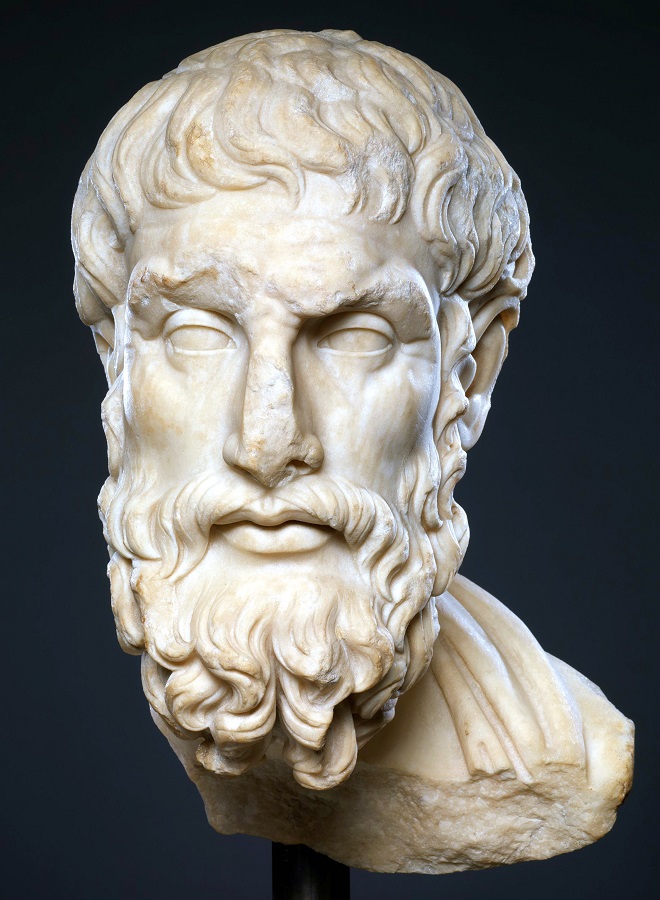
Bust of Epicurus from the Metropolitan Museum of Art.
Sensations and preconceptions are criteria of truth, but not the only ones nor the most important. The position of greatest dignity is occupied by the affections, which constitute the ultimate and definitive criterion of a true and happy life. The affections are two: pleasure and pain. The first is connatural, while the second is alien to individuals. For this reason they reveal themselves as the most authentic criterion for our choices and rejections.
Sensations and affections would be impossible if in living beings there were not an enabling body, which Epicurus calls the soul. Epicurean philosophy is openly materialist: the soul is a body formed of atoms of great subtlety which in turn forms part of an equally material organic complex (what we would call the body). Epicurus grants the human soul no privileged status with respect to that of other living beings. Consequently, like all of them, the human being faces death as the “departure” of that body, constituted of subtle atoms, from its specific organic complex. Here we find once again the idea mentioned earlier: atoms that scatter and form new bodies in a constant journey toward an inexhaustible plurality of future worlds.
In all this framework dominated by infinitesimal particles, where do the gods stand? Epicurus displaced the figure of the divinity to a world of pleasure and happiness, so far from human beings that it precludes any contact with them. Its existence cannot be denied, for our soul harbors an image of it, admittedly diffuse as a result of the distance that lies between it and us. The most relevant effect of this separation is divine indifference toward human affairs, which inoculates us against any belief in rewards and punishments for the actions that take place on earth.
Chance guides our decisions, and we must assume their consequences without expecting interventions from magical or supernatural entities. Our existence too is a matter of chance and, just as we were born thanks to the fortuitous collision of some atoms with others, one day these will scatter and we will die. There is no need to fear this supervening dismantling of our atomic complexes, for death is only this. Therefore, when we exist it has not yet arrived, and when it finally arrives, we will have ceased to exist. Epicurus thus erects an image of undoubted beauty which, nevertheless, offers a poor consolation and an exhausted hope. This is because our philosopher shifts the disquiet over death in favor of his interest in life: the fundamental problem of every individual is that of living well. To do so, it is indispensable, first of all, to eliminate all our fears; only afterward is it possible to attain a particular kind of pleasure, the most perfect affection it is given us to feel: a life devoid of pain.
Many critics of Epicureanism have tried to distort this doctrine by labeling Epicurus a vulgar hedonist, concerned solely with his personal well-being. Like all distortions, this one too possesses traces of plausibility, although scant and biased. It cannot be denied that when Epicurus speaks of pleasure he is thinking of the concrete individual who values his own satisfaction above all else, as when he asserts that true friendship is the kind that produces pleasure; or when he proclaims that one must live hidden and avoid meddling in collective affairs, because these constitute the surest source of pain. Epicureanism presents a profoundly individualist ethics, but its hedonism does not guide us toward dissipation or toward solipsism.
Epicurus distanced himself from these ideas, represented in Antiquity by the Cyrenaic school. One of its champions, a certain disciple of Socrates named Aristippus, had defined pleasure as an agreeable movement (kinetic pleasure) and pain as a violent movement that overwhelms us. For him there was no intermediate state of rest except in sleep, but little pleasure, he said, can be afforded us by a circumstance in which we are deprived almost entirely of sensitivity. So that, for Aristippus and the other Cyrenaics, pleasure was condensed into a pleasurable sexual encounter, a good meal or an agreeable stroll after a hectic day’s work.
Epicurus, by contrast, thought that kinetic pleasures, agreeable though they be, prove insufficient, for they are subject to the passing of time, which ends up devouring them. Against these, he advocated a kind of pleasure that required no movement and which, consequently, did not have to be renewed; a pleasure that consisted simply in remaining free of disturbances, untouched by all pain. It is katastematic pleasure, which, once attained, remains forever. Moreover, it is not a pleasure subject to each person’s preferences, but something natural in the living being, who indubitably flees from pain.
Katastematic pleasure is cultivated by satisfying the natural and necessary desires of the human being, such as eating when one is hungry, drinking when one is thirsty or sleeping when one is tired. It is a pleasure within the reach of all those who act with prudence at every moment of life. In short: it is a pleasure that cannot be devoured by time, because once attained it neither increases nor diminishes, and since nothing more perfect exists, it brings it about that the fear of death vanishes, for nothing better can any longer be expected from life.
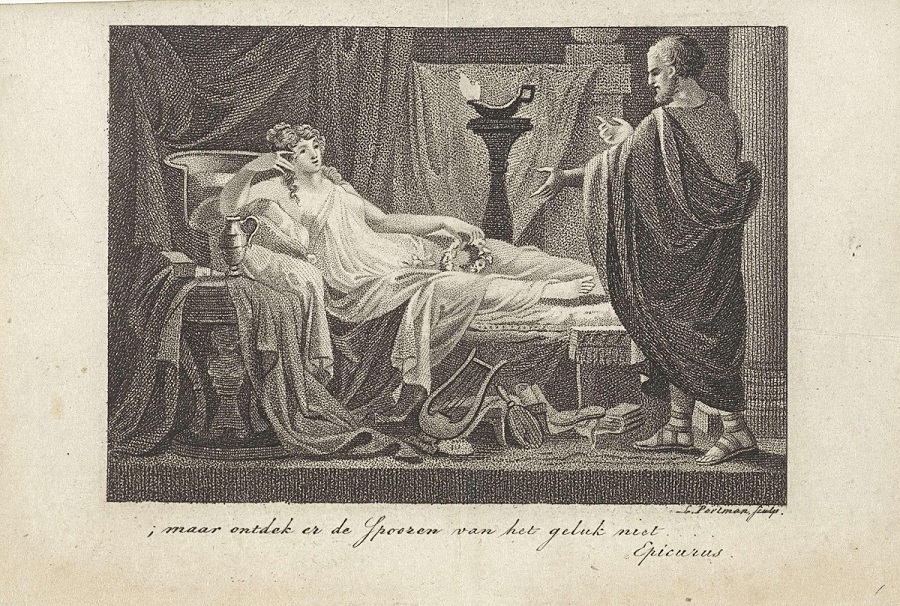
Epicurus and the philosopher Leontion by Ludwig Gottlieb Portman (1803)
The sage is such for having attained katastematic pleasure. The physical pains proper to life cannot disturb him, because he knows that, if they are intense, they will be brief and, if they are prolonged, bearable. We preserve a fragment of the letter that Epicurus sent to his friend Idomeneus, one of the regulars at the gatherings of the Garden, hours before dying. In it he says: “on this happy and at the same time final day of my life […] I am still accompanied by the pains of the bladder and the belly, which do not lessen the extreme severity of their assaults. But against all of them is deployed the joy of the soul, founded on the memory of the conversations we have had” (Diogenes Laertius, Lives… X, 22). For these moving words and for the fascinating power of his teachings, the Roman poet Lucretius dedicated to him the following verses:
When human life lay foully prostrate upon the earth before the eyes of all, crushed beneath the weight of religion, whose head loomed in the celestial regions, threatening with a horrible grimace to fall upon mortals, a Greek was the first who dared to lift his perishable eyes toward it and to rebel against it. He was not held back by the fables of the gods, nor by the thunderbolts, nor by the sky with its menacing roar, but rather these all the more excited the ardor of his spirit and his desire to be the first to force the tight bolts that guard the gates of Nature. His vigorous spirit triumphed and advanced far, beyond the flaming ramparts of the world, and traversed the infinite Whole with his mind and his spirit. From there he brings back to us, the spoils of his victory, the knowledge of what can come into being and of what cannot, the laws, in short, that delimit for each thing its power, and its deep-set boundary stones. So that religion, subdued in its turn, lies at our feet; and the victory exalts us to the heavens (Lucretius, On the Nature of Things, I, 63-79. Trans. by E. Valenti Fiol).
Bibliography:
Deleuze, Gilles, Lógica del sentido. Paidós, 2005.
Diógenes Laercio, Vidas y opiniones de los filósofos ilustres, Alianza Editorial, 2007. Traducción, introducción y notas de Carlos García Gual.
Epicuro, Obras completas, Cátedra, 1995. Traducción y edición de José Vara.
García Gual, Carlos, Epicuro, Alianza Editorial, 1981.
Lledó, Emilio, El epicureísmo, Taurus, 1984.
Mas, Salvador, Epicuro, epicúreos y el epicureísmo en Roma, Ediciones UNED, 2018.
– Epicurus: Life, Thought and Works – – Alejandra de Argos –