Jean-Jacques Rousseau: Biography, Thought and Works
Jean-Jacques Rousseau always liked to swim against the current, like an enfant terrible who let himself be swept along by no fashion or opinion, perhaps because he understood philosophy as an existential rather than a professional commitment. He grew up in the company of many readings in which “that free and republican spirit took shape, that indomitable and proud character, incapable of bearing the yoke and servitude” (Rousseau, 1997, 34).
Life and work
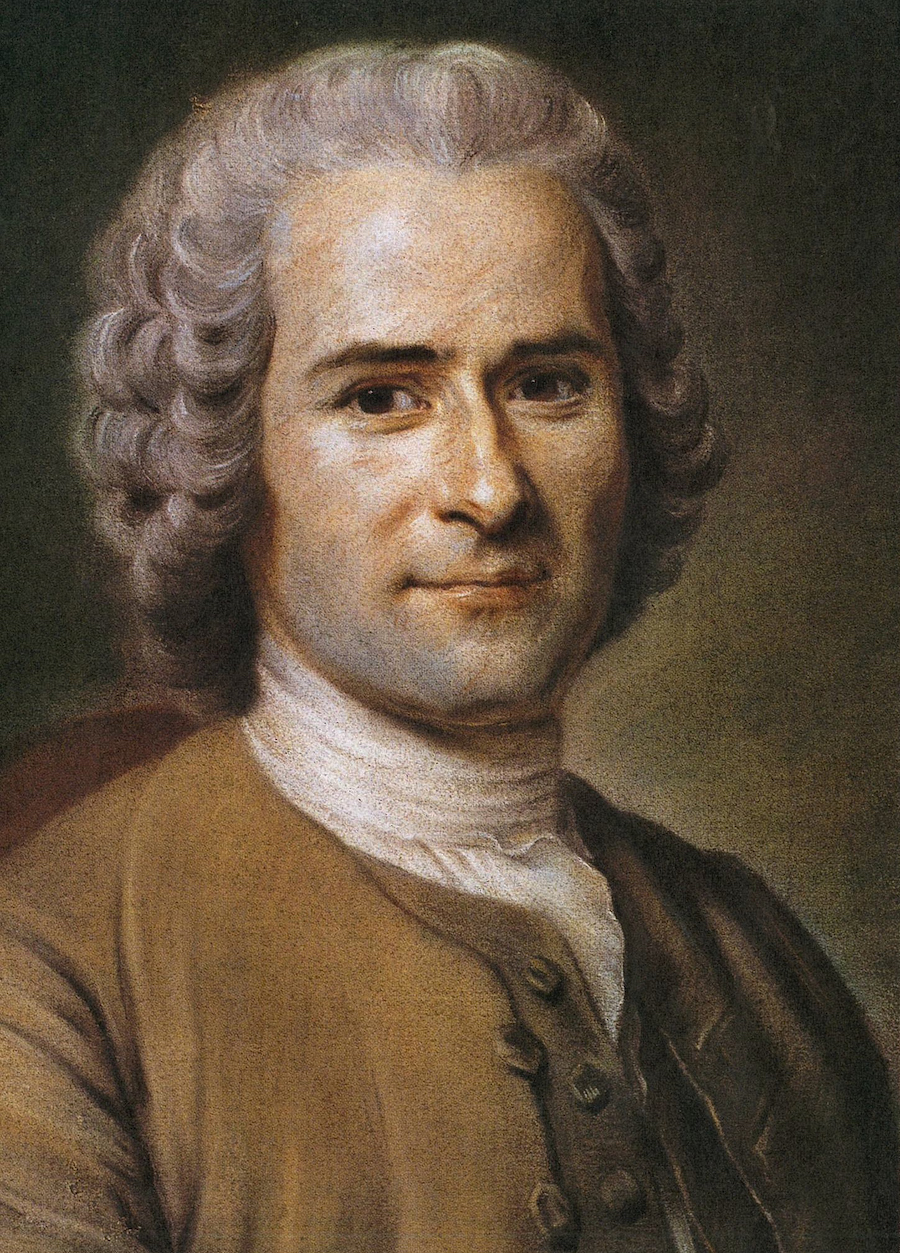
Jean-Jacques Rousseau was born in Geneva in 1712, into a humble family of artisans. Despite losing his mother at birth, his childhood was happy, with a self-taught, largely informal education, in the company of many readings in which “that free and republican spirit took shape, that indomitable and proud character, incapable of bearing the yoke and servitude” (Rousseau, 1997, 34). His adolescence and youth, however, cast him far from home, plying every sort of trade: from engraver’s apprentice to copyist of musical scores, by way of lackey, secretary or tutor in aristocratic families; thus, until his arrival in cosmopolitan Paris, around 1742, his life was marked by the sign of anonymity and geographical mobility, by wandering and precariousness.
Settled in the capital, Rousseau began to frequent the enlightened circles, contributing as an article-writer to the brand-new Encyclopedie, while trying without success to consolidate his career as a musician and composer. In 1750, however, he leapt to fame overnight, when the Academy of Dijon awarded first prize to his Discourse on the Sciences and Arts, a work that stirred up a genuine commotion. That first Discours was followed in 1755 by the Discourse on the Origin and Foundations of Inequality among Men, which confirmed his standing as an essayist and brilliant polemicist, although his many-sided output proved versatile across different genres: from operas to theatrical pieces, from texts on musical notation to poetry or treatises on political economy, not to mention his successful debut in the art of the novel with Julie, or the New Heloise, of 1761, and of course his epistolary legacy, both public and private, one of the most prodigious in the history of thought.
The year 1762 marked a decisive turning point in Rousseau’s life and work. The simultaneous appearance of The Social Contract and Emile, or On Education ended in his public condemnation by the civil and ecclesiastical authorities in Paris and Geneva. That context of hostility marked the beginning of a tumultuous period defined by proscriptions and aimless travels through various European cities. Feeling persecuted and abandoned by his contemporaries, his final years found a refuge in botanical investigations and, of course, in his autobiographical writings, a literary genre of which he may be considered the modern father: from his celebrated Confessions to the Reveries of the Solitary Walker, both published posthumously; let them be read as writings of (self-)justification and exculpation, of a strong longing for insularity, in which he stylized his life on the margins of a solitude as cherished as it was sought in nature. He died, back again in Paris, in 1778.
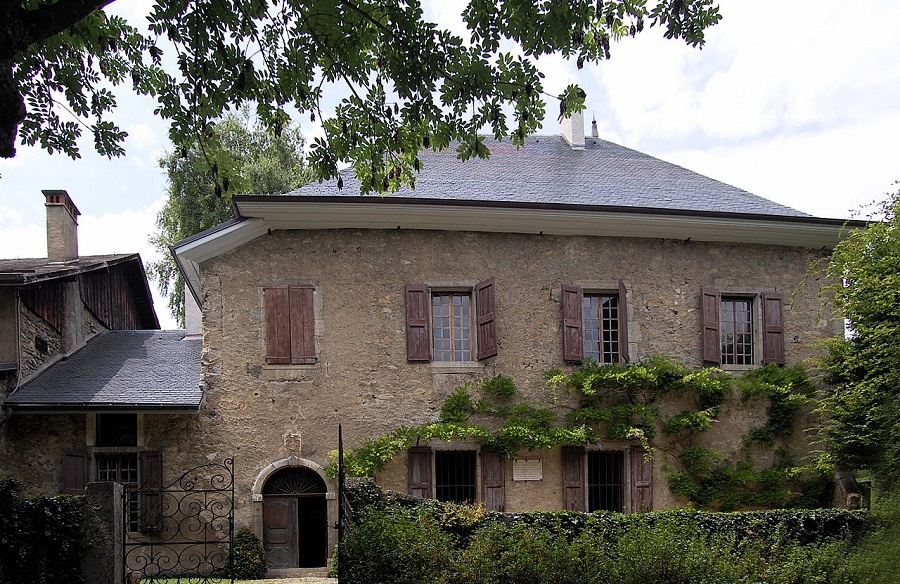
Les Charmettes, Chambery. Residence of Jean-Jacques Rousseau from 1735 to 1736. Today turned into a museum dedicated to Rousseau.
An enlightened critic of the Enlightenment
Rousseau is of course an enlightened thinker, a child of the Age of Lights, but certainly an unruly child. He always liked to swim against the current, like an enfant terrible who let himself be swept along by no fashion or opinion, perhaps also because he understood philosophy as an existential rather than a professional commitment. In the age of the learned academies, his attitude was rather anti-academic and rebellious, and his powerful capacity to irritate the philosophes, whose initial friendship always ended in resounding ruptures (Voltaire, Diderot, D’Holbach, etc.), was due in part to the fact that he saw them as forming part of the very world they criticized. There is no doubt that his irruption was a novelty for a bourgeois public sphere then taking shape, exercised as it was from a double role of observer and implacable accuser of society: someone who looks at the civilization in which he lives and, beneath its pomp and pageantry, discovers a rot that he begins to denounce without scruple in a bewitching style of writing. As a “man of letters who spoke against letters” (Starobinski, 1983, 261), his very first accusation in the Discours of 1750 was aimed at those who, armed with optimism, trusted in the unstoppable power of culture and the social function of scientific knowledge. So behind his eloquent rhetoric, the prizewinner’s thesis was clear: against the enlightened conviction that the happiness of the human species would arrive with the progress of the sciences and the arts, neither of the two had contributed to promoting freedom or improving collective morality, but rather they veiled social oppression and the corruption of morals; both, in fact, ought to begin to be judged not so much by the pleasures they afford as by the miseries they conceal:
The sciences, letters and arts […] spread garlands of flowers over the iron chains with which those men are laden, stifle in them the feeling of that original freedom for which they seemed to have been born, make them love their slavery and form what is called civilized peoples (Rousseau, 52005, 7).
With his defiant style, Rousseau attacked a blind spot that even today retains an undeniable relevance: beneath the appearance of brilliance and wit, the cultural apparatus of the Lumieres resembled an immense soap bubble that concealed hypocrisy, selfishness and vanity, like a false stage set adorned with empty discourses and formalisms without substance, where the distance between the words and the actions of its protagonists did not coincide at all; in the Parisian salons, to look no further, one could say anything, but no one believed a word of what was said, and in place of the search for truth or knowledge there had imposed themselves such values as prestige, luxury or the opinion of others. In short: besides tending toward a homogenizing model of culture -one need only think of his critique of the theater (Rousseau, 1994a)-, modern civilization consecrated the divergence between being and seeming, an antithesis common in the age of Tartuffe that Rousseau would carry to a decisive dramatic extreme. “No one any longer dares to appear as he is, and in this perpetual compulsion, the men who form this herd called society, placed in the same circumstances, would always do the same things” (ibid., 9).
A first facet would thus be introduced: as a harsh critic of culture and of civilization, Rousseau risked a diagnosis of the ills of a society he judged to be inauthentic, denouncing the omnipresence of self-love (amour propre), “a relative, fictitious feeling, born within society, which leads each individual to set more store by himself than by anyone else, which inspires in men all the evils they inflict on one another” (ibid., 235). At the same time, however, he also wished to seek an explanation of how and why those vices, lies and miseries had come to take shape within the human condition itself, a novel approach in which the Genevan was able to problematize the complex relations between nature and culture: for if civilized man was degenerate, if the veil that covered his society dissembled his genuine natural feelings, who would the true man be, if indeed he ever was, and how to inquire into the sources of that inequality which kept perpetuating itself?
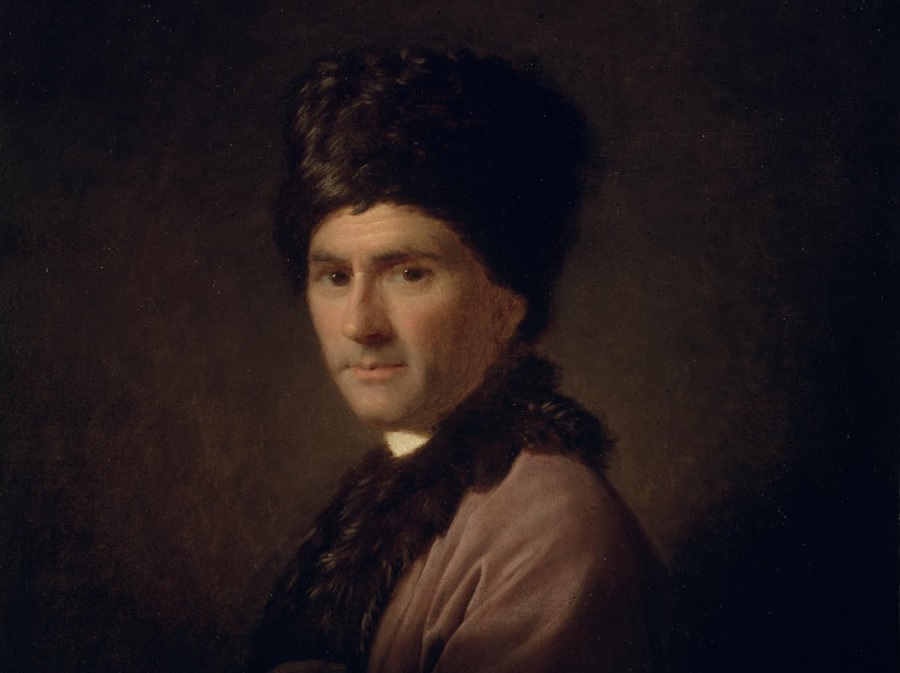
Rousseau in Armenian dress. Oil painting by Allan Ramsay
The question of man: on the state of nature and inequality
In the second Discourse, we read the following declaration of principles: “It is of man that I am going to speak” (ibid., 117), among other things because “the most useful and the least advanced of all human knowledge seems to me to be that of man” (ibid., 109). Yet, regarding how to study man, Rousseau was the first philosopher who, acting also as the first ethnologist (Levi-Strauss), placed the emphasis on the way we look at ourselves while we study him (Rousseau, 2006, 25). At least two facets of this praxis seem to me worth noting.
On the one hand, we know that he practiced upon himself the demand to look at ourselves in another way, gazing into the distance but inward, as a tenacious observer who made of himself his best (and most contradictory) instrument of observation: the whole art of introspection exercised in his Confessions, the whole obsessive recourse to inwardness and surrender to feeling, reveal that, for Rousseau, writing about himself was an individual and non-transferable act bound up with moral conscience, in the sense that to study oneself, “from within and beneath the skin” (Rousseau, 1997, 27), meant to seek the sincerity of the heart and to detect its slightest alterations. It hardly surprises us that he was the forerunner of Sturm und Drang or of romanticism: if feeling was the first modality of human existence, long before reason, the understanding or ideas, we had to observe our existence as a constant chain of secret affections that constitute us, intimating to us the dreadful vertigo of difference from others and from oneself, its incommunicability and opacity ever lying in wait; without that (public) commitment to (private) observation, his life could not have been consecrated to his repeated search for truth. In this sense, in the history of ideas there are few thinkers whose life and work are so intertwined. Rousseau liked to mask himself in his autobiographies and literary characters, transcripts of his vital crossroads; and there is no doubt that he did so to justify and defend himself, in apologetic narratives that move between self-pity and self-lament, imposture and persecution mania. But at the same time they articulated a hiding in order to show oneself better: to take a stand against the noise and superficiality of the outer world by means of a writing that, from the margins of a cherished solitude, sought an ideal of transparency set against lying and selfishness.
On the other hand, it is under the demand to look at ourselves in another way that his well-known ideas on the state of nature and the noble savage can be introduced, both of them tools that would serve to examine the foundations of society and to judge its present. Their centrality is indisputable, although one misunderstanding ought to be cleared up: the etat de nature is a “state that no longer exists, that perhaps has never existed, that probably will never exist” (Rousseau, 52005, 111). As an experimental reconstruction of the origins of humanity, it eludes empirical investigation: it refers neither to a particular historical period (ibid., 120), nor to a lost paradise that sings the praises of primitivism. But while impracticable as a scientific experience, it does open us to the philosophical experience of thinking: as a hypothesis for conjecturing the progressive civilization of humanity, it offers a point of reference so that, as Kant -his best reader- saw, man might “look at it from the position in which he now finds himself” (2014, 241), determining the corrupted aspects that would have been introduced into our human nature, in an arc running from its prepolitical origins to the appearance of private property and inequality, by way of the institutions of language or the family, among many other devices. Of course there could be no returning to that primordial state, nor any preaching of a flight from civilization to go about “on all fours” (Voltaire); the Genevan knows that society is an irreversible fact, the result of the perfectibility of the human being and his species (Rousseau, 52005, 132), and as a social being endowed with reason he would be capable of (re)discovering a moral feeling even in the worst of corruptions. Man is not to be given up for lost, for only in society could we become moral beings: historical pessimism, yes, with shreds of fatalism, but always offset by an anthropological optimism.
In the light of this caveat, who would that homme sauvage be who had lived isolated and in harmony with nature? Free and equal, solitary and idle, the savage men would have lived within themselves (ibid., 203), in direct contact with things, with no need to transform the world in order to satisfy their needs: their communication would be silent, their language and their signs natural, like the voice and the gesture, the living expression and presence of a primal feeling. The decisive inflection in Rousseau’s description, however, is another, and it bears a moral dimension: and it is that this savage man would be good by nature -unlike Hobbes, for whom man would be evil by nature-, but would have been corrupted by society. In this way, the age-old myth of the savage -which is a myth about the image and incarnation of the Other, whose iconographic representation and literary expressions run through the whole of our Western civilization- is morally reconstructed in a modern key: Rousseau’s noble savage serves to reflect an otherness, which is always ourselves, and to recount the myth of an other that we always were. Hence he articulates a conjectural narrative about the fall, which would also blend the imaginary of the myth of the Golden Age with the Christian attribution of responsibility for evil to humanity, a secularized version of original sin that would have been born, however, of the consequences of the organization of human society. Such are some of the avatars of “natural goodness,” which emerges as a guiding thread that, as he expressed it in the famous letter to Beaumont of November 1762, would give unity to the whole of his thought:
The fundamental principle of all morality, upon which I have reasoned in all my writings […] is that man is naturally good, a lover of justice and order, that there is no original perversity in the human heart and that the first impulses of nature are always upright (Rousseau, 1994b, 61).
In the evolution that leads man from the natural state to that of civilization, several stages would have to be distinguished, and no doubt a common reading interprets it as the degradation of a sort of original innocence lost in favor of his alienation in material things. There will be those who believe they can identify an anticipation of Marx, although this Rousseauian denunciation was articulated, to my mind, out of his formidable taste for paradoxes: and it is that the material progress of civilization, the political institutions and the modern conquest of freedom did not generate moral progress, however much natural law might proclaim the natural equality of all men; what is more, such progress continued to be perfectly compatible with the exploitation of man by man, the dissolution of fraternal communal bonds and the generation of new uncharitable inequalities, or the perpetuation of old ones. Endowed with an enormous sensibility, Rousseau’s denunciation was always uncomfortable because it pointed out inequalities not so much physical or natural as social and economic, which are always inequalities of a moral or political nature, since it depends on a kind of convention that is established, or at least authorized, by the consent of men. This latter consists in the different privileges that some enjoy to the detriment of others, such as being richer, more honored, more powerful than they, or even getting themselves obeyed (ibid., 118).
An egalitarian absolutism, then? No, rather that “no citizen be wealthy enough to buy another, and none poor enough to be forced to sell himself” (Rousseau, 52017, 58). Thus, in this light, his treatment of private property, the source par excellence of inequality, whose originary scene has been quoted a thousand times (Rousseau, 52005, 161 f.), takes on better contours. Beyond the ignorance of those who attribute to him the abolition of private property, his defense of property as a sacred right upon which political society rested sought, rather, to be compatible with the defense of the small property of the peasant or artisan over his means of production; far from demanding a leveling of conditions, he claimed that property remain limited to the real needs of the individual, so that the grounding of the right of property would not issue in a defense of unlimited inegalitarian property, something that was being sharpened in a growing context of proletarianization of the French peasantry in the middle of the century, that is, the expulsion from their lands of part of the small owners or usufructuaries: glimpsing the transformation that was taking place in social relations with the introduction of the capitalist system, the relations of freedom and independence that independent producers maintained among themselves had cracked, giving way to the servitude of new wage relations (ibid., 203).
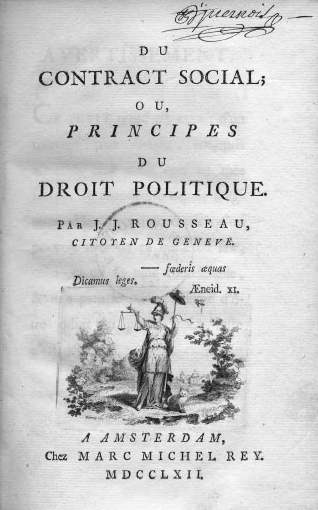
Front cover of The Social Contract 1762 by Jean-Jacques Rousseau
The question of the citizen, or on a new pact of association
Although civilization had caused many of our ills, Rousseau held that we only become men after making ourselves citizens; in fact, however much the modern State may be one more moment within the process of moral decline that would have been unleashed when men began to move away from their natural state, to renounce one’s freedom today “amounts to renouncing one’s quality as a man, the rights of humanity and even its duties” (52017, 10). Consequently, in taking seriously the idea that the man who does not enjoy complete freedom is not a man, Rousseauian philosophy inevitably becomes political: we must seek the general foundations of good government, know what regimes can be built on legitimate bases and, above all, agree among ourselves upon some principle of the civil authority that founds political right, without thereby ceasing to be what we are. This is, of course, the inquiry begun in The Social Contract:
I want to inquire whether, in the civil order, there can be any legitimate and sure rule of administration, taking men as they are and laws as they can be […]. A State thus designed could set a limit to wars and injustices, but it would also prevent the dismemberment of man, the estrangement from his original nature (ibid., 3).
It is well known that Rousseau has gone down in history as one of the thinkers par excellence of modern democratic theory, in particular of the republican theory of democracy, not without interpretive difficulties, controversies and chiaroscuros in his reception. Today, when through carelessness or indolence we take our democracies for granted, we tend not to appreciate just how explosive his defense was of it as the only legitimate form of State, one that could not so much establish a rigorously egalitarian society as reduce inequalities and correct social injustices, revealing himself a faithful heir of the republican political tradition and its model of citizenship, whose priority was to guarantee the civil freedom of men. But the Genevan was under no illusion: “Man was born free, and everywhere he is in chains. […] How did this change come about? I do not know. What can make it legitimate? I believe I can resolve this question” (ibid., 4). Thus, the resolution of that problem consisted in (re)posing the very question of the pact that would make possible the well-being of a society from a just order, legitimated by the people as the repository of sovereignty. Here is the dilemma:
A form of association must be found that defends and protects with all the common force the person and goods of each associate, and by virtue of which each one, uniting with all the others, nevertheless obeys only himself and remains as free as before (ibid., 16).
To refound the theory of the social contract demanded originality, and even while remaining within the sphere of natural law it had to circumvent the most consecrated formulas of modern contractualism: neither a pact of submission, in which freedom was alienated for the sake of security (Hobbes, Grotius), nor a double contract of civil association followed by another of political submission (Pufendorf), for both modalities depended on the guarantee of an external sovereign whose limits could be as abstract as they were ineffective. The pact had therefore to be reconceived as a single contract of association at once civil and political, of a normative and procedural character, through which the civic-political community would be created according to the demands of freedom and equality. That would be the place of the general will (volonte generale): each one (as a singular) would give himself to all the others (as a community) by means of an unreserved alienation of his rights and duties, of his goods and power, and, in turn, as members of the community we would receive all the others (as singulars) on the same conditions, so that reciprocity and equality might be the guarantee of freedom.
Once again, it is worth clearing up some misunderstandings, despite the complexity of the concept. For far from being a sum of particular wills (volonte de tous), the general will would overcome the disputes among individual choices by way of a superior and unappealable authority (ibid., 17). Uniting in this way, Rousseau points out, men would form a public person called the sovereign, and they would be free because they would obey, not a man, but the law they have themselves prescribed and which defines their rights at the same time as their duties (ibid,, 35), that is, they would recognize the authority of reason in order to unite under a common law within a single body politic, since the law they obey would be born of themselves. Sovereignty, therefore, understood as the principle of the legitimacy of power rooted in the people, would be “nothing but the exercise of the general will” (ibid., 27), and from it the sovereign power would emanate, a political power that would be inalienable, indivisible and absolute; hence also that, far from thinking in terms of representative and delegated power (ibid., 108), the people must necessarily legislate for themselves and approve the laws by voting in deliberative public assemblies, of a periodic character and under conditions of real equity and freedom, the government being a mere commissioner, charged with the execution of their mandates, obliged to render accounts and liable to be removed at any moment.
It has been said that the political model proposed in The Social Contract draws on the Conseil General of Geneva or on the old Swiss cantons, where a direct democracy was practiced; an idealized Geneva of his youth, one might add, and clothed in the admired institutions and virtues of the republics of Antiquity. But it would hardly be possible to see in Rousseau’s proposal merely a simple utopia, as is clear from his less well-known Constitutional Project for Corsica (1765) and his Considerations on the Government of Poland (1771), where the principles of the Contract fused with concrete political reflections and programs: from the claim for a democratic government to equality of rights; from respect for traditional customs to the defense of a civic patriotism; from the defense of private property to the (chimerical) economic autarky by way of limiting individual gains or foreign trade; from the democratic defense of religious pluralism, based on the cornerstones of tolerance and freedom of conscience, to the proposal of a civil, secular and utilitarian religion, a profession of faith that would help to cement the internal cohesion of the citizens.
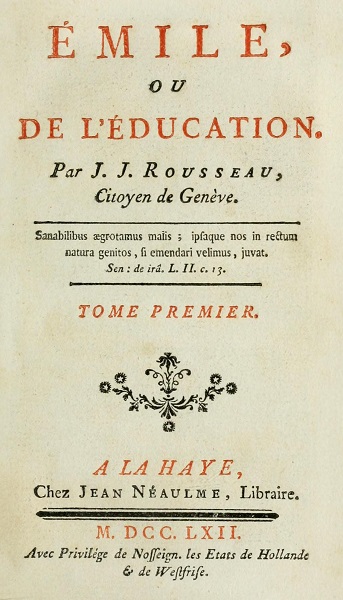
Front cover of the first edition of Emile, or On Education.
Education is also political
Between lost nature, to which we cannot return, and present-day society, the seat of the ills and inequalities of our civilization, there arises the necessary social experience of education, a pillar of Rousseauian thought set out in Emile and Julie, or the New Heloise, an elegiac novel that imagines the idyllic education of a small society of beautiful souls, a diaphanous universe whose characters manage to communicate without (apparent) obstacles. It is true that, before leaping to fame, Rousseau had devoted himself to teaching as a means of subsistence: he had taught music and worked as a tutor, and he had taken an interest, like many of his contemporaries, in questions relating to teaching as a forerunner of active pedagogy. It should not surprise us: education was a decisive battlefield of the Enlightenment, but in Rousseau it only blossomed as a political and moral problem of the very first order out of his understanding of the state of nature and of natural man.
There will be those who think his answer to this question seems naive: the end of education must be to learn to live. And how does one learn to live? By taking nature as a teacher, by learning from her: “Observe nature and follow the path she marks out for you” (Rousseau, 1990, 49). An exhortation, therefore, to exercise the faculties that nature -which knows neither evil nor disorder- has bestowed on us, in order to attain full individual autonomy, something that is of course not achieved in the solitude of the forests but by acting according to the mandates for which the individual himself, as a citizen, is responsible. At all times, Rousseau wanted to build a subject of independent judgment, capable of admitting the necessity of things, but not the arbitrariness of men: for evil, true, exists, and in part it refers to a problem of social constitution and economic inequality. But it is not resolved only with good laws; it requires a profound transformation of society, a reencounter with nature within society -or in spite of it- finding man’s first nature within oneself:
But consider, first, that in aiming to form the man of nature, the point is not therefore to make of him a savage and relegate him to the depths of the forests, but rather that, enclosed in the social whirlwind, it is enough that we not let him be swept along either by the passions or by the opinions of men; it is enough that he see with his own eyes, that he feel with his own heart, that no authority govern him but that of his own reason (ibid., 342).
From this perspective, perhaps we may better understand why the educational method set out in Emile, a work poised between the novel, the pedagogical treatise and the essay, places the emphasis on the child’s freedom to develop: “[To] grant children more true freedom and less dominion, to let them act more for themselves and demand less of others” (ibid., 79). Now then, with the prevailing methods, how to defend and guarantee freedom as the supreme value of education? Certainly not through imposition or instruction, nor through principles such as emulation or reproduction, for with these one would perpetuate preexisting human norms or conducts. His young protagonist, Emile, is a laboratory in which to experiment with the education of men -more than of women, for the character of Sophie does not make her appearance until the fifth book, and her confinement to the domestic sphere of docility, modesty and shame is open to criticism for its natural determinism- and to avoid the premature dangers of positive education, “which tends to form the spirit before its time and to make known to the child the duties of a man” (Rousseau, 1994b, 88), as he wrote in the aforementioned letter to Beaumont. In its place, he defends a negative education aimed at perfecting “the instruments of our knowledge, before giving us knowledge” (ibid.), understanding by negative that education which “prepares for knowledge by protecting him from error” (Shklar, 1985, 148), something that would be exercised through the figure of the tutor, a subtle mediator in the apprenticeship of nature; the aim would be to cultivate the maximum of his natural capacities, physical and mental, while minimizing or delaying in him the development of the weaknesses proper to society.
It is impossible to gather here all the nuances and decisive aspects of the Copernican turn that Rousseau impressed on educational matters, but of his indisputable legacy, of his rich reception, there is at least one that deserves to be highlighted by way of a final reflection. For, indeed, Rousseau insisted as few have that to seek to educate a child through reason, perhaps in order to furnish him with virtues or to know the truth, would be tantamount to beginning at the end, “to want to make the instrument out of the work” (Rousseau, 1990, 107). Reason is not innate, and in any case it will emerge from that cultivation of the senses: for the child is not a small adult whose blank mind allows for the simple external impression of ideas about the world and society. Rather, he represents a radically autonomous reality, distinct from that other into which he will have to turn; that is why the educational process must take into consideration not only the practical subjects as against the theoretical and abstract ones, but above all the age of the pupil and the particularities of each vital stage when determining the didactic contents: four stages (the age of nature, of strength, of reason and the passions, of marriage and wisdom), which would correspond to the two phases in which, as an adult, the subject will relate to the institutions of the family and the State: domestic and civic education, the first as a particular being, the second as a subject insofar as he is a member of society.
Rousseau – General Will and the Social Contract
Bibliography
Cottret, M. y B. (2005). Jean-Jacques Rousseau en son temps, Paris: Perrin.
Kant, I. (2014). Antropologia en sentido pragmatico, edicion bilingue y traduccion de D. M. Granja, G. Leyva y P. Storand, Mexico: FCE.
Rousseau, J.-J.
— (1990). Emilio, o De la educacion, prologo, traduccion y notas de M. Armino, Madrid: Alianza.
— (1994a). Carta a D’Alembert, estudio preliminar de J. Rubio Carracedo, traduccion y notas de Q. Calle Carabias, Madrid: Tecnos.
— (1994b). Escritos polemicos, edicion de J. Rubio Carracedo, Madrid: Tecnos.
— (1997). Confesiones, traduccion, prologo y notas de M. Armino, Madrid: Alianza.
— (52005). Discurso sobre el origen y los fundamentos de la desigualdad entre los hombres y otros escritos, estudio preliminar, traduccion y notas de A. Pintor Ramos, Madrid: Tecnos.
— (2006). Ensayo sobre el origen de las lenguas, traduccion de A. Castanedo, Mexico: FCE.
— (2016). Ensonaciones de un paseante solitario y otros fragmentos autobiograficos, edicion de R. R. Aramayo, Madrid: Plaza y Valdes.
— (52017). El contrato social o Principios de derecho politico, estudio preliminar y traduccion de Ma. J. Villaverde, Madrid: Tecnos.
Shklar, J. (1985). Men and Citizens. A Study of Rousseau’s Social Theory, Cambridge: Cambridge UP.
Starobinski, J. (1983). Jean-Jacques Rousseau. La transparencia y el obstaculo, Madrid: Taurus.
Trousson, J. (1995). Jean-Jacques Rousseau. Gracia y desgracia de una conciencia, Madrid: Alianza.
– Jean-Jacques Rousseau: Biography, Thought and Works – – Alejandra de Argos –