Thomas Aquinas: Biography, Thought and Works
Thomas Aquinas taught at several universities (Paris, Naples and Viterbo, among others) and was a most profound connoisseur of Aristotelian philosophy. But these facts, rather than turning him into the paradigm of Scholastic philosophy, show only that Aquinas was a child of his time. If Thomas holds interest for philosophy beyond the fact that his thought can be situated within a particular historical period, it is because he presents an extraordinarily powerful and original philosophy.
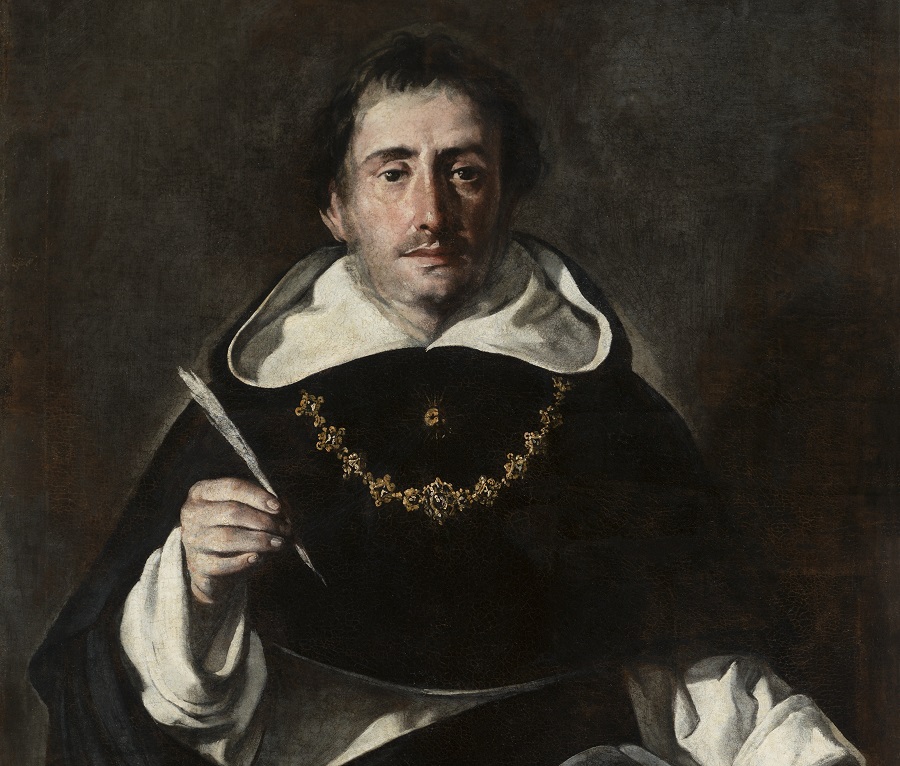
Saint Thomas Aquinas by Antonio del Castillo Saavedra
Introduction
Today we study the history of philosophy as a subject organized by authors and schools, without taking too much into account that our classifications represent, in themselves, an interpretation of the various philosophical bodies of thought. The fact that Plato, father and master of philosophers, founded the Academy, a space of teaching and of shared living based on philosophical principles, may have influenced this perhaps somewhat institutional view of Western philosophy. Nevertheless, many of the philosophers whose works we can today ascribe to one school or another, or to one philosophical movement or another, did not conceive of themselves as their representatives or champions; rather, it has been their works that have allowed us to exemplify the way of philosophizing of a given historical moment.
Perhaps the clearest example of the above is the consideration of Thomas Aquinas as the paradigm of Scholastic thought. As its very name indicates, Scholasticism was a method of thinking philosophically bound fundamentally to the universities and cultivated under the direction of a master (scholasticus). It consisted in interpreting the Sacred Scriptures by means of the instruments provided by the various branches of human knowledge: grammar, dialectic and philosophy. In this way biblical exegesis was submitted to broad rational schemes that went beyond mere literal or symbolic commentary. The recovery in the medieval universities of Aristotelian thought during the seventh to twelfth centuries, first through the Latin translations by Boethius and, later, of the entire Organon, received growing attention during the thirteenth century thanks to the enormous work of preservation and commentary by the Arab scholars. It is in this period that the great centers of university study were to be consolidated in Paris, Oxford and Salamanca. The study of the works of Aristotle was so successful in the university sphere during the thirteenth century that it practically displaced attention to the other classical authors.
Thomas Aquinas taught at several universities (Paris, Naples and Viterbo, among others) and was a most profound connoisseur of Aristotelian philosophy. But these facts, rather than turning him into the paradigm of Scholastic philosophy, show only that Aquinas was a child of his time. If Thomas holds interest for philosophy beyond the fact that his thought can be situated within a particular historical period, it is because he presents an extraordinarily powerful and original philosophy. As one of his most important scholars in the twentieth century, Etienne Gilson, has stated:
It is then held that if Saint Thomas had wished to have a philosophy […] like those of the ancient philosophers, he would have chosen that of Aristotle. There is nothing to object to on this point, except that, if Saint Thomas had done so, he would have been merely one more Aristotelian; we would have no Thomist philosophy. It is a satisfaction for us that Saint Thomas did something completely different
(Gilson, 2009, 27-28).
That Thomism became one of the summits -perhaps the highest- of Scholastic and Christian philosophy is a different question, the fruit of historical contingencies that we cannot deal with properly here, but which, in any case, developed independently of the aims and longings of Thomas the philosopher. And it is with the philosopher that the following lines will deal.
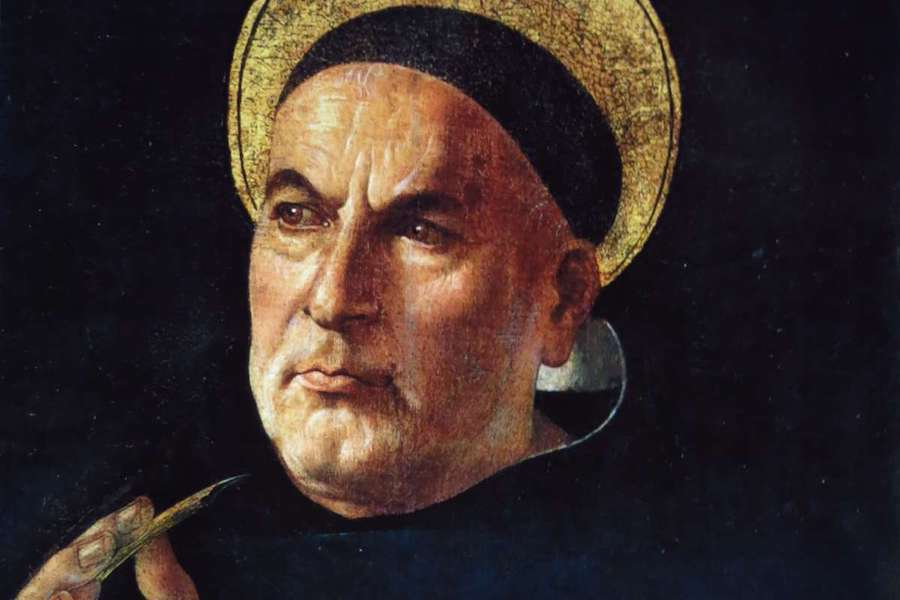
Thomas Aquinas according to Sandro Botticelli.
Life and context of the philosophy of Thomas Aquinas
Thomas Aquinas was born in Roccasecca, near Naples, in late 1224 or early 1225. He was the son of Landulf, count of Aquino, and, as was customary in that age, at the age of five he was placed in the abbey of Monte Cassino, where he undertook his first studies until Frederick II expelled the monks in 1239. After a brief stay with his family, he began his studies at the university of Naples. There he came into contact with a convent of Dominican friars whose way of life captivated him. He entered the order in 1244. This decision provoked strong opposition in his family, who wished for the young novice a brilliant ecclesiastical career at Monte Cassino. Fearful that study might harm such an objective, his brothers abducted him and kept him imprisoned for almost two years, first in one of the towers of the castle of Monte San Giovanni Campano, property of the family, and, later, in Roccasecca. Throughout all this time his sisters tried to persuade him of the negative consequences of his decision, but the isolation produced the opposite effect. Thomas took advantage of that time to study the Sacred Scriptures, the Sentences of Peter Lombard and some Aristotelian texts. In the end, he managed to escape in a large basket and entered the order of the Dominicans for good.
Between 1245 and 1248 he studied at the university of Paris. In that last year he traveled to Cologne with his master, Albertus Magnus, who was preparing to found a Studium Generale of the order of preachers. After a stay of four years with Albertus, he continued his studies in Paris, where he received, in 1256, the license to teach in the Faculty of Theology. After a brief period as a teacher at that university, he returned to Italy as magister. In 1268, once again in Paris, he took part in the Averroist controversies until his return to Naples in 1272. He died in 1274 in the Cistercian monastery of Fossanova, between Naples and Rome, on his way to Lyon, where Pope Gregory X had summoned him to take part in the council. The life of Thomas Aquinas is, then, that of a scholar and teacher in the service of various European universities at a historical moment in which Christian doctrine and classical Greco-Roman philosophy converge in an extraordinary and unique way, generating intellectual fruits of which present-day European thought continues to be the heir.
The work of Thomas Aquinas has traditionally been the object of unfounded prejudices: on the one hand, the historicism and positivism of the nineteenth century underrated its intellectual importance, considering it a way of philosophizing subordinated to the principles of the Catholic religion. For their part, the defenders of the purity of the faith have dismissed it as the fruit of the intellectual arrogance of its author. To the former one might reply that the methodological subtlety, the systematic character and the analytical capacity of Thomas bear a very close relation to Platonic dialectic and, in general, to the philosophical attitude. To the latter, that in our philosopher this perspective is never foreign to spirituality, nor is its adoption presented by him as an essential condition for salvation. In order to understand this important aspect better, it is worth beginning by setting out how Thomas conceives the relation between reason and faith.
Reason and faith: the fundamental principles of all knowledge
The relation between faith and reason was one of the great themes of philosophy in the age of Aquinas. Already in the eleventh century we witness a dispute between the so-called “dialecticians,” who granted primacy in the investigation of truth to Aristotelian logic and to the art of rational discussion on the basis of opposing arguments, and the “anti-dialecticians,” who placed faith first as the primary mechanism of access to truth, minimizing the role of reason. Anselm of Canterbury sought to find a balance between the two positions: on the one hand, he granted primacy to faith under the principle credo ut intelligam (I believe in order to understand); on the other, he admitted that the intellect could adduce “necessary reasons” to demonstrate the mysteries of the faith. The debate took on enormous complexity and divided many religious orders within Christendom.
For Thomas, theology was a branch of knowledge that proceeded, like any other, from self-evident principles that did not need to be demonstrated (axioms) and that acted as the foundation of all subsequent demonstration. Now then, unlike the rest of the branches of knowledge, the principles of theology are self-evident, but only for God, not for the human being. They are articles of faith, so that the acquisition of theological knowledge presupposes in the scholar faith in God. This does not mean that philosophical principles and the authority of the philosophers are useless, but rather that they function as “extraneous and probable arguments” that accompany and clarify the “proper and decisive” ones that we find in the Sacred Scriptures. So that the step taken by Thomas, a decisive one, consists in establishing a balance between reason and faith by granting natural reason a relevant contribution in the service of faith.
Reason and faith are for Thomas two autonomous forms of knowledge. This does not mean that each of them carries a different kind of truth. Truth is one alone and, consequently, the truths of reason and those of faith cannot be contradictory. The difference between the two is found solely in the source of access to them: natural truths are reached by means of reason, and revealed truths can only be known through the Scriptures. Alongside these areas of knowledge, we find a space of convergence formed by truths that have been given to us by revelation, but which we can attain through reason. These are what Thomas calls the “preambles of faith,” which can only be known by humans and not without errors and doubts.
Among the natural truths Thomas includes the existence and the unity of God, while truths of faith are, for example, the divine trinity. More important still is the consideration as a preamble of faith of three questions with a great tradition in classical philosophy and in which this is to acquire a fundamental importance for this Thomist natural theology guided by reason: the existence of God, the immortality of the soul and the creation of the world ex nihilo (out of nothing).
Being and essence: the real distinction between essence and existence
To explain the nature of the things we perceive through the senses, Thomas made use of Aristotle and, in particular, of his hylomorphic theory, which he modified appropriately in order to adapt it to the Sacred Scriptures. Aristotle had affirmed that things or substances are a compound of matter and form. Matter is that of which they are composed (of a statue, the bronze or the marble; of the table, the wood) and form is that which makes the thing identifiable as such (the form statue, the form table, the form chair, and so on). Matter and form stand in a relation of potency-act: the matter bronze can be considered a statue only in potency, but it does not attain “being” a statue -and, therefore, will not become a substance- until the sculptor gives it the specific form of a statue. Hence for Aristotle matter was secondary and incomplete, always in search of a form in order to be able to exist (that is, to be in act). Matter isolated from form (or prime matter) is, therefore, indefinable: mere potency insofar as, by itself, it has no entity.
In his early work, On Being and Essence, Thomas adopts the foregoing Aristotelian scheme, but introduces a third element to explain the world: the pair essence-existence, which modifies the sense that Aristotle had wished to give to the explanation of substances. The essence of corporeal beings would be formed not only by the form, but by the compound matter-form. Now then, in order for an essence to form part of the world, it is necessary that an additional characteristic can be attributed to it: existence. Existence stands with essence in a relation of potency-act. Put another way: the corporeal substances that we perceive through the senses possess an essence, which is a combination of matter and form, but, in order to be realized, they require that someone grant them existence, that someone create them. Existence is, consequently, the act by which the essence is.
The difference is clear: for Aristotle, substances are already there, in the world, and we can perceive them through the senses. Returning to the previous example: the statue is a compound of matter and form, the form being the primordial element that allows the bronze in potency to be “actualized,” thanks to the sculptor’s work, into the form statue. For Thomas, however, the statue is a compound of matter and form which we call essence, yes, but we can only know the essence of the statue (we can only, in short, define it) when someone actualizes that possibility through its creation. As can be observed, Thomas does not stop at the mere description of substances, but tries to explain why those substances occur in the world (exist) and can be known by us. Therefore, unlike Aristotle, Thomas is not speaking here of the sculptor who models a particular sculpture, but of a kind of first sculptor who creates the paradigm statue and who, consequently, allows all of us humans to identify that something is a statue and not something else.
In Thomist philosophy that sculptor is God. But the ultimate aim of the theory is not merely to demonstrate that the Christian God is a creator God, but rather that essences (recall: the corporeal substances composed of matter and form) are contingent, they do not exist by necessity. Their existence is the consequence of a free act of the divinity. The essence-existence distinction is, therefore, fundamental in Thomist thought, since it allows the contingency and creation of the world by God to be established. As against the philosophies of Plato and Aristotle, in which the fundamental element of being was placed on the side of form, for Thomas it is existence that takes on a central role. Things, all of them creatures of God, possess existence insofar as God grants it to them; his essence, however, consists in existing.
To explain the complex relation between God and the world, Thomas is to make use of the Platonic principle of participation: the world participates in the divinity in different degrees of likeness. It is precisely this likeness that allows us to know, though in a certainly precarious manner, some features of God. But before tackling this question, it is necessary to ask about the possibility of rationally demonstrating his existence, which obliges us to enter into Thomist theology.
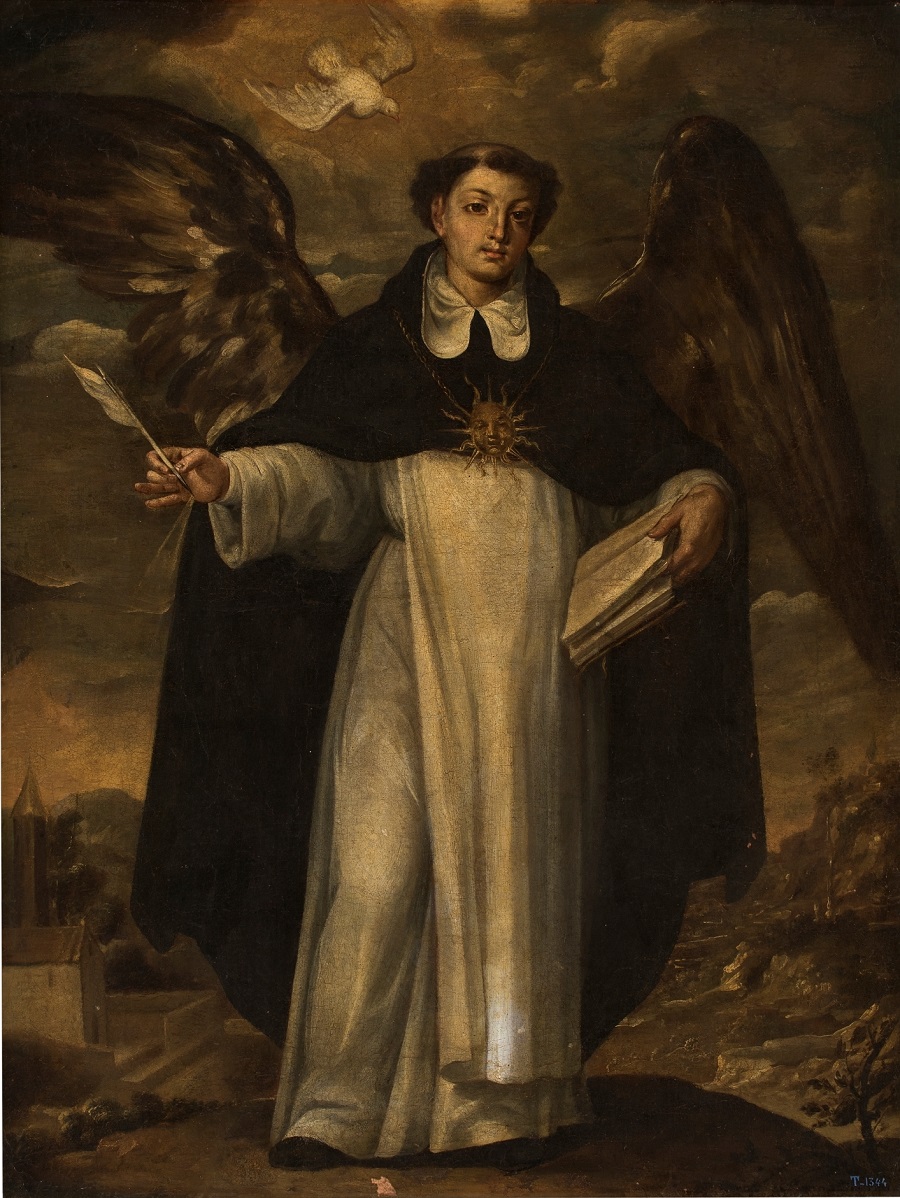
Saint Thomas Aquinas by Jose Risueno (Museo del Prado)
Thomist natural theology
When we refer to a theological system in an essay on Thomist philosophy we are alluding to natural theology, not to revealed theology. Unlike the latter, natural theology, although it too is guided by faith, consists in a fundamentally rational investigation. The precision is relevant if we bear in mind that the demonstration of the existence of God is a preamble of faith and, consequently, accessible to reason, but for this reason its demonstrations cannot be conclusive, but only probable and plausible. Thomist natural theology is divided into existential theology, devoted to demonstrating the existence of God, and essential theology, whose function is the attribution to God of the predicates that best suit him.
Perhaps existential theology is the best-known part of Thomas’s thought. The ways to demonstrate the existence of God, which we find in his most important work, the Summa Theologica, were irrefutable for centuries. Only Kant, at the end of the eighteenth century, settled the question by decreeing the impossibility of a rational demonstration in this regard. But even today, although they are taken as a mere exercise of reason, they merit our attention for their philosophical interest.
Thomas considers that the existence of God can be demonstrated only a posteriori, that is, on the basis of the data we obtain from the senses. The a priori demonstration, also known as the ontological argument, formulated by Saint Anselm, is not convincing. Already present in Greco-Roman philosophy in various forms, this celebrated argument affirms that the proof of the existence of God lies in the fact that all humans are capable of conceiving of a being greater than which nothing can be thought. But, for Thomas, the fact that this being can be thought does not mean that it must exist de facto outside our mind. For this reason, and given that all our knowledge proceeds from the senses, the existence of God can only be demonstrated from his creatures.
The ways for the a posteriori demonstration are five and always have the same scheme:
- They start from sensible facts.
- They assume the impossibility of an infinite process in the series of causes.
- They are based on the principle of causality.
- The term is always the same: the first cause exists and is God.
The first way is that of motion, which our author prioritizes over the rest and calls the manifestior argument. The argumentative scheme had already been used by Aristotle, Maimonides and Alexander of Aphrodisias, and conceived of motion in the Aristotelian sense, that is, as the passage from potency to act. Therefore, motion is not to be understood here merely as local displacement, but as the process by which a thing attains, let us say, its fullness (for example: a seed becomes a tree). Let us see it in Thomas’s words:
The first and clearest is the one deduced from motion. For it is certain, and the senses perceive it, that in this world there is motion. And everything that moves is moved by another. In fact, nothing moves unless, as potency, it is oriented toward that by which it moves. For his part, he who moves is in act. For to move is nothing other than to pass from potency to act. Potency cannot pass into act except through what is in act. Example: fire, hot in act, makes the wood, hot in potency, pass to hot in act. In this way it moves and changes it. But it is not possible for a thing to be the same, simultaneously, in potency and in act; it can only be so with respect to something different. Example: what is hot in act cannot at the same time be hot in potency, but it can be cold in potency. Likewise, it is impossible for something to move and be moved at the same time, or to move itself. Everything that moves needs to be moved by another. But if what is moved by another moves, it needs to be moved by another, and this one by another. This proceeding cannot be carried on indefinitely, because one would not arrive at the first that moves, and thus there would be no mover at all, for the intermediate movers do not move except by being moved by the first mover. Example: a staff does not move anything if it is not moved by the hand. Therefore, it is necessary to arrive at that first mover whom no one moves. In this one, everyone recognizes God.
The argument is as simple as it is forceful: given that (1) a thing cannot be actualized from its state of potency without something already in act compelling it to take that step; that (2) everything that moves is moved by another; and that (3) an infinite series of movers is impossible, then there must exist a first mover, that is, a mover not moved by another.
The second has been called the way of the efficient cause or of the creator being, which our author takes from Aristotle and which had already been used by Avicenna. The argument consists in affirming that nothing can be the cause of itself because, in order to be so, it would have had to exist before itself. Since it is impossible to proceed ad infinitum in the series of efficient causes or creators, there must be a first cause which we call God.
The third way is that of necessity, used already by Maimonides and, again, really taken from Avicenna. It is based on the fact that the beings we perceive through the senses are contingent (they are born and die and, therefore, can be or not be). At the end of the chain of contingent creator beings there must exist a necessary being, the cause of the contingent beings coming to exist. This being is God. It is, in reality, a matter of postulating a sufficient reason for the existence of the world.
As Copleston has noted (1983: 334), when Thomas affirms that an infinite series is impossible he does not seem to have a temporal scheme in mind. What Thomas denies is the possibility of an infinite series in the order of causes currently dependent. What does this mean? Let us suppose that the world had been created from eternity. There would then be an infinite historical series, but the entire series would consist of beings moved by another (way 1), caused by another (way 2) or contingent (way 3), since the fact of there being no beginning does not resolve the problem of the first cause of motion, of the first creator or of that which exists by necessity. What Thomas denies is the possibility of an infinite series in the ontological order of dependence. Put another way: at the beginning, let us say, of the chain, there must exist a being qualitatively (or ontologically) distinct from the rest of existing things, one that acts as the origin of everything.
The fourth way takes as its point of departure the degrees of perfection of the things we perceive through the senses. This fact allows us to formulate comparative judgments of the following form: “x is more beautiful than y” or “a is more just than b.” Since an infinite series of comparisons is impossible without there being an optimum that acts as an absolute paradigm, this optimum must exist and we know it by the name of God. It is an argument of Platonic origin and presupposes the idea of participation to which I referred earlier: creatures participate in different degrees in divine perfection just as the things of the Platonic sensible world participate in the Ideas.
The fifth and last way to demonstrate the existence of God starts from the order of the world. Many inanimate things or inorganic beings seem to operate in the sensible world with an end (fire burns, water nourishes the fields or quenches thirst, and so on). Now then, inorganic objects lack consciousness or will and cannot tend toward an end unless they are directed by an intelligent mind that supplies that lack. This intelligent being is God. This fifth way takes up an old tradition of Greco-Roman philosophy that we find already in the final cause of Aristotle, but also in the debates between Epicureans and Stoics. The former saw only chance where the latter perceived the action of providence. Kant will affirm that this way, for which he felt an enormous respect precisely on account of its antiquity, did not lead to proving the existence of a creator being, but, at most, of an architect similar to the Platonic demiurge of the Timaeus. In any case, regardless of the validity we currently grant to these ways -which must be slight after the Kantian critique- this attempt to arrive at God starting from the sensible world and not from abstract theories that remain solely in our mind, as happened with the ontological argument of Saint Anselm, is interesting.
The existence of God as a necessary being having been demonstrated, one may ask what kind of being he is. To this is devoted Thomist essential theology, which here we can only summarize very briefly. To answer this question there are, again, two different ways: a negative one, in which Thomas, taking up the Neoplatonic tradition and that of Pseudo-Dionysius, affirms that of God one can only indicate what he is not. For example: we can affirm that God is not corporeal, that in him there can be no composition whatsoever (of matter-form, of substance-accident, of essence-existence, and so on) or that he does not change, for if his essence is to exist he cannot undergo any ontological change.
In the second place, it is possible to describe the divine essence affirmatively. But this way requires prudence, because every adjective that qualifies it will always be limited: if we say that God is good, just or beautiful we will only be approaching what he might be. The divine essence will always infinitely exceed the semantic content that these words carry. And this is because, when we affirm these qualities, we are predicating their preexistence in God and, consequently, the limited participation of things in them. Hence the most adequate way to describe the divine essence is that of eminence: divine goodness is affirmed in order to negate it immediately and then affirm the maximal attribution of that quality. God is just; but he is not just as we believe him to be just; God is the most just of the just.
The creation of the world, man and life in society
Following the Christian philosophical tradition that goes back to Augustine, Thomas considers that God created the world ex nihilo, out of nothing. But what does this mean? That the essence of the world is nothingness, perhaps? Not at all. It means that God had nothing to create the world with, except his free will. As against Avicenna, who considered that God created the world by necessity of his own nature, Aquinas attributes to the divinity the free will in which humans participate to a lesser, though recognizable, degree. If one could speak of the motives by which God created the world, we would have to affirm that he did so out of love. As I have already indicated, just as with the existence of God, Thomas considers that creation ex nihilo is a preamble of faith, that is, a revealed truth that can, nevertheless, be reached through reason.
The human being too is a divine creation, whose composition Thomas explains from an Aristotelian point of view. The human being is a single substance composed of body (matter) and soul (form). Despite this unity, the soul can exist independently of the body, although it only attains its natural perfection in union with the latter. The idea of the soul without the body as an incomplete substance leads to numerous problems, among which are that of death or the existence of evil in the world. It is one of the most complex themes and the one that caused the most discussions among the medieval Christian philosophers.
Indeed, if God is infinite goodness, how is it possible that illness, death, frustration or natural catastrophes exist? To answer this question, Thomas begins by distinguishing between physical evils and moral evils. In relation to the former, although God did not seek them, they are a consequence of the contingent nature of every creature. He did not will suffering as such, but he did will that his creatures be corruptible. Physical evil is generated “by accident” and is, consequently, a necessary collateral damage that, nevertheless, makes the existence of creatures possible.
Different from the foregoing is moral evil, attributable exclusively to man, whether as a consequence of his free will or through ignorance. Virtuous behavior consists in acting in accordance with the natural law, which is the part knowable by humans of the divine plan established by God in the eternal law. Its first precept states that good is to be done and evil avoided. The other precepts, such as the preservation of one’s own being, life in society or the knowledge of truth, are derived from that one. All of them are infused in us by nature and their habit constitutes the synderesis, that natural disposition of humans to detect the good and the bad and to behave accordingly. Natural law constitutes the foundation of positive law, and the government of States must respect it at all times in order to favor the common good and peaceful coexistence among human beings. A coexistence based on Christian principles that Thomas constructs rigorously with the fruitful tradition of classical philosophy.
Bibliography
- Copleston, F. (1983). Historia de la Filosofia. 2. De san Agustin a Escoto. Barcelona: Ariel.
- Chesterton, G. K. (1973). Santo Tomas de Aquino. Espasa Calpe.
- Gilson, E. (2009). Introduccion a la Filosofia Cristiana. Madrid: Encuentro.
- Pirenne, H. (1992). Historia de Europa. Desde las invasiones hasta el siglo XVI. Fondo de Cultura Economica.
- Tomas de Aquino, Suma de Teologia. Edicion accesible on line en: https://www.dominicos.org/estudio/recurso/suma-teologica/
- Tomas de Aquino (2011). El ente y la esencia. Eunsa.
Great Documentaries: Saint Thomas Aquinas
– Thomas Aquinas: Biography, Thought and Works – – Alejandra de Argos –