Is the Cosmopolitan Ideal Achievable?
Few concepts in the Western heritage have been as hopeful and fascinating as that of cosmopolitanism. The ideal of the peaceful coexistence of all human beings, gentle and captivating, represents the summit of the dreams of living together among those who differ. And this despite the fact that the historical attempts to carry the idea over into reality have almost always turned out to be turbulent and intemperate.

The relevance of the cosmopolitan ideal today
Few concepts in the Western heritage have been as hopeful and fascinating as that of cosmopolitanism. The ideal of the peaceful coexistence of all human beings, gentle and captivating, represents the summit of the dreams of living together among those who differ. And this despite the fact that the historical attempts to carry the idea over into reality have almost always turned out to be turbulent and intemperate.
The French historian Marc Bloch already warned us of the misunderstandings generated when one traces the origin of concepts, for it almost always happens that behind a single signifier different meanings lie concealed. The caution seems made to measure for cosmopolitanism, whose earliest origin never referred to the spacious universe of human beings, but rather to a narrow species, that of the sages. Only the passage of time turned the cosmopolis into an ideal political community, integrating and harmonious. At least, this is the meaning it has for us today. Confidence in its possibilities has driven philosophy ever since the fall of the Berlin Wall, with numerous contributions that advocate attempting once more a society of planetary contour.
The German philosopher Immanuel Kant may be considered, in all fairness, the father of the modern idea of the cosmopolis when he states in Perpetual Peace:
According to reason, States in reciprocal relations have no other recourse than to leave the lawless condition that entails nothing but war, just as individuals abandon their savage lawless freedom, and to conform to restrictive public laws, thereby forming a State of Peoples that grows constantly until it finally embraces all the peoples of the earth (B. 37-38, p. 87 of La paz perpetua. Un diseno filosofico, edition and translation by Roberto R. Aramayo, Alamanda, 2018).
A large part of the current proposals in favor of a cosmopolitan organization rest in one way or another on this work of Kant’s: either they use it as their primary inspiration -such is the case of Adela Cortina, to whom I shall refer later- or they combine Kantian doctrine with others, essentially Stoicism -such is the case of David Held, in “Principles of cosmopolitan order”- or Stoicism associated with Aristotelian elements, as occurs in the case of Martha Nussbaum, to whom I shall also devote some closing reflections.
It happens, however, that these cases, even though they hold rigorous positions, tend to overlook certain peculiarities of ancient thought that cast serious doubt on the viability of the cosmopolitan proposal understood as the definitive overcoming of human conflicts. It is therefore not amiss to devote a few lines to examining the different meanings the ideal took on in Antiquity. And it is not amiss because the longing for the peaceful coexistence of men is as old as philosophical reflection itself.
Stoic cosmopolitanism
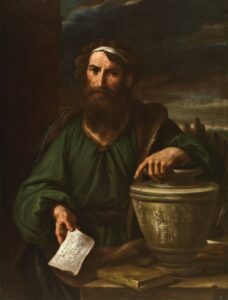
Diogenes of Sinope, the Cynic philosopher who was in the habit of sleeping in a barrel and whose indecorous behavior scandalized many of his contemporaries, once answered, on being asked where he came from: “I am a citizen of the world (kosmopolites, in Greek)” (Diogenes Laertius, Lives of the Eminent Philosophers, VI, 63). This seems to have been the position of Socrates as well, as Cicero informs us in Tusculanae, V, 108. Such affirmations probably enclosed a concrete and profound philosophical stance, but, since they are not accompanied by any theoretical development, they lend themselves to a multitude of interpretations. For this reason, we are left with no choice but to resign ourselves to understanding them in the light of what the later cosmopolitan ideal came to be.

Diogenes Sitting in His Tub Jean-Leon Gerome, 1860
The figure of this ideal was sketched by the father of the Stoic school, Zeno of Citium, in a work, the Politeia (political community or republic, in Greek), which unfortunately we have not preserved and know only through indirect tradition, that is, through quotations by later authors. Zeno seems to have designed a political community without physical borders, but delimited with enormous precision by means of firm and lofty moral barriers. Only the sage could form part of it. The rigorism demanded in fulfilling the requirements for adhesion to this congregation of sages was such that it was unrealistic to aspire to attain that state while retaining the characteristics proper to the human being, whom the Stoics considered for the most part unconscious and frivolous. The result of so demanding a condition was that Zeno’s disciples found themselves unable to point to a single example of a sage made flesh. Not even the founding father, nor Chrysippus, the most important systematizer of the philosophy of the Stoa, were considered sages by the successive adherents of the school.
Stoic wisdom consisted in displaying conduct subjected at every moment to the strictest rationality. In practice, this meant mastering one’s own passions (what today we would call emotions) and behaving appropriately according to the social position one occupies at each moment. The social order and the psychological order had been perfectly arranged by the logos, a divine and providential reason capable of assembling all the pieces that make up nature by means of a hierarchy among living beings that placed the human as an intermediate species between the beasts and the gods. Wisdom consisted in adjusting one’s own conduct to a nature conceived, organized and guided by the logos.
Consequently, and paradoxical as it may seem, the first model of the cosmopolis that philosophy offers us, far from being attractive and integrating, was demanding and profoundly elitist. In the utopian city without borders devised by Zeno, only those who had reached the arduous and remote summit of Stoic morality received letters of citizenship. The rest, the fools, remained shackled to the worldly cities, condemned to a morally sterile life brimming with fratricidal struggles.
The figure of the Stoic sage received a multitude of criticisms already in Antiquity, not only for its extreme rigidity and demandingness, but for the attributes that defined him as a member of this restricted moral community. The sage never erred; consequently, neither did he forgive, given that indulgence always entails the assumption of a prior error of judgment; the sage did not hold opinions and, therefore, could not change his mind. His voice was the voice of reason, the voice of the law. Categorical, the Stoics asserted that wisdom founded a moral state which, once attained, admitted of no return. And conversely: the fool remained a fool until he reached the summit of moral progress. In the same way -they said- that a person submerged in the sea drowns just as surely two meters deep as ten centimeters from the surface, the fool remains a fool as long as his action does not culminate in the final, complete and irrevocable state of wisdom.
Some late philosophers, Christian and therefore critical of Stoic paganism, refer to certain passages of Zeno’s Politeia more closely linked to Cynicism, which the founder of the school seems to have received from his teacher Crates, himself a disciple of Diogenes of Sinope. Such is the case of Epiphanius of Salamis (4th century A.D.), a Father of the Church. In his Panarion, a treatise on the heresies, he informs us that the Stoic sage may eat human flesh, even that of his own children, or freely abuse young boys (SVF. III, 36). Diogenes Laertius also conveys this report to us. Referring to the same work, he asserts:
[The sage] will live as a Cynic. For Cynicism is a shortcut to virtue, according to Apollodorus in his Ethics. And he will even taste human flesh under certain circumstances. He alone is free, while fools are slaves. For freedom is the power to act on one’s own behalf, and slavery is the deprivation of that self-determination (Lives of the Eminent Philosophers, VII, 121).
For his part, the skeptical philosopher Sextus Empiricus (2nd century A.D.) tells us that Zeno permitted the sage to caress his mother’s vulva with his own member, since no one would say it is wrong to caress any other part of the body with the hand (Outlines of Pyrrhonism, III, 205).
It is true that all these testimonies come from schools rival to the Stoic. Epiphanius was a Christian, Diogenes Laertius an Epicurean and Sextus Empiricus a skeptic. Now then, their testimonies are plausible in the light of the configuration of that ideal of the sage who is guided solely by the pursuit of the supreme good: to live virtuously, that is, in accordance with nature. Everything else is indifferent (adiaphoron, in Greek). And although the Stoics accepted that there were preferable indifferents (wealth or health) and non-preferable ones (poverty or sickness), as their very name indicates, these were never essential to a virtuous life. From this perspective, there does not seem to be any rationally significant difference between the genital organs and any other part of the body. The differences, doubtless very relevant, are of a cultural nature, but these are of no importance to the Stoics.
Founded and governed by the sage, Zeno’s cosmopolis was a harmonious community where private property did not exist and where friendship reigned -only the sage, they asserted, is a faithful and loyal friend- among all its members, free and equal beings.
Cosmopolitanism in Rome
The Stoic cosmopolitan ideal, so restrictive and circumscribed to the adoption of this school’s principles, would have been reduced to an episode of Greek thought of no great interest had it not been for a factor of enormous historical relevance: the exceptional expansion of a small city of Latium that came to dominate the whole Mediterranean. I refer, of course, to Rome. It was this expansion that brought about the success of cosmopolitanism as a useful construction in a twofold sense:
1. As an ideal capable of judging the degree of suitability of the worldly communities.
2. As the foundation of a longing for domination that does not renounce attaining justice, even though both words -domination and justice- may seem an oxymoron in the eyes of present-day readers.
Let us see the scope of these two senses or orientations.
1. Greek philosophy and rhetoric grasped at once the difficulties entailed by the cosmopolitan ideal reduced to so scant a body, almost nonexistent, of sages. Nevertheless, the optimism generated by Roman imperial expansion, which seemed to have no limits at the height of the 1st century A.D., nourished in some thinkers of Stoicizing tendencies the affinities between Rome and Zeno’s cosmopolis. This despite the fact that the times had changed and the absolute freedom and equality of the citizens of the Zenonian utopia could serve only as referents, or ideals, to be hurled against the excesses of certain emperors. Perhaps this was one of the reasons why a certain Stoicism rebelled against tyranny in defense of the liberties of the Senate, with Cato of Utica, a sturdy Stoic of the 1st century B.C., as the most accomplished model of the traditional virtues. The Pharsalia of the poet Lucan, nephew of the philosopher Seneca, describes him in this way with enormous beauty.
An interesting author for understanding this perspective is the sophist Dio of Prusa, also known as Dio Chrysostom for his oratorical gifts. In his Borysthenitic Discourse, Dio, at the request of the inhabitants of Borysthenes -a city near the Black Sea-, attempts to define the concept of the city. Following Stoic precept, the sophist declares that a city is a group of human beings who dwell together and are governed by one and the same law (Orationes, 36, 20). I have already noted that the law (nomos, in Greek) revealed, for the Stoics, the rational order. Just as the human being is endowed with a rationality that orders his conduct, so too the city possesses an organization that is nothing other than the transposition of the rational law.
Unlike what happens in present-day democratic regimes, the validity of this law did not depend on the fulfillment of a series of formal requirements, such as a concrete subject matter to be regulated or a specific organ that approves it by a previously established procedure, but rather formed part of the natural order of things: it was, we might say, one more piece in the gearwork of the cosmic harmony brought about by the divinity. As against the Epicureans, who considered convention or agreement among human beings to be the foundation of every political community, the Stoics found the ultimate root of the norms of coexistence in nature.
From this premise two consequences of enormous relevance for political philosophy follow: the first lies in the fact that natural law, the manifestation of this universal and divine rationality, establishes a binding standard for the positive laws, which are the laws approved by the institutions of any given city. The ultimate criterion for determining the validity of a positive law resided, then, in its correspondence with natural law. Dio expresses it very eloquently: “for just as he who lacks reason is not human, so too that in which the law does not prevail is not a city. For a senseless and disorderly city could not be lawful” (Orationes, 36, 20).
The second premise derives from the first: if only that which manifests cosmic rationality can be law, only that in which natural law prevails will be able to be called a ‘city’. The question that immediately arises is whether, in Dio’s judgment, there would exist a worldly community worthy of being baptized with so distinguished a name.
The Borysthenitic Discourse offers us a negative answer. This should not surprise us, for as a good Stoic, Dio does not consider that there exist on Earth communities formed by sages, so that it is impossible to speak of a government wholly subjected to natural law. Dio’s city would exist only in the heavens or, at most, would be made up of gods and men, the latter being, in the end, like children living alongside adults who prescribe for them norms of behavior that are unfathomable. Although in the discourse the city of sages is replaced by that of gods and men, Dio takes up without substantial modifications Zeno’s idea of the cosmopolis, for those men to whom he refers are, obviously, sages and, as such, live in accordance with Reason, that is, they cohabit with the divinity. Therefore, Dio continues to travel the same path that the father of Stoicism had earlier trodden: the path of utopia.
Both Zeno’s Politeia and Dio’s city of gods and men reflect the bonds existing between Stoic politics and theology, for the logos is, for this philosophy, the supreme legislator. The centrality of divine reason is decisive insofar as it dispenses a concrete and finished model of social organization. More plainly: the principles of Stoic philosophy make up the precepts of the city’s natural law. For this reason, if we remove the framework that the Stoic system provides, the cosmopolitan ideal collapses beyond remedy.
Now then, as against Zeno’s scholastic fantasy, Dio’s Stoic cosmopolis acquires a valuable attribute. For, between the lines, the seasoned reader perceives the critical impulse that drives it as a useful referent for evaluating the moral deviations of the Rome of the emperor Domitian, who has gone down in history as one of the greatest tyrants of the Early Empire and by whose decision the sophist had had to go into exile. In the Borysthenitic Discourse, Rome is the Rebecca of Daphne Du Maurier, an absent figure ever present who emerges by contrast with the ideal city in order to show the depth of its moral imperfections.
2. The history of ideas is never linear. A thinker casts forth a concept as the shipwrecked man commits a bottle to the sea. Sometimes the vessel shatters by chance into a thousand pieces and the concept, made brittle by the damp, crumbles to its complete decomposition. At other times it lands on a little-frequented shore where it rests from the fashions of the age until another thinker (or woman thinker) stumbles upon it and picks it up. But it also happens at times that the bottle reaches an influential and prominent port, is picked up at once and its message immediately deciphered. This last was the case of the cosmopolitan ideal in the second sense to which I referred earlier.
The one who picked up the bottle on this occasion was a Roman, Marcus Tullius Cicero, who discerned in the message an inestimable opportunity to supply theoretical tools to a new world subjected to the power of Rome. Let us go back, then, to the middle of the 1st century B.C., a moment of formidable territorial expansion though of visible decadence of the republican government. In reality, the idea of a city that would integrate the existing Stoic sages held scant interest for Cicero. But, stripped of the most characteristic Stoic elements, it was extremely useful for legitimizing Roman dominion over the Mediterranean. With this idea in mind, Cicero introduced two substantial modifications to Zeno’s project. The first proved decisive: where the latter had spoken of sages, Cicero began to speak of Roman citizens. The second was no lesser: where the Stoics spoke of natural law, Cicero began to speak of ius civile, that is, the law applicable to those citizens. A law that drew nourishment from the customs and traditions of the ancestors, the so-called mores maiorum. By dint of these two significant modifications, the philosopher of Arpinum transmuted the Roman Republic into the most accomplished form of the cosmopolis.
Cicero retrieved the bottle cast forth by Zeno, but there where the latter had written Politeia, the Roman philosopher read the glorious name of Rome.

Cicero Denounces Catiline Cesare Maccari
Our author conceives the Roman Republic as a humani generis societas, the society of the human race, and describes it in accordance with what he considers to be the traditions proper to the aristocracy of his time (On the Laws, III, 12). In his treatise On the Republic, he presents the program for the political regeneration of a deeply fractured community, owing to the profound disputes existing within the senatorial elite, above all after the Gracchan reforms. His interest consisted in recovering the consensus of all prudent men, that is, of those who, in his judgment, sought the highest Roman virtues. In On Duties, his last work, he described the qualities that the citizen of this republic was to display, anchored in a moment prior to the rupture of social cohesion and retrieved for the present from the depths of the collective memory of his time.
Cicero always believed in the manifest superiority of Roman values and traditions, the irreplaceable foundation of the ius civile. So much so that he considers this law to be the most accomplished form of natural law, for which reason he proposed it as the primary code for this universal community that Rome sponsored.
A text from this last work illustrates the aspects that our thinker considered relevant to the good functioning of that cosmopolis:
Now then, to take something away from another, and for a man to increase his own advantage through another’s harm, is more contrary to nature than death, than poverty, than pain, than anything else that can befall the body or external goods. But above all it destroys life in common and human society […] [N]ot only nature, that is, human right, but also the laws of peoples, establish in a general way that it is not lawful to cause harm to another in order to benefit oneself. To this the laws are directed, this they seek: that civil coexistence be kept intact; and those who attempt to dissolve it they punish with death, with banishment, with prison and with fines (On Duties, III, 21-23).
Cicero’s matchless cunning consisted in appropriating a Stoic idea, the cosmopolis of sages, and stripping it of the content that the Stoa had provided it. The words (society of the human race, natural law, and so on) exude Stoicism from every pore, but the final product is something new. Stoic philosophy, the source of the moral and juridical ordering of the utopian Politeia, was replaced by Roman traditions and law, general principles of conduct for an ecumenical government. The Stoic city of sages became the Rome of the citizens. And I do not consider it mistaken to suppose that the Ciceronian interpretation underlay the gradual broadenings of Roman citizenship secured in the subsequent centuries.
This ambitious operation, extraordinarily successful, nonetheless raises a crucial question that bears on the possibilities of the practical application of the cosmopolitan ideal. For it will not have escaped the reader that the Ciceronian interpretation has elevated to universal a particular human condition. In carrying the cosmopolitan ideal over from theory to practice, Cicero has turned it into the theoretical framework of imperialism.
It is not easy to address this problem. Just as it was engendered, cosmopolitanism can only function within the Stoic system, for one cannot conceive of a city without ethical and political principles to order life in common. The Stoic sage has very precise ones, the virtues, of onerous effort, yes, but which act as natural commands that point out the straight path toward the supreme good. If we deprive the cosmopolitan ideal of the prescriptive content that Stoic philosophy provides, we deprive the city of its norms of coexistence. Consequently, if we do not want this city to be a mere form, empty of content and uninhabitable, it becomes indispensable to offer a new meaning for natural law. And that is what Cicero did, and what so many thinkers after him have done. For reasons of space, I cannot dwell on their proposals, but I consider that all of them fit in one way or another within one of the two orientations indicated here.
Cosmopolitanism today: Martha Nussbaum and Adela Cortina
My intention is to examine the most current ones, alluded to at the beginning of this exposition. I refer to those of Martha Nussbaum and Adela Cortina. Well then, although with differing enthusiasm, both sink their roots into the philosophy of Kant, who in Perpetual Peace recovers the cosmopolitan ideal by combining the two senses to which I have referred. On the one hand, the Prussian philosopher provides a ‘regulative ideal’ that allows the worldly political communities to contrast their moral deficiencies with the ‘Republic of Ends’, a refashioned translation of the Stoic cosmopolis. Now then, it is worth stressing that the ‘regulative ideal’ does not possess only a critical function, but sets out a guide for action. And, indeed, the Kantian community of ends does not seem to want to settle into the storehouse of ideas, but rather longs to be transfigured into a worldly city under the guise of the principles of the Enlightenment: the primacy of reason, moral autonomy and the emancipation of the individual. So that Kant, in thinking his cosmopolis as a practicable idea, endows it with contents that reveal the peculiar conjuncture of 18th-century European philosophy.

The same occurs with the proposals of Nussbaum and Cortina. The former has devoted numerous works to the possibility of developing the cosmopolitan ideal today. The most recent, The Cosmopolitan Tradition. A Noble but Flawed Ideal, is a study of the different proposals concerning cosmopolitanism that have existed from Antiquity down to herself. The final chapter (pp. 253 ff.) consists precisely in setting out her proposal, which revolves around what in the book she calls the “capabilities approach”, an idea sponsored in the eighties by the economist Amartya Sen. For Nussbaum, a “constructive approach” to global problems would have to preserve the set of “central human capabilities”: life, health and bodily integrity, the senses, imagination, thought, the emotions or practical reason.
In principle, Nussbaum presents the capabilities as a scheme or “abstract template” that might well serve as a regulative ideal. But, once again, this ideal possesses two faces and the reader perceives that the philosopher’s purpose does not confine itself solely to the theoretical plane. The chapter takes on the features of a concrete proposal for preserving these capabilities effectively in a worldly political community of universal scope. And it is here that Nussbaum takes sides in favor of a typically Western democratic system in which values such as freedom of expression or the right to enjoy a dignified health and education system of equal access for all predominate. The present writer has no conflict whatsoever with this proposal, but notes that it is the fruit of a specific cultural development, of Greco-Roman and Christian root. Obviously, Nussbaum also knows this, but does not seem to feel comfortable acknowledging this circumstance, for she fears that the theory of capabilities may be wounded by the very arguments she uses against Cicero.
The ancient combination of the two senses of cosmopolitanism that the Kantian regulative ideal reflects is patent, even more so than in the case of Nussbaum, in Cosmopolitan Ethics. A Wager on Good Sense in Times of Pandemic, by Adela Cortina. The Valencian philosopher signs a contract of adhesion to the principles of the Prussian philosopher and takes up once more the battle for the cosmopolis as a means of “making the progress of the Enlightenment viable”. “Cosmopolitanism” -she affirms- “makes it possible to develop the best seeds of humanity through the historical process, which is also the educational process”. For this reason, she advocates “the construction of a cosmopolitan society as the supreme juridical good because it makes peace possible, which is the definitive end of law within the limits of mere reason and answers to the command of practical reason that ‘there shall be no war’, because that is not the way in which human beings should resolve their disputes” (pp. 156-157). Beautiful words and yet defenseless before a human nature that has so often shown itself merciless and lost.
Far from discouragement, Cosmopolitan Ethics makes its offer of a three-phase constitution for a universal democracy backed by a single people: the first stage would be the revolutionary one, which would extend from the end of the 18th century to the Second World War; the second, which she calls welfarist, would develop from the end of the Second World War; and the third, unfinished, would consummate the cosmopolitan ideal begun with the construction of Europe and the great international agreements (p. 164). A periodization that could be applied to Europe, and not without hesitation, but very dubiously to the rest of the planet.
From the cursory examination of their works we may conclude that both authors maintain close ties with Zeno and Dio, but also with Cicero, for the one and the other elevate to universal a particular cultural condition. This circumstance leaves open the question that heads these lines: is it possible to realize the cosmopolitan ideal of a city in which all human beings live in a peaceful and harmonious manner? The philosophical proposals I have considered seem to place us in a dead end. Or, rather, in an alley whose only way out is the sublimation of the cultural values of the West. This is not strange, if we bear in mind the geographical origin of the concept and the scope of its pretensions: the totality of the Earth. The universal character of this aspiration is inexplicable without resorting to Greco-Roman thought and, subsequently, to the Judeo-Christian philosophy built upon its base. Not for nothing does catholic (katholikos, in Greek) mean universal.
To what extent this attitude is or is not correct carries us off to a puzzle of a different order on which the ancients also reflected in an outstanding manner. I refer to the difficulties entailed in making utility and morality compatible. It is the theme of Plato’s Republic, and also of the treatise On Duties, the last work of Cicero, who -like Nussbaum and Cortina- did not renounce the idea that the power exercised by Rome might be qualified as just.
– Is the Cosmopolitan Ideal Achievable? – – Alejandra de Argos –