

The Thyssen Museum Dazzles with a Rediscovered Caravaggio
“Saint Catherine of Alexandria” recovers its splendor thanks to the magnificent restoration carried out by the museum’s experts. The process can be admired together with the canvas in a complete exhibition, open until 25 May.
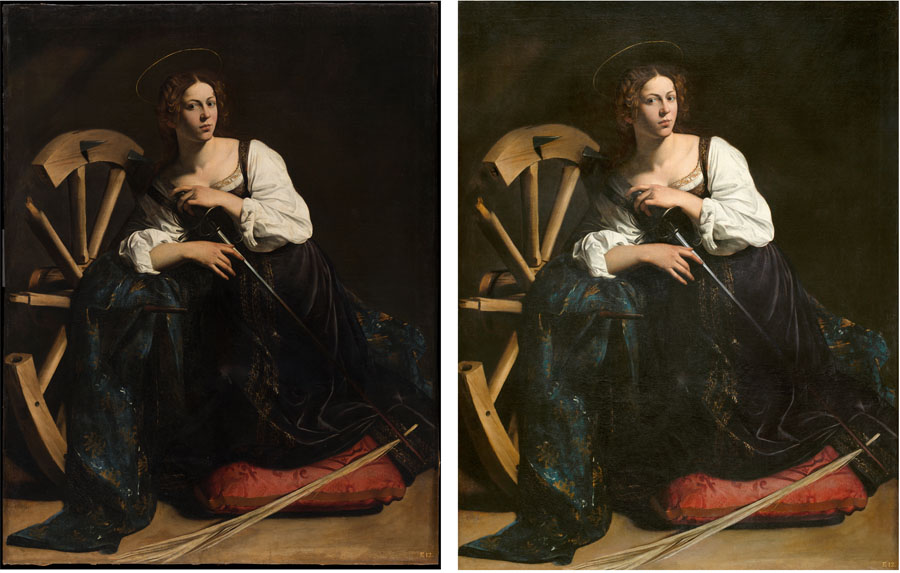
Restoration of Saint Catherine of Alexandria: before and after. Museo Nacional Thyssen-Bornemisza.
The name of Michelangelo Merisi Caravaggio draws crowds. His deeply Baroque paintings, full of passion and unease and executed with limitless mastery, have made the Italian artist one of the stars of the art firmament. The Museo Nacional Thyssen-Bornemisza, owner of one of the few works by the artist preserved in Spain, reveals this month the result of the restoration and technical study of the canvas Saint Catherine of Alexandria. The work has been carried out by the museum’s Restoration Department with the collaboration of Asisa and can currently be followed in an exhibition that will remain open until 25 May, in which the leading role is undoubtedly taken by the painting itself. The work was commissioned from Merisi by Cardinal Francesco Maria del Monte: to represent the saint, the artist chose as a model Fillide Melandroni, a very popular courtesan in Siena between the 16th and 17th centuries and who at that time was 17 years old.
Presentation of the restoration and technical study of Saint Catherine of Alexandria, by Michelangelo Merisi Caravaggio.
The painting is a faithful portrait of the young woman, who poses defiantly looking directly at the viewer, with the palm of martyrdom discreetly abandoned on a cushion. Fillide Melandroni was the reason why the painter (eternal protagonist of brawls and drunken revelries) killed his pimp Ranuccio Tomassoni in 1606, after which he had to go into exile from Siena to flee from justice. The restoration has revealed subtle details of the original work, such as the saint’s loose hair, and has removed layers of dirt and aged varnishes, exposing the artist’s original. For the restoration of the work, cutting-edge techniques and laboratory work have been used, which, together with the work of the museum’s experts, have given rise to a spectacular result. It is time to rediscover a masterpiece, transgressive and delicate, which four hundred years after its creation continues to awaken limitless admiration.
You may also like
 “Catalanes y escoceses: union y discordia”. The Astute Analysis of John H. Elliott
 Banksy Strikes Again with a Corrosive Christmas Image
 The British Museum Programs a Major Edvard Munch Retrospective
 The Cayon Gallery Brings Dan Graham’s Work to Madrid
 Lita Cabellut Fulfills the Dream of Exhibiting with Her Master
 The Statesman and the Artist: Sir Winston Churchill and Painting