Salvador Dali: Surrealism Is Me
Editorial Taschen has published a monumental collector’s edition devoted to Salvador Dali, which in two volumes reveals previously unseen material on his life and work with the collaboration of the Gala-Salvador Dali Foundation. This exhaustive overview shows the genius from Figueras in all his complexity: creator of the paranoiac-critical method, an egomaniacal provocateur and a revolutionary of 20th-century art. Among religious fantasies, erotic obsessions and the mythical figure of Gala, Dali embodied surrealism as a personal and vital attitude beyond any doctrine.
Editorial Taschen has launched a monumental monographic book on Salvador Dali (1904-1989). What is interesting about this collector’s edition, presented in two volumes, is that it provides previously unseen material on the life and work of the Catalan artist, thanks to the archives and the invaluable collaboration of the Gala-Salvador Dali Foundation. The first of the volumes displays his work in large-format photographs, which together with the second volume, complemented with texts written by Montse Aguer and Carme Ruiz, make an exhaustive journey through the painter’s life and work, and offer us a complete and significant vision of the emblematic figure of the Catalan genius.
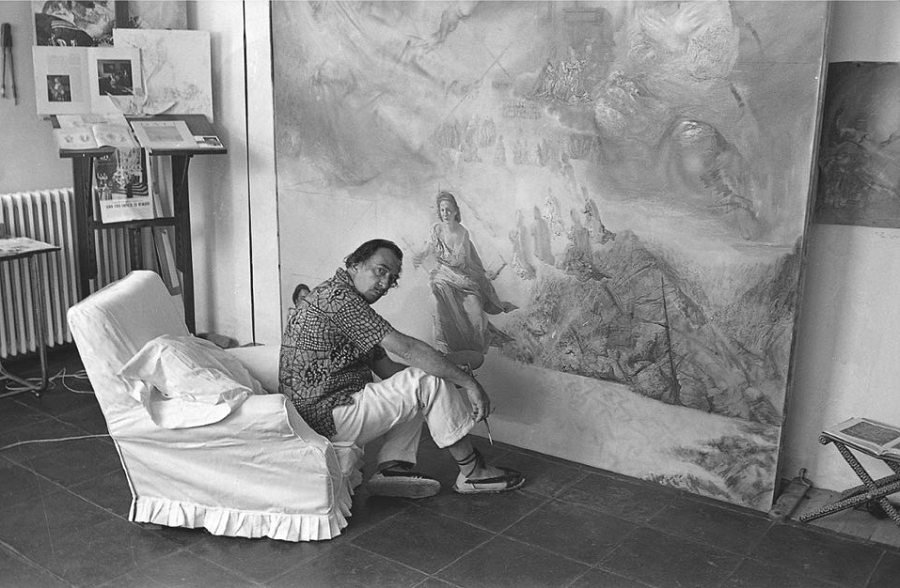
Salvador Dali in his studio at the Casa-Museo in Portlligat, 1969.
“I am surrealism”: this provocative statement was made by Dali in 1939, when he was expelled from the Surrealist movement by its founder, the poet and writer Andre Breton. This famous assertion expresses the egomaniacal and narcissistic character of the artist. Breton considered that Dali had moved away from the Marxist and revolutionary values of the group. In the reply the painter gave him emerges the ideal of transformation that Dali wanted to bring about, turning surrealism into a personal and vital attitude, independently of the objectives of this movement. He arrogantly declared that he embodied surrealism and placed himself above all doctrine.
The Surrealist movement, with which Dali identified, sought to surpass the limits of art. Founded in 1924 by Breton, it aimed to revitalize the imagination of Romanticism, but using the methods provided by Freud’s psychoanalysis. He believed that the unconscious, that hidden part of the mind, had much to say and that this material should be used as a means of artistic creation. The aim was revolution: that art should help to liberate the human being, even beyond what reason allows.
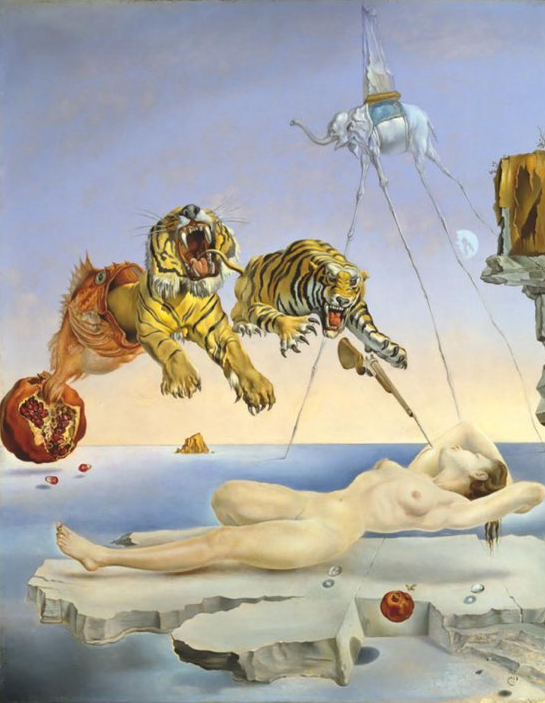
‘Dream Caused by the Flight of a Bee around a Pomegranate a Second before Awakening’. Salvador Dali, 1944.
Dali considered that the human gaze already carries an unconscious charge implicit within it. Therefore, it would not be necessary to deform reality to show its delirious force. And he thought that when images are rendered more realistically, the greater the power they attain. He thus developed, from Freudian theories, a technique he called the paranoiac-critical method, by which he transformed reality through delirious relationships and double images such as: Paranoiac Face (1935) or Face of Mae West (1935). This methodology was “a spontaneous method of irrational knowledge, based on the critical and systematic objectification of the associations and interpretations of delirious phenomena.”
In the work of the painter and writer from Figueras, his religious and erotic fantasies are manifested, but above all his well-known obsessions with the Catalan landscapes, with himself or with Gala, his wife and muse, whom he took from the French poet Paul Eluard, whom he married in 1932 and whom he came to mythologize lyrically in his autobiography “The Secret Life of Salvador Dali” (Dasa Ediciones). Of Gala he thought that when she came into his life, eternity became tangible, that she was not a woman but a cosmic event. She gave meaning to his existence, for before knowing her he considered himself a fragmented and frightened being, who did not feel that he lived in freedom: “Gala discovers and brings me all the essences that I turn into the honey of my thought, into the busy hive of my brain.”
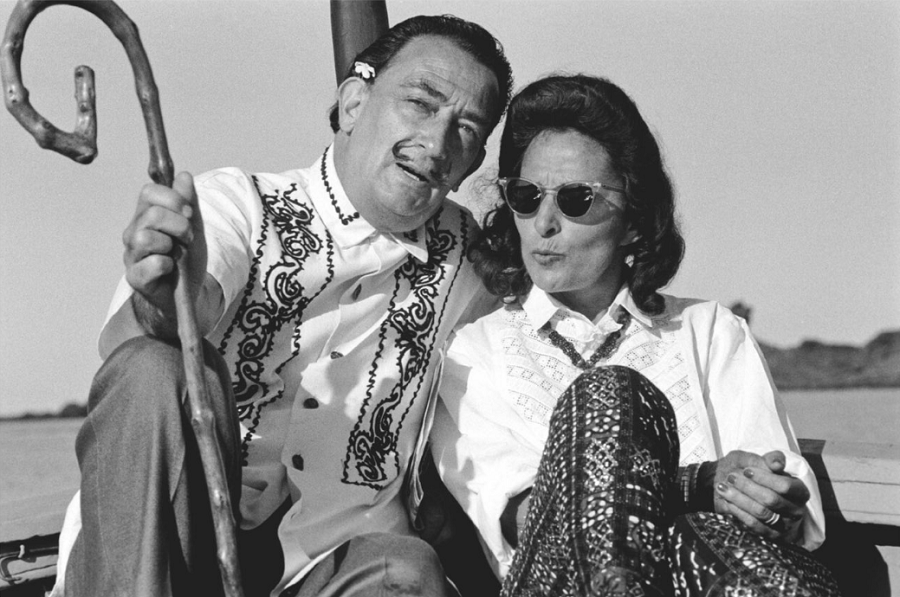
Salvador Dali and his wife Gala in Cadaques in 1960.
But if he was known for anything it was for his narcissism and his obsession with his genius, expressed in the public declaration: “Every morning when I wake up, I experience a supreme pleasure: that of being Salvador Dali.” His regard for himself was above everything else. He sought to provoke with his art, with words and public exhibitions, and became a brilliant revolutionary of 20th-century art.
– Salvador Dali: Surrealism Is Me – – Alejandra de Argos –