Anders Zorn: An Ode to Femininity
The MAPFRE Foundation devotes, in the Sala Recoletos, a notable retrospective to Anders Zorn, one of the great painters of the belle epoque. A master of watercolor, oil and engraving, the Swedish artist turned light and water into the protagonists of a body of work that celebrates femininity, nature and modern elegance. An exhibition that allows us to rediscover a cosmopolitan creator, deeply tied to his homeland.
One of the most interesting exhibitions of the season in Madrid comes courtesy of the MAPFRE Foundation. The Sala Recoletos hosts, from 19 February, the show Anders Zorn. Travel the World, Remember the Homeland, devoted to one of the most notable painters of the belle epoque, the Swedish artist Anders Leonard Zorn (Mora, Dalecarlia, 1860-1920).
He was a master of watercolor, oil and engraving. He painted what he saw with immediate fidelity, capturing the reality of his world through a command of natural light so extraordinary that it could define the luminist naturalism of his era. A limited palette with which he brilliantly achieved a coherent representation of light and atmosphere.
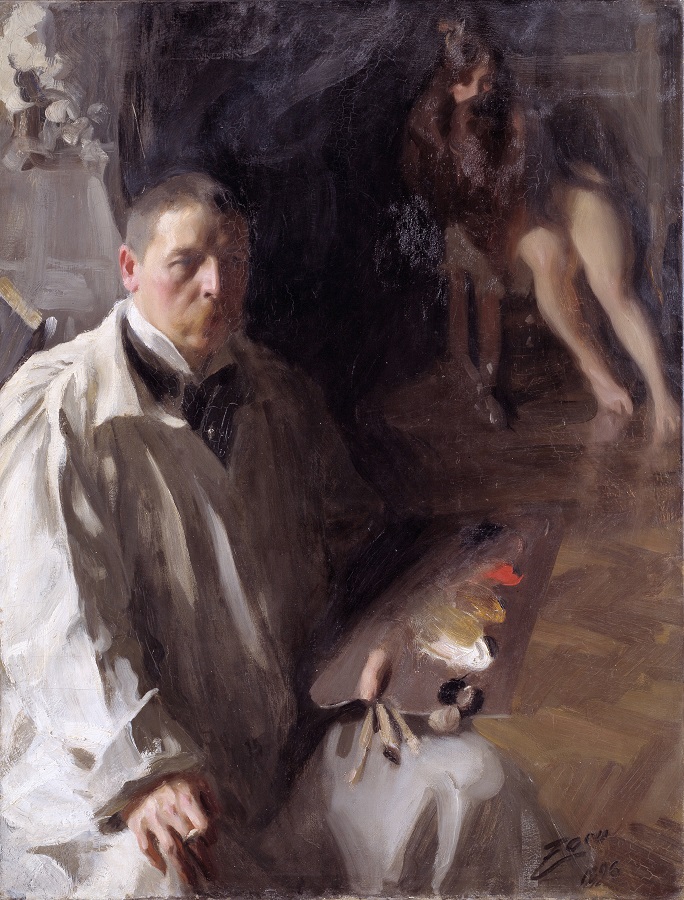
Anders Zorn. Self-portrait, 1896.
The life of Anders Zorn offers the keys, both to his artistic skill and to the themes he treated. He was born in 1860 in the Swedish region of Mora, where today one can visit his house-museum. His childhood, of humble origins, took place in a traditional rural environment, which imprinted his aesthetic sensibility tied to the landscapes of Lake Siljan, its forests, popular customs, agricultural work, religious festivities. After the death of his father, a Bavarian brewer whom he never came to know, he was surprised with a small inheritance that allowed him to improve his educational situation, later reaching a prominent position in the international art scene of the late 19th and early 20th centuries.
In 1875 he was admitted to the Royal Swedish Academy of Fine Arts in Stockholm. His initial intention was to devote himself to sculpture, but he soon turned toward watercolor. And in 1880 he obtained a first great success with In Mourning, exhibited in the student show and much sought after by collectors, including King Oscar II of Sweden.
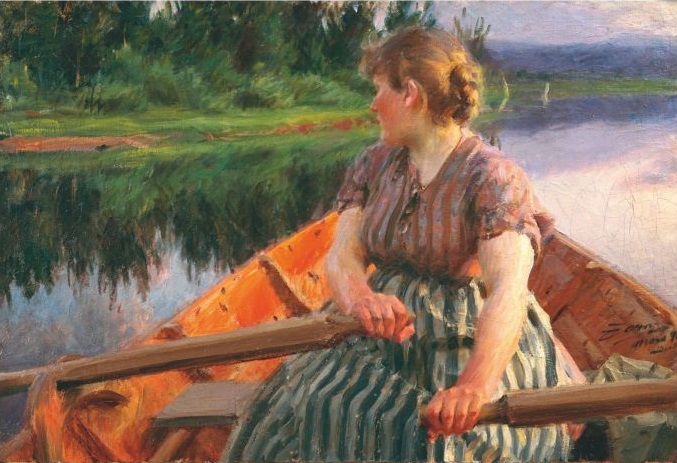
Anders Zorn, Midnight, 1891. Oil on canvas.
Zorn left the academy early. At the same time, he began a relationship with Emma Lamm, belonging to an upper-middle-class Jewish family from Stockholm. During these years he was influenced by the watercolor of Egron Lundgren, especially by his British tradition based on transparency and realism, although Zorn developed a more synthetic and innovative language.
Johan Cederlund, doctor of philosophy and director of the Anders Zorn Museum, in his book Anders Zorn Sweden’s Master Painter tells us how he spent six months in Spain, between Seville and Cadiz, where he painted watercolors of local scenes and of their women. When he arrived in Seville he wrote a letter to his future brother-in-law, Hugo Geber: “Here it is hot, there is sun, pretty girls and picturesque beggars, a paradise for painters”. One of the works of this period, The Cousins, was accepted at the Paris Salon of 1882, which marked his first international recognition.
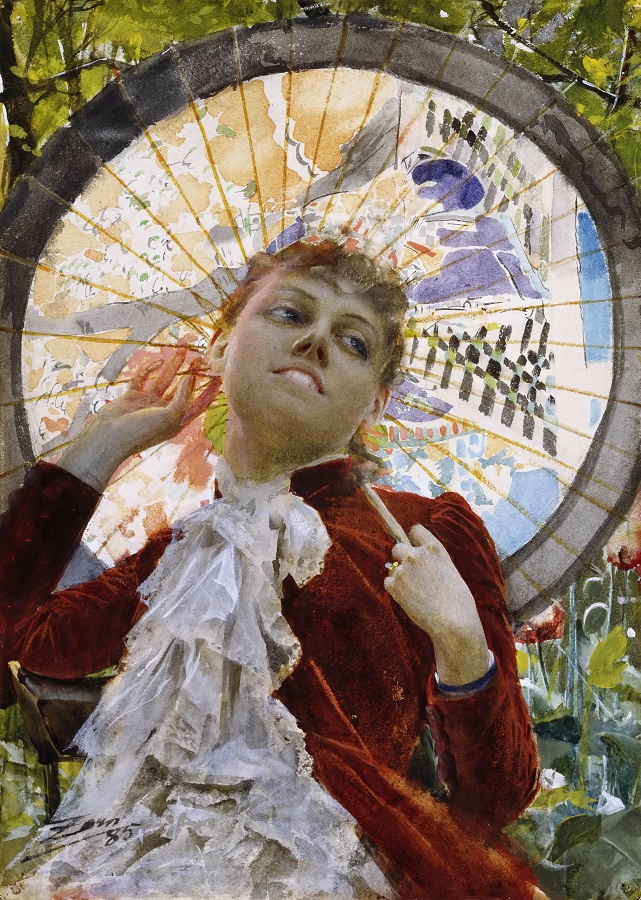
Anders Zorn. Castles in the Air, 1885.
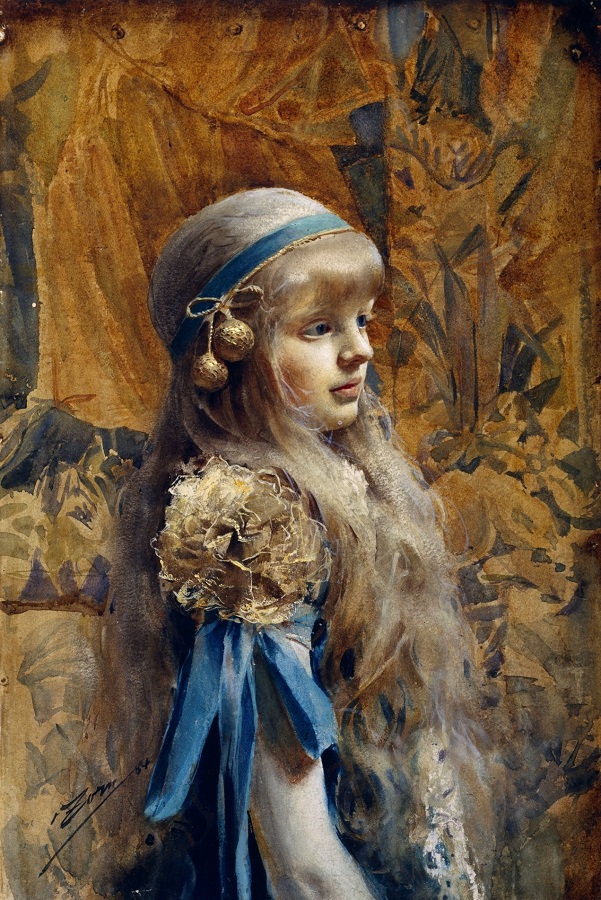
Anders Zorn. Portrait of Cristina Morphy, 1884.
That year, Anders Zorn settled in London, where Cederlund tells us that, installed in Mayfair, he began to receive portrait commissions, first from the Swedish colony and later from British and American clients. In 1884 he made a new trip to Spain and, with the beautiful portrait of Cristina Morphy in Madrid, demonstrated that watercolor can compete with oil in result.
In 1885 he returned to Sweden and married Emma Lamm, who would be his great intellectual support and a fundamental figure in managing his career. They traveled to Constantinople for their honeymoon, where Zorn suffered a serious illness. Once recovered, they traveled through Europe, North Africa and Spain. A painting that represents the painter’s virtuosity is Summer Vacation, (1886). Anders was enjoying his first summer, newly married to Emma, in Dalaro, in the Stockholm archipelago. In this Nordic atmosphere, water is the protagonist of Zorn’s skill in the treatment of light.
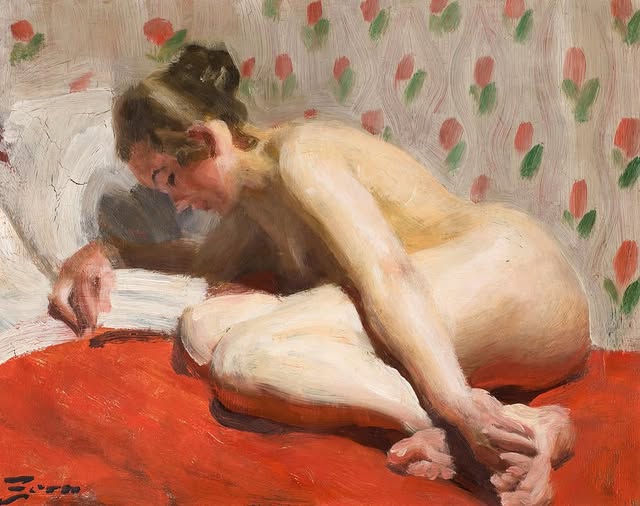
Anders Zorn. Study of a nude, 1881 to 1882.
The luminous reflections on the silvery water and the rower give movement to the poetic scene, in harmonious tension with the serene stillness of the woman in white.
The sea took Zorn to Cornwall and he began to paint in oil regularly. He painted Fishermen in St Ives, which obtained international recognition when it was acquired by the French State after the Paris Salon of 1888. In this way, his place was Paris, where he took part in the Universal Exhibition of 1889 and received the Legion of Honor. His painting was not immune to the influence of certain elements of impressionism, but always maintaining its formal construction.
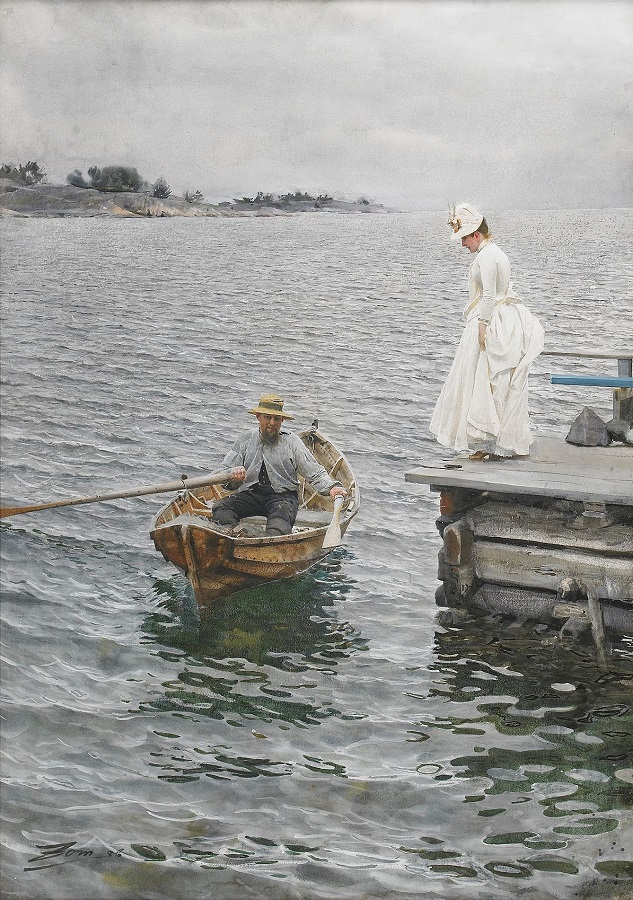
Anders Zorn. Summer pleasure, 1886.
Toward the end of the 1880s he became known for his open-air nudes, far from any mythological reference, centered on the relationship between the female body, light and the natural environment. During the 1890s he reached his greatest recognition as an international portraitist, especially in the United States, and developed in parallel a notable graphic body of work. In 1896 he returned definitively to Mora, where he combined his artistic activity with an intense cultural and heritage commitment that culminated, after his death, in the creation of the Zorn Museum.
– Anders Zorn: An Ode to Femininity – – Alejandra de Argos –