Man Ray: Lights and Dreams
“Man Ray: Forms of Light”, the new exhibition at the Palazzo Reale in Milan, reveals the essential figure of the artist who redefined photography and the avant-garde of the 20th century. Through rayographs, solarizations and objects charged with Dada wit and surrealist spirit, the show illuminates Man Ray’s experimental power and his still-current legacy, in dialogue with the parallel exhibition at the Met in New York. His life, marked by innovation, aesthetic rebelliousness and the influence of women such as Kiki de Montparnasse and Lee Miller, reveals a creator who turned light into language and imagination into form.
The Palazzo Reale in Milan has just opened the great exhibition of the season, “Man Ray: Forms of Light”. This important retrospective devoted to the American artist Man Ray (1890-1976) offers us a broad view of his biography and artistic career. And it highlights the relevance of his work’s legacy with the simultaneity of another great exhibition at the Metropolitan Museum of Art in New York, “Man Ray: When Objects Dream”. The title of this exhibition comes from the Dada poet Tristan Tzara, who used it to describe the rayographs, a term coined by Man Ray in 1921 to designate his emblematic version of the 19th-century technique of making photographs without a camera. These photograms generate hypnotic images, imbued with mystery, that highlight the innovative energy of their creator. The same spirit also led him to the manipulation of objects, light and media, experimenting with solarization, which gave the photographed figures a spectral halo.

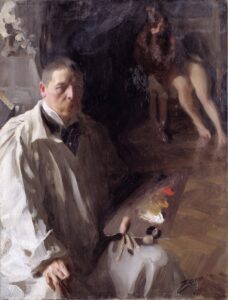
Self-portrait, 1931.
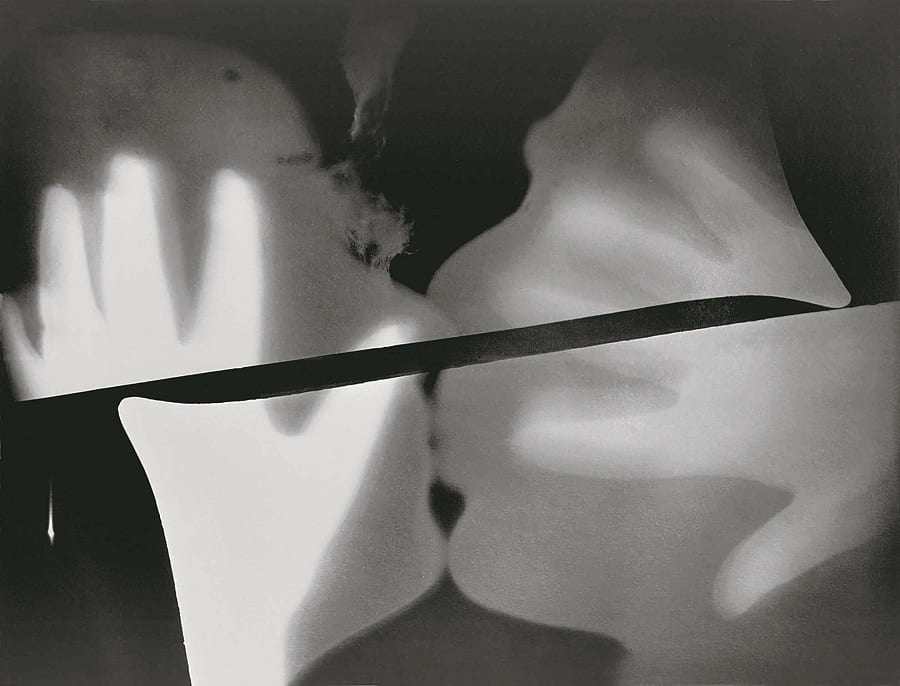
Rayograph (The Kiss), 1922.
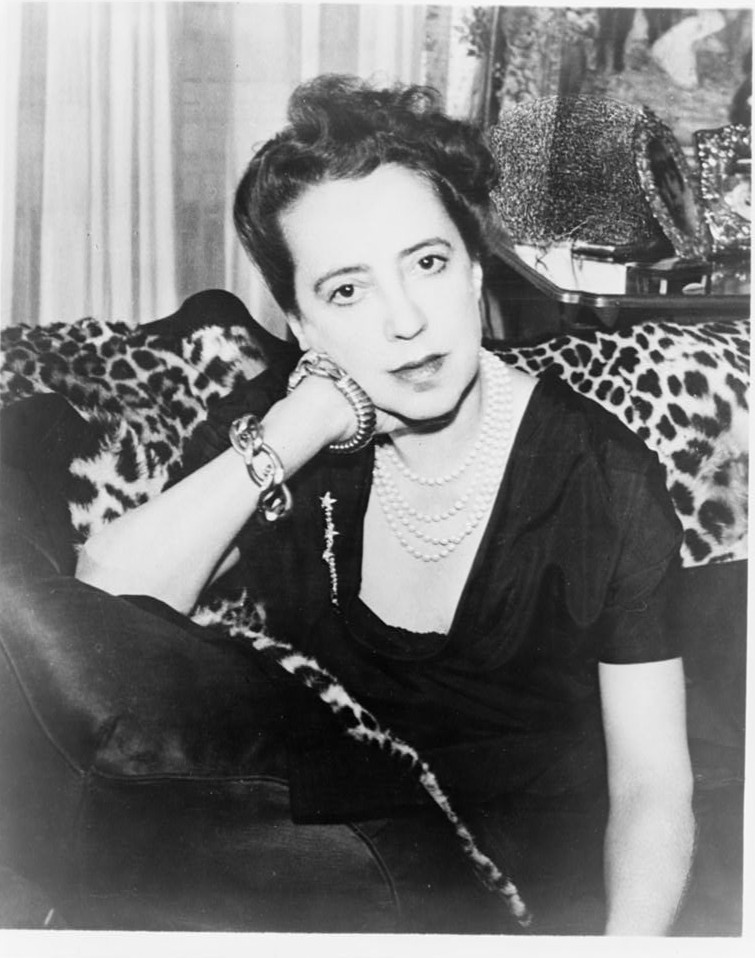
The Met exhibition has the support of the maison Schiaparelli, highlighting Man Ray’s ties with fashion and his close artistic and personal relationship with Elsa Schiaparelli. Their collaboration in Paris erased boundaries between design and visual art, and today the firm keeps that creative heritage alive.
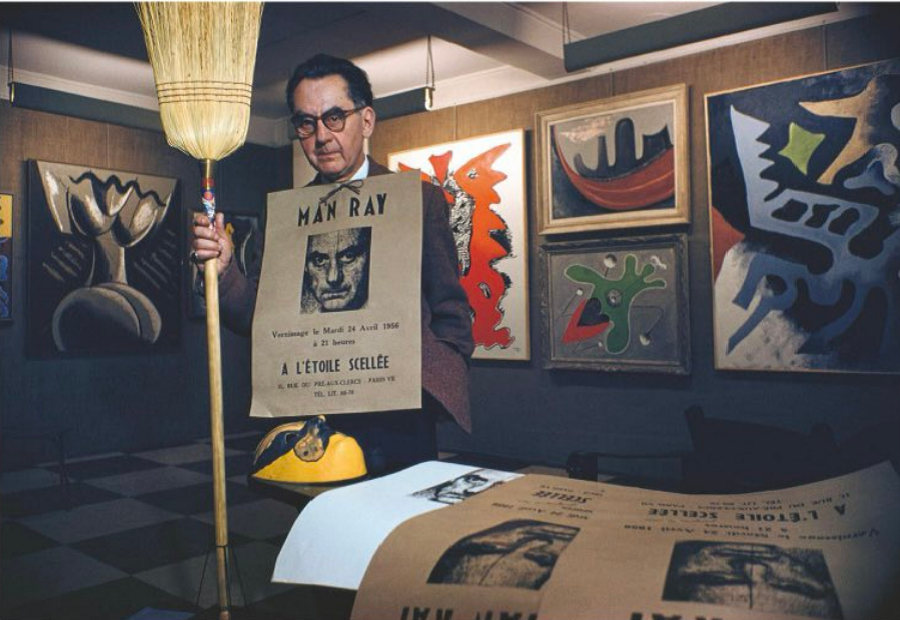
Man Ray in his studio in Paris, 1956.
Man Ray was born in Philadelphia as Emmanuel Radnitzky; he was the son of Russian Jewish immigrants and, to avoid the antisemitic discrimination of the time, the family changed the surname to Ray. He studied in New York, where he became familiar with the European avant-garde movements and struck up a close friendship with Marcel Duchamp, with whom he opened the way to Dadaism in the United States. Dadaism emerged in 1916 in Zurich, at a turbulent moment in Europe. With a nihilistic spirit and a negationist attitude, they sought to destroy all values, the artistic ones too. This led them to go further than any other artistic movement, in which the author arbitrarily decided an object that became a work of art, such as “Fountain”, Marcel Duchamp’s famous urinal. When Man Ray arrived in Paris in 1921, Duchamp was already there and introduced him into all the circles. He was immediately welcomed by the Dadaists led by the Romanian Tristan Tzara. Later he would strengthen ties with the members of the surrealist circle, such as the poets Paul Eluard or the founder of Surrealism Andre Breton in 1924, creating an alternative to the empty and finished protest of Parisian Dadaism.
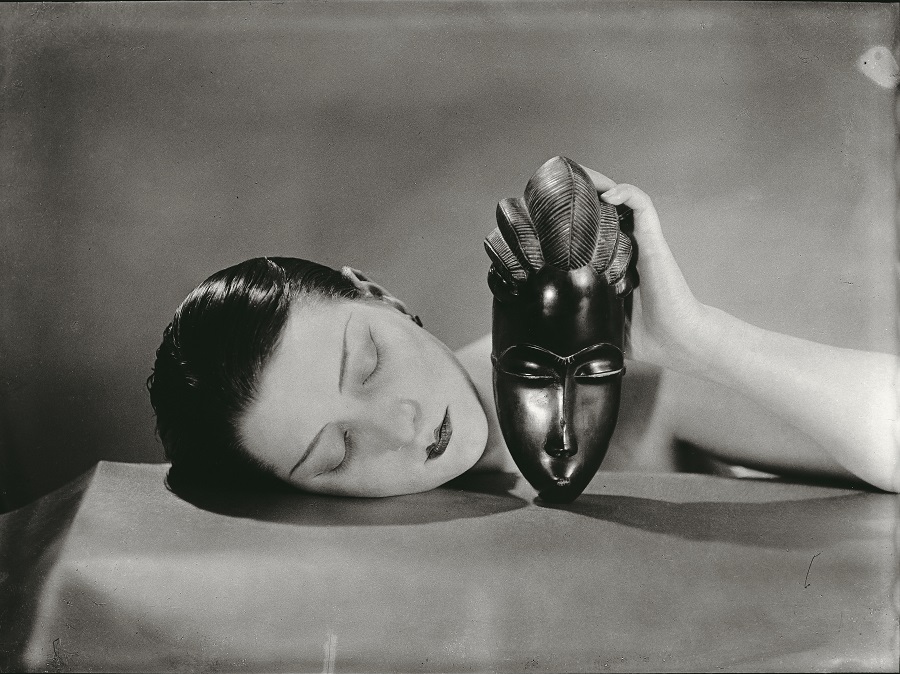
“Black and White”, 1926.
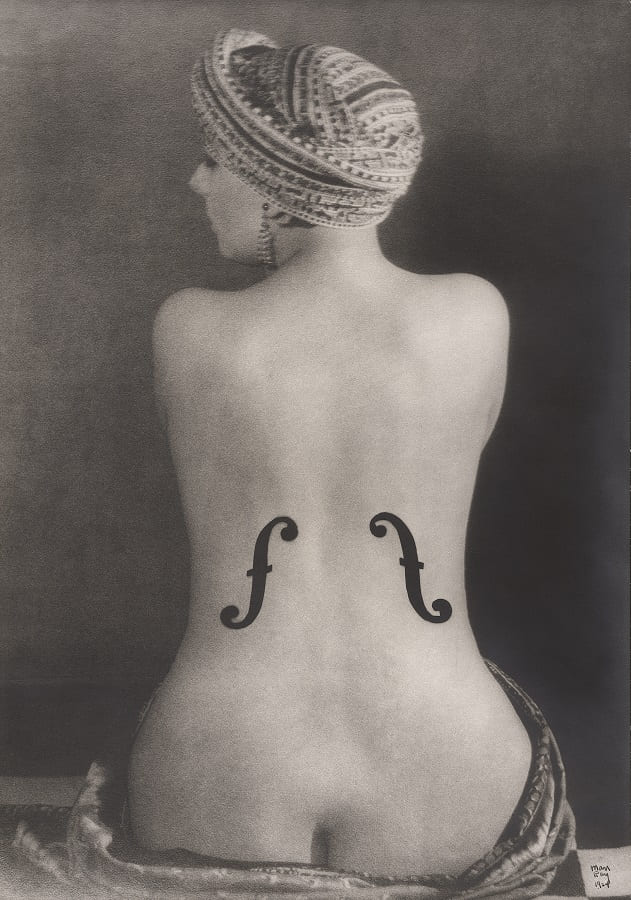
“Ingres’s Violin” (Le Violon d’Ingres), 1924.
Man Ray, one of the most influential visual artists of the 20th century, was a painter, photographer, creator of object-sculptures of Dadaist spirit, such as the iron with nails titled “Gift”, and an experimental filmmaker. He was always at the avant-garde as a pioneer of new visual languages, leaving for the History of Art photographs as iconic, elegant and immortal as “Ingres’s Violin” or “Black and White”, of his lover and muse, the French singer and model Kiki de Montparnasse (Alice Prin), with whom he lived in his Parisian studio in the 1920s. In 1929 he met another of his great muses, the American model and also photographer Lee Miller (1907-1977), who became his romantic partner and source of inspiration until 1932. Later this relationship was transformed into a deep friendship that would last until Man Ray’s death. With Lee there was a close creative collaboration that gave rise to emblematic photographic creations such as “Tears”, which shows Lee Miller’s eyes. When they separated, fundamentally over disagreements about the authorship of the reinvention of the photographic technique of solarization, Lee returned to New York and created a photographic studio. She became a fashion photographer, contributed notably to art with her surrealist experimentation and became the first war reporter for Vogue magazine, documenting events such as the liberation of Paris, of the Nazi concentration camps and of other historic moments. Being an eyewitness to the horrors of the Second World War produced in Lee post-traumatic stress and depression, from which she would never recover.
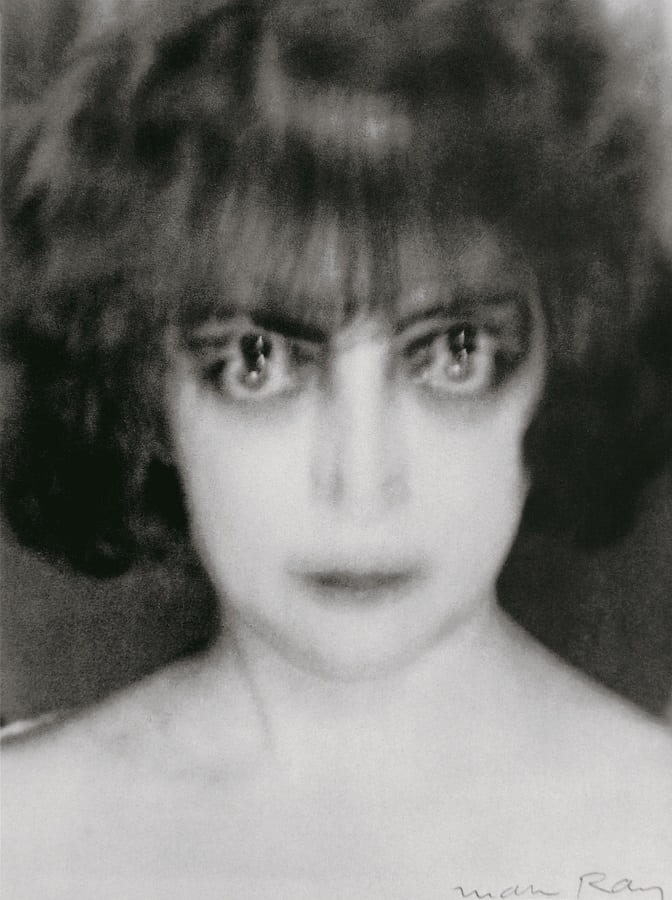
Marquise Casati. “The Portrait of My Soul”, 1922.
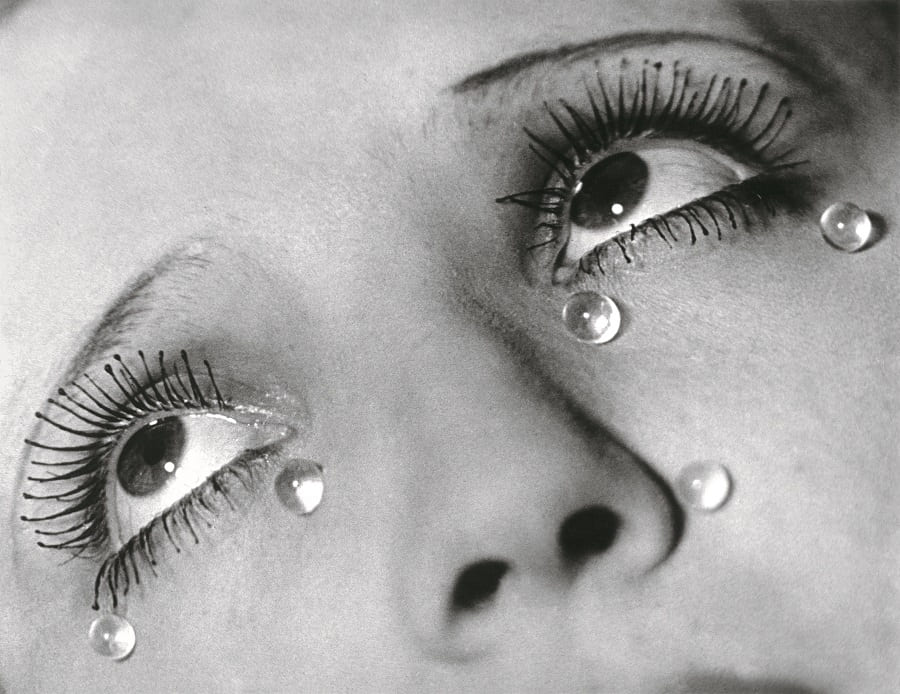
“Tears”, 1932.
In 1940 Man Ray returned to the United States, to come back again to Paris in 1951. In 1946 Man Ray married the American dancer and model Juliet Browner, with whom he would live until his death in 1976. In a 1972 interview given to Keith Dewhurst, his last question was: Looking back on your life, what would you say has given you the most satisfaction? To which Man Ray replied: I think women.
– Man Ray: Lights and Dreams – – Alejandra de Argos –