The Eternal Return of Anselm Kiefer
“Anselm Kiefer. Fallen Angels” has just opened in Florence, an important exhibition by the German artist Anselm Kiefer (1945). His monumental work is confronted with the Renaissance spirit of the Palazzo Strozzi. This palace of Florentine pietraforte stone, inspired by Greco-Roman architecture, will house, until 21 July, a show curated by the historian and art critic Arturo Galansino, composed of paintings, sculptures, installations and photographs.

Anselm Kiefer. Fallen Angels at Palazzo Strozzi.
“Anselm Kiefer. Fallen Angels” has just opened in Florence, an important exhibition by the German artist Anselm Kiefer (1945). His monumental work is confronted with the Renaissance spirit of the Palazzo Strozzi. This palace of Florentine pietraforte stone, inspired by Greco-Roman architecture, will house, until 21 July, a show curated by the historian and art critic Arturo Galansino, composed of paintings, sculptures, installations and photographs.
The intellectual heritage of this visual artist is as boundless as his work. Reading is his main source of inspiration and his interests range across mythology, the Catholic religion in which he was educated, but also the Jewish mystical texts, which aroused great interest in the author when he felt the need to know about the past of his native Germany, at a time when memory wanted to be buried. Philosophy, history, alchemy, science, literature and poetry inspire his work and his thought. All this is reflected in this exhibition with infinite meanings. For Kiefer, art intervenes when the debate is open to different opinions and concepts.
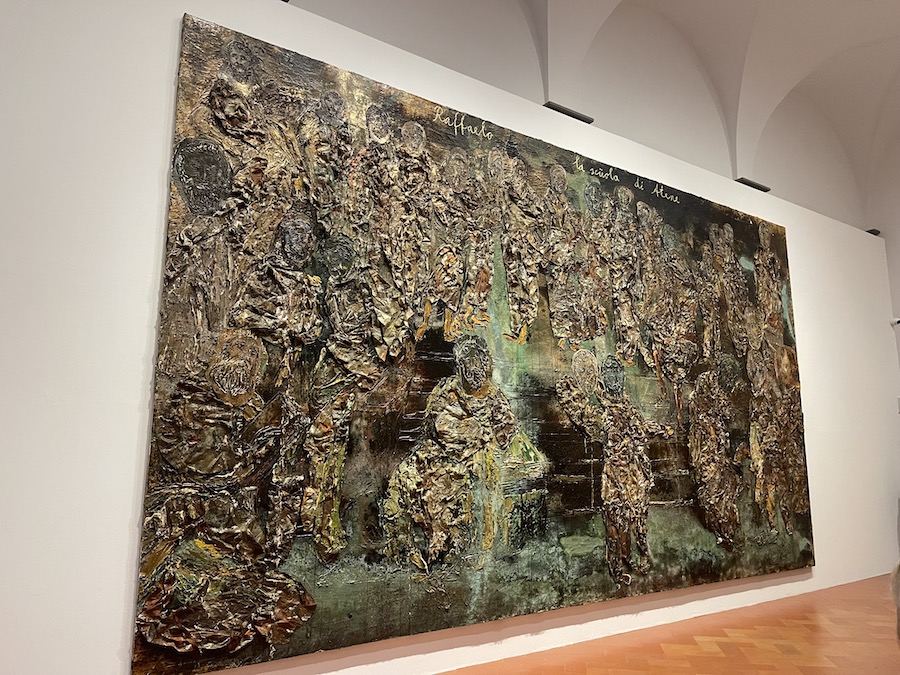
In the lessons that Anselm Kiefer gave in Paris in 2011, invited by the prestigious College de France, in his inaugural lecture he begins by explaining the difficulty of trying to define what art is. Kiefer says in it that there is no definition of art. If we try to delimit its boundaries with words we run the risk of impoverishing it, of pacifying it, of making it harmless. And art must act according to its own criteria, it must be subversive, be a nuisance. It must also ask about the great questions of existence; it is not mere entertainment, it is something uncomfortable: “After all,” he says, “the artist produces meaning in an ocean of absurdity. He does so by transforming the ugliest and most trivial things into splendor…”
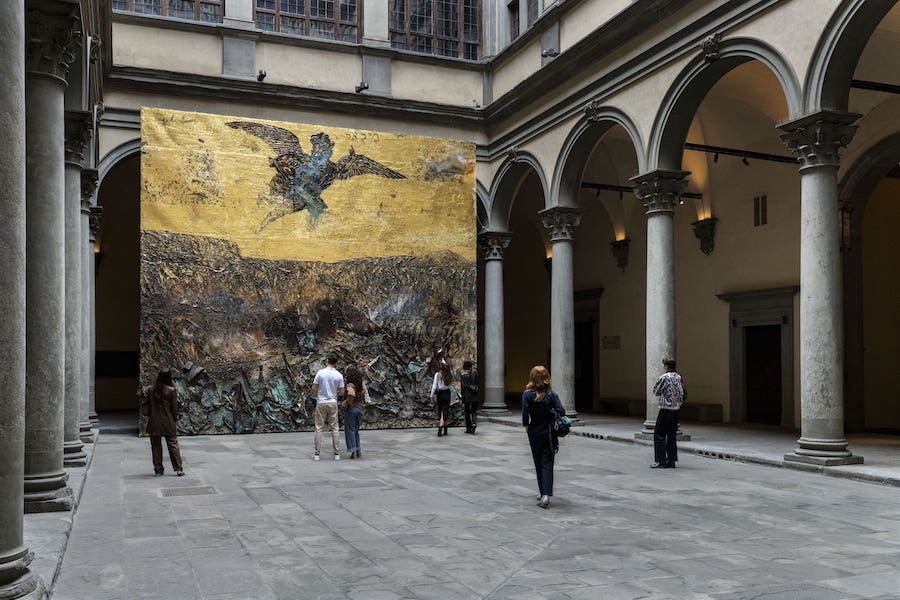
With this idea we enter “Fallen Angels”, a monumental work of 750×840 cm, created specifically for this space, which greets us in the porticoed courtyard we reach after passing through the entrance arcade of the Palazzo Strozzi. It alludes to the passage of the Bible in which the angels are expelled from Paradise for rebelling against God, but the lower part of the painting represents humanity. Our human condition is what this symbology conceals, and it centers Kiefer’s interest on theodicy and the problem of evil: how an omnipotent and benevolent God can allow the evil of the world.
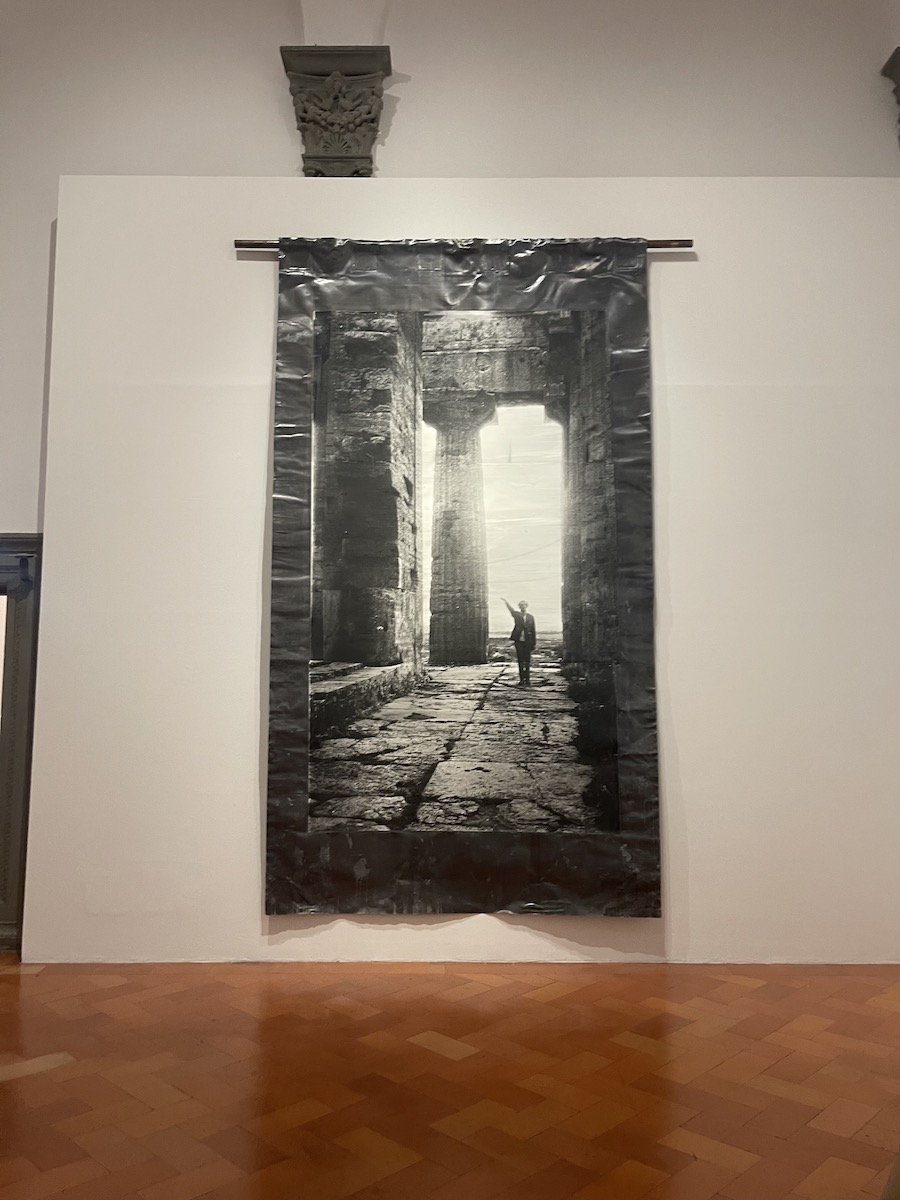
For Kiefer, art does not progress as science does, so that a work of our time does not have to be more advanced than one of the Renaissance. Past, present and future merge in this exhibition where time has never been understood by him in a linear way but a cyclical one, like an eternal return to the past and to memory. This concept comes from the Eastern way of understanding time, the world and, with it, each instant, each event will repeat itself where it is extinguished only to be created again. For Kiefer, memory creates the new. And memory is in the enormous quantity of diaries, writings and reflections of this artist.
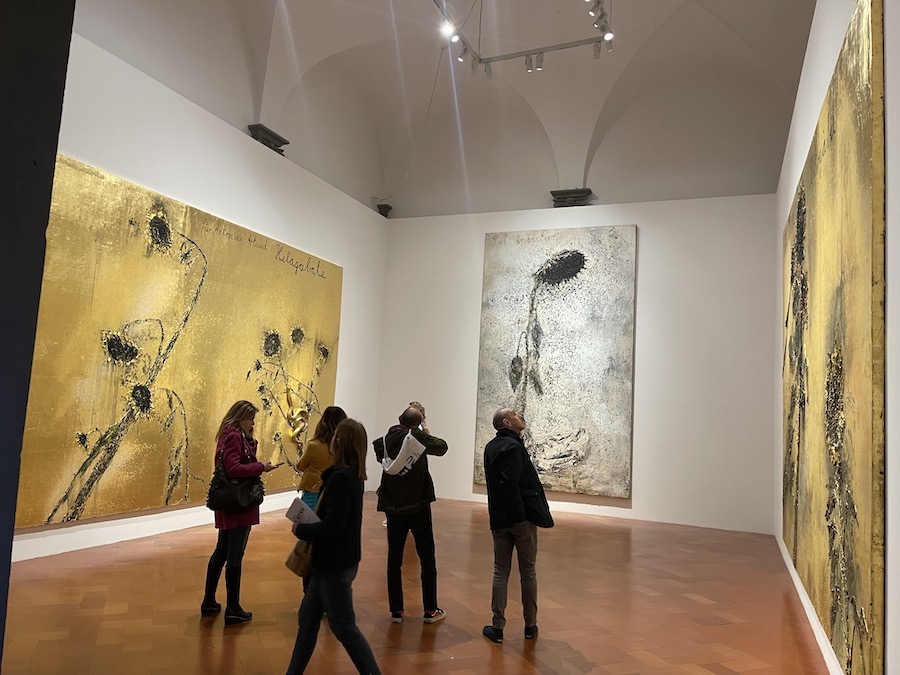
To see an exhibition by Kiefer is much more than an aesthetic experience. His works symbolize his thought, a reflective thought that has its sources in books. Knowledge and poetry are the engine that ignites his works. For Kiefer, “art and poetry are the only reality in our lives, the rest is pure illusion. It is the anchorage in the infinite void.” For his creative and destructive process (both joined together) to be set in motion, there has to be something that does violence to his thought. His work is in a perpetual state of evolution, it is never finished. Kiefer explains that he returns to his works, brings them out of the darkness and gives them a new light, new states. The vibration for his works only ends when the works leave the studio, when he can no longer return to them. His work is widely recognized, but his thought and his writings are brilliant and can only produce admiration and respect in all those interested in knowing what art is and what an artist is.
– The Eternal Return of Anselm Kiefer – – Alejandra de Argos –