

High-Flying Art: Prehistoric Paintings Found at 2,200 Metres of Altitude
Researchers from the High Mountain Archaeology Group have located the highest cave paintings in the Iberian Peninsula in two rock shelters of the Ordesa and Monte Perdido National Park (Huesca).
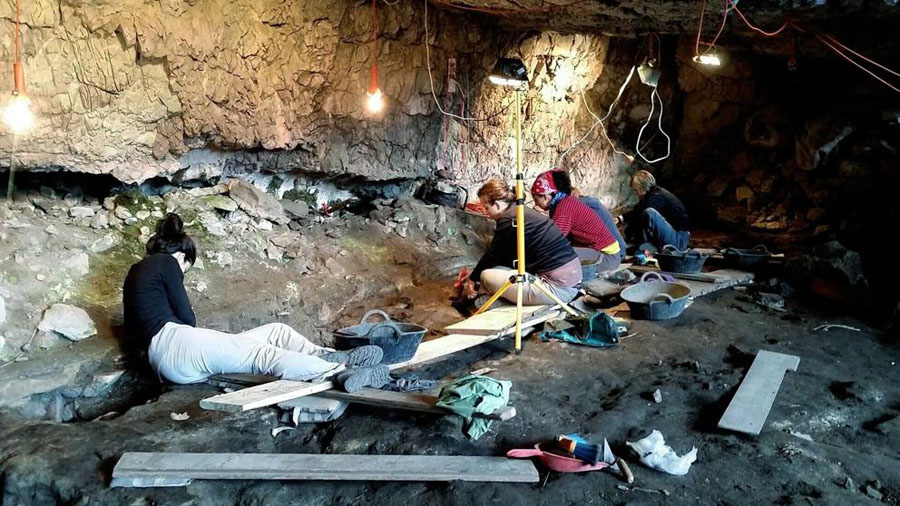
Group of researchers working in the rock shelters of the Goriz Valley, Huesca. E. Gassiot – EFE. On lavanguardia.com
In the summer of 2018, the High Mountain Archaeology Group (GAAM) began to entertain the possibility of finding prehistoric paintings at an altitude that until now had been considered, to say the least, improbable. The suspicions have been confirmed in early spring 2019: the researchers of the GAAM have found cave paintings located at an altitude of 2,200 metres, the highest recorded to date in the Iberian Peninsula. The artistic representations are in the Huesca Pyrenees, specifically in two rock shelters of the Goriz Valley. The site lies within the Ordesa and Monte Perdido National Park, located in the province of Huesca, where since 2015 the research work directed by Javier Rey, Ignacio Clemente and Ermengol Gassiot has uncovered numerous examples of prehistoric art.
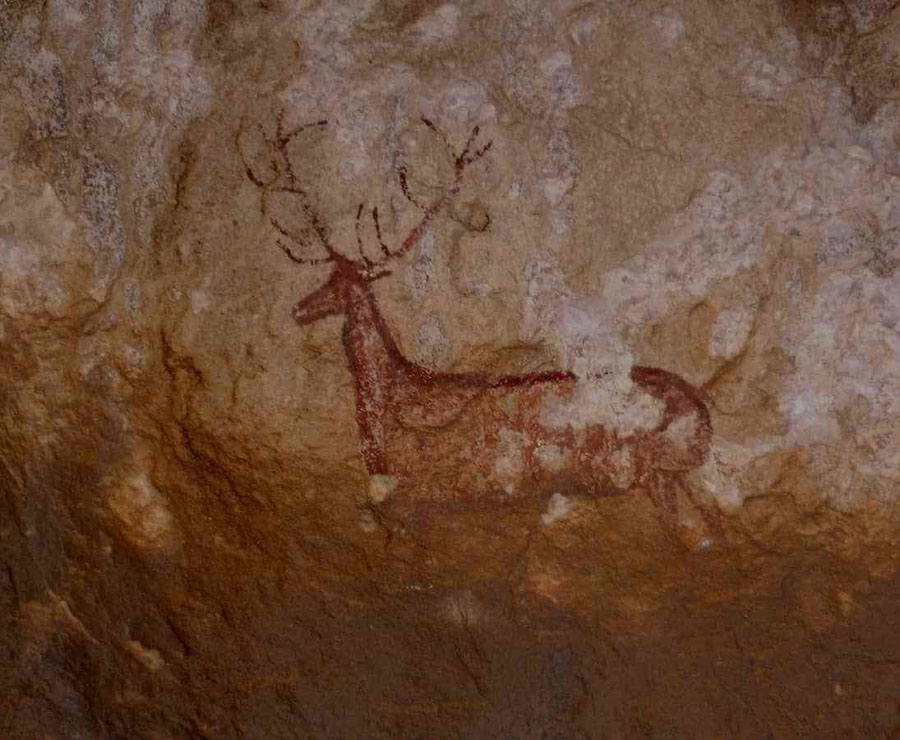
Depiction of a deer in the Colungo paintings (Sierra de Guara, Huesca). On estrelladigital.es
The artistic representations belong to what is known as the “schematic style,” characterised by figures rendered with basic strokes in red, depicting hunting scenes, groups of people, animals and symbols. A magnificent example of this style (also located in the Huesca Pyrenees) are the paintings of Colungo, a village in the Sierra de Guara on the banks of the River Vero. The representations found in the rock shelters of the Goriz Valley do not reach the quality of those of Guara, but they serve to further attest to the presence of human beings in high-mountain locations since prehistoric times. Until now, the highest altitude recorded for cave paintings in the Iberian Peninsula was 1,650 metres, corresponding to the paintings of Fanlo, also situated in the Sobrarbe region (Huesca). The new paintings belong to the Rock Art of the Mediterranean Basin of the Iberian Peninsula, which encompasses all the examples of prehistoric art located in the Spanish Levante.
You may also like
 The Museo Picasso de Malaga Opens the Largest Bruce Nauman Retrospective in 25 Years
 “Ciudadanos” by Simon Schama. A Chronicle of the French Revolution
 “Historia y arte de la mirada”. Mark Cousins Takes Up the Baton from John Berger
 “Filosofia y ficcion”. Reflections and Stories by Ignacio Gomez de Liano
 “Eter”: Anka Moldovan Exhibits Her Latest Work in Mieres
 Cristina Iglesias Creates a Site-Specific Work for the Royal Academy of Arts