Miguel de Unamuno: A Philosophical Approach
The thought of Miguel de Unamuno revolves around the concrete human being, the person of “flesh and bone,” and his anguished struggle between reason and life. From the craving for immortality to faith as a creative impulse, his philosophy turns contradiction into a vital engine, proposing a way of existence that finds meaning in tension, doubt and the desire to endure.
The starting point of his philosophizing: the man of “flesh and bone”
How should one begin a philosophical approach to Don Miguel de Unamuno (1864-1936)? Perhaps one of the fundamental traits of his philosophy, contained chiefly in his 1913 book The Tragic Sense of Life in Men and Nations, lies in its being neither abstract nor systematic, but concrete and human, and as such always written for a man of flesh and bone. Let us take this center of gravity: philosophical practice always refers back to a vitally rooted form of writing, set out from an exposed and contradictory “I,” at times pathetic and exasperated, and only from that angle should it aspire to address its readers, in order to move them, to spur them to act and take charge of their own destiny. In the words of the professor of Greek and, by then, rector of his beloved University of Salamanca:
Philosophy is a human product of each philosopher, and each philosopher is a man of flesh and bone who addresses other men of flesh and bone. And whatever he may do, he philosophizes not with reason alone, but with the will, with feeling, with the flesh and with the bones, with the whole soul and with the body the man philosophizes (Unamuno, 2004a, 297).
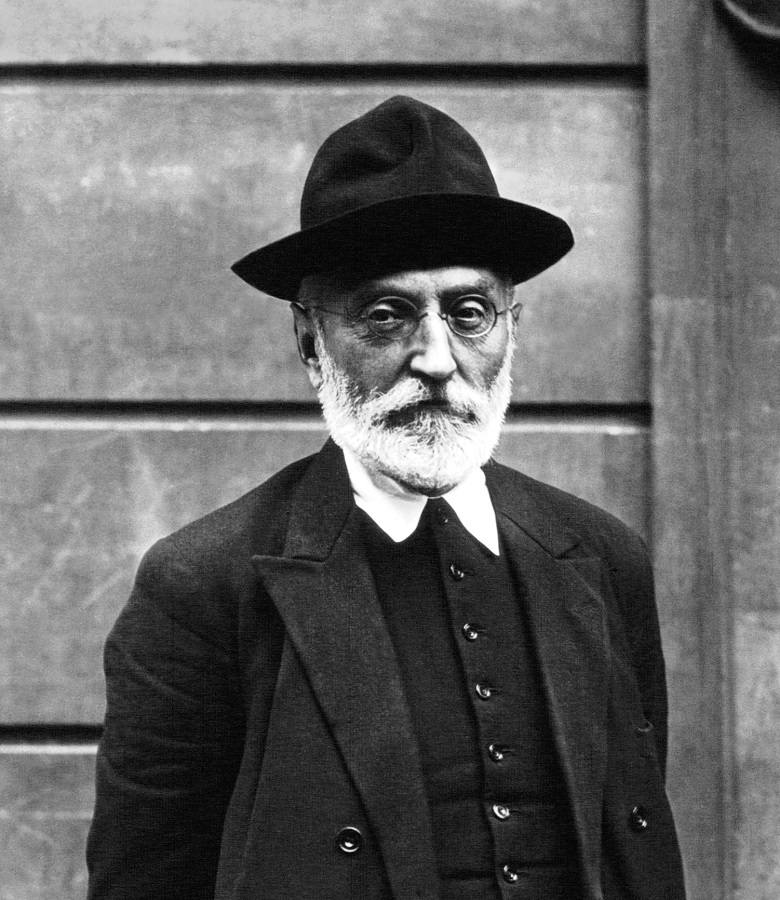
Miguel de Unamuno, photographed in 1925.
Those who have seen in Unamuno a forerunner of existentialism, in the sense that existential concerns -the finitude and anguish of existing- acquire an undeniable centrality, are not mistaken. Nor are those who emphasize his unbending individualism; for, as against the abstract subject, his philosophy starts from the incontrovertible existence of the individual “who is born, suffers and dies -above all, dies- who eats and drinks and plays” (ibid., 275). He therefore does not think about man in general, nor about the human species, but concerns himself with the finite and unrepeatable individual, just as he feels and experiences himself in existing: feeling himself to exist, irreplaceable. That concrete human being is the true subject of history, the temporal stage on which he stakes his whole existence, an existence that springs from a single source: life, understood as aspiration and desire.
In this first center of gravity, Unamuno’s teaching is provocative, because the image of the philosopher and of his task is overturned: it is from that irreducible fact of our singular existing that we philosophize, with our whole being. We think -that is, we philosophize- in order to live. Consequently, this philosophizing of the individual also springs, as a human product rooted in his concrete situation, from a particular feeling about life, from a ground that is not only rational but volitional and unconscious, always contradictory and paradoxical, because philosophy is an expression of life: “Our philosophy -that is, our way of understanding or not understanding the world and life- springs from our feeling toward life itself. And this, like everything affective, has subconscious, perhaps unconscious, roots” (ibid., 276).
The fundamental problem: the craving for immortality
And yet, what is the aspiration of that concrete human being? Unamuno will locate it in a vital craving, a “hunger for immortality”, a central motif of his philosophy, but visible too in many of his finest novels, from Augusto in Mist (1914) to Don Manuel in Saint Manuel Bueno, Martyr (1931), by way of Gertrudis in Aunt Tula (1921). Studying it from countless angles, the Bilbao-born thinker stresses that this craving for personal immortality has its origin in the individual experience of death, an unconquerable obstacle from which there is no fleeing or looking away; not for nothing does death belong to the intrinsic horizon of human living, to the feeling that the flow of time inexorably drags our being along.
Although obsessive, at times anguished, Unamuno’s attitude toward death never issues, however, in a nihilistic pessimism, as in Schopenhauer, but in the defense of a transcendent pessimism. Despite the anguish of our consciousness when it represents to itself the annihilation of our “I,” despite the fear of being left suspended over the abyss of nothingness, the enigmatic constancy with which we long not to die is significant: “to persist indefinitely in our own being” (ibid., 304), as Spinoza had already intuited with his conatus. This yearning to survive after death, which has taken on countless practices, languages and cultural expressions, is for Unamuno the starting point of all action of the human being who seeks “to know what for” (ibid., 300), revealing an ontological avidity by which the very essence of our being consists in willing to persevere; but also a universal longing, by virtue of which each thing in the universe longs to be everything in everything for ever and ever.
At bottom, this pessimism never gives up being hopeful: to affirm personal immortality means, for Unamuno, to root it in feeling and in the affections, in the bodily dimension, as the irrational impulse of life to be more life, to its increase and perfection, so that life unfolds in its dimension of totality and infinity: as an undemonstrable postulate, it can only be posed existentially, sought passionately. In this passionate search Unamuno attained an undeniable mastery, and he did so by cultivating numerous registers, through a writing as prolific as it was unmistakable, alternating the essay and poetry, the novel, the short story and the theater, as well as literary criticism, journalism and letter-writing; without aiming to be exhaustive, let us trace a few of the paths of this search.
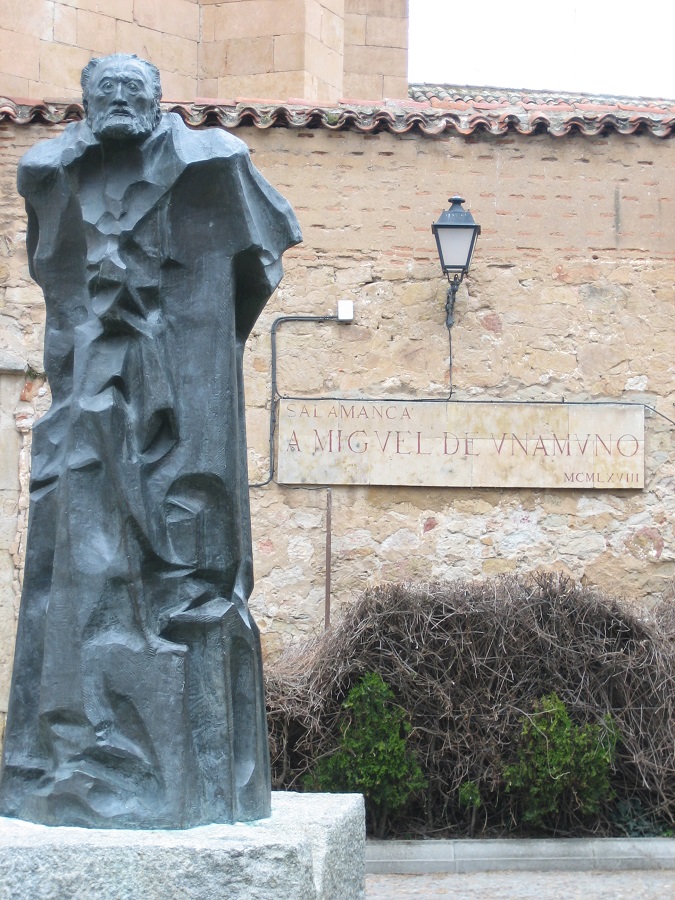
Sculpture of Unamuno in Salamanca by the artist Pablo Serrano (1968).
On tragic agonism, or how to live at the bottom of the abyss
True to an agile and nervous, direct and impulsive style of writing, Unamuno has gone down in history as a thinker of dialectical temperament, and also as a declared lover of contradictions and paradoxes. His discourse, which had much of the dramaturgical about it, liked to stage tensions and confrontations in order to illuminate how the human condition of the fin de siecle found itself installed in a tragic situation. Now then, in what did the dialectic of that existential tragedy consist?
To begin with, within man he detects a harrowing conflict: on the one hand, the desires of his heart, whose chief engine is not to die, and, on the other, the empire of reason, which relies on science to declare that this hunger for immortality is impossible to satisfy. Even if it is a somewhat well-worn image in our intellectual tradition, we might appeal here to the fundamental antagonism between reason and life, an inevitable struggle which for Unamuno makes up the tragic sense of life: between the heart, which aspires to immortality, and the head, which ceaselessly denies that longing.
Endowed with a special sensitivity toward the limits of modern reason and the idolized role of science as an impulse and a passion for knowledge, Unamuno never tired of denouncing the intellectualism and overwhelming scientism of his age, as reductive as it was sterile, which he would define as a sickness. Intellectually formed in his youth under the prevailing rationalism and positivism, he vehemently challenged the concept of reason that emanated from that paradigm: the instrumental reason of science reduced to pure analysis, confined to the universe of facts and their relations, which leads to a skepticism contrary to life: “everything vital is anti-rational, and everything rational is anti-vital, because reason is essentially skeptical” (ibid., 347), his motto will run. Incapable of penetrating life, he granted it a power of dissolution, placing it at the margin of the demands of life; indeed, by “setting itself against this our longing for personal immortality […] reason is the enemy of life” (ibid., 346), given its inability to fulfill our affective and volitional aspirations, denying us all consolation. In decreeing the impossibility that our existence be eternal, it is even the least consoling faculty of all, leading to absolute despair.
For this reason the agreement between reason and life is irresolvable, hence its tragic character. There is no solution, nor mediation, nor dialectical synthesis: “its only formula is all or nothing” (ibid., 361). The tragedy occurs without remedy:
The tragic history of human thought is nothing but the history of a struggle between reason and life -the former bent on rationalizing the latter, making it resign itself to the inevitable, to mortality; and the latter, life, bent on vitalizing reason, forcing it to serve as a support for its vital longings (ibid., 367).
How can we avoid succumbing to an absolute skepticism, to the nihilistic idea that after my death nothing in me will survive? A question as modern as it is pertinent, before which Unamuno invites us to inhabit the uncertainty that constitutes us: we must descend to the bottom of the abyss, and learn to live there. “Not to make peace between my heart and my head, between my faith and my reason -rather I want them to fight and deny each other, for their combat is my life”, he wrote in his unpublished My Confession of 1904 (Unamuno, 2015, 31). We must therefore turn that agony, in the etymological sense of “struggle,” into the condition of our spiritual life, and accept the relentless conflict between reason and life, recognizing it within ourselves: “one must accept the conflict as such and live in it” (Unamuno, 2004a, 375). Accepting the conflict in no way means passive resignation or surrender. Displaying his hopeful pessimism, he wishes to make of tragic conflict and despair the stimulating basis of a vigorous life, the very source of meaning for action:
But behold, at the bottom of the abyss the despair of feeling and will and rational skepticism meet face to face, and embrace like brothers. And it will be from this tragic -that is, strangely loving- embrace that the wellspring of life will gush forth […] Peace between these two powers becomes impossible, and one must live off their war. And make of this, of the war itself, the condition of our spiritual life (ibid., 360).
Irresolvable, this agonic condition may seem more or less habitable, and yet it reveals a strange philosophical productivity, very characteristic of the modern individual: that man has no resource other than his own despairing. It should not surprise us, then, that Unamuno dwells admiringly on despair, as Kierkegaard had done with anguish. Why is despair fruitful? As a fundamental feeling derived from consciousness before death and the finitude of consciousness, it is that inner tension which makes it possible to deactivate the pretensions of reason and of the heart by way of uncertainty: for in the engine of hopeful despair, cordial faith feeds on passionate doubt, and reason no longer closes itself off dogmatically.
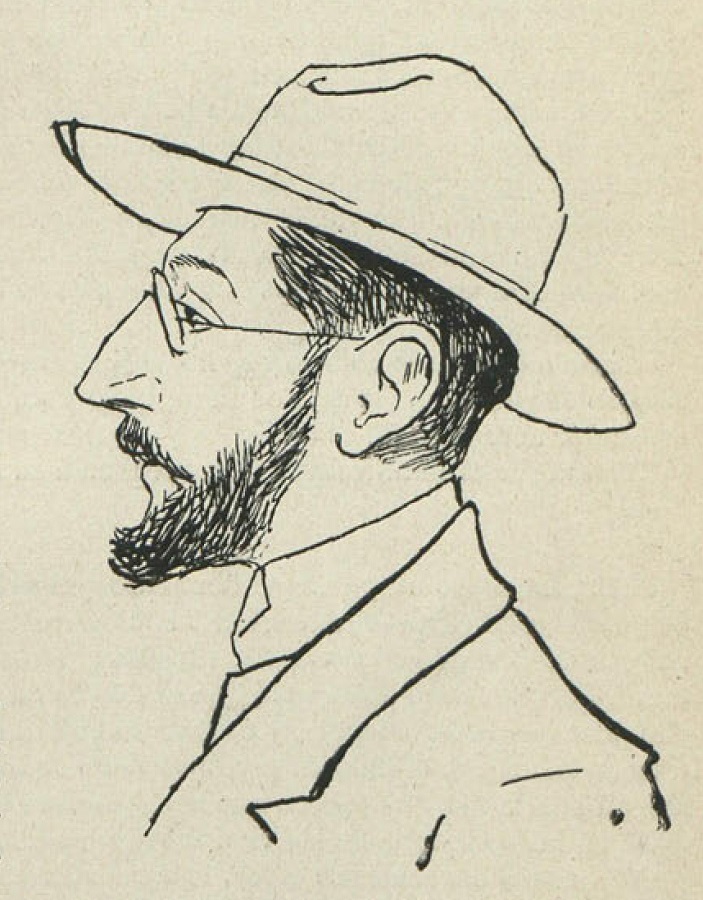
Self-portrait of Unamuno, in “Auto-retrato” (Revista Iberica, 30 September 1902).
Because of its open character, Unamuno’s legacy problematizes a crossroads that perhaps we should never consider closed: what matters is not to live only according to reason or only according to feeling, but to feel feeling from reason, and to think the rational from feeling. To defend life in that struggle, to defend the tension between the two fields, is to nourish contradiction as a source of life: between a reason that contradicts the will and forces it to be more rational in its beliefs, and a will that, in turn, forces reason and demands that it satisfy its desires. This is the only agonic path on which, according to Unamuno, human life can appear in all its splendor; only in that agonic tension is freedom possible.
Creative faith as the defender of life
Unamuno’s entire work is immersed in a religious atmosphere and tinged with a Christian personalism -inward and mystical, of a hesitant, doubting bent; he was a thinker shaken by religious disquiet, born of the very despair provoked by mortal life, and he made of its aesthetic transfiguration an engine of his questioning; on this, it will suffice to enjoy poetic works such as The Christ of Velazquez (1920), novels such as Saint Manuel Bueno, Martyr, or essays such as The Agony of Christianity (1925).
This sort of Christian existentialism is, however, in no way classifiable; that, in fact, may be its chief value, and even the reason for its survival, transformed, in other thinkers of the stature of Maria Zambrano. “I do have, with affection, with the heart, with feeling, a strong tendency toward Christianity, without adhering to the special dogmas of this or that confession”, he insisted in “My Religion” (1907) (Unamuno, 2008, 53). For, an enemy of all Catholic orthodoxy, critical of the simple faith of the charcoal-burner or the dogmatism of any sort -a refuge of laziness and fear- Unamuno moved here against the current; unbending and complex, he never wed himself to anyone, perhaps with the same attitude with which he modulated his changing political positions, inclined toward a tragic, militant and discomfiting liberalism, which so often ended in ostracism and exile, or in bitter confrontations against the very barbarism of thought, as in his famous clash with Millan-Astray in October 1936.
From these coordinates we can better understand the meaning that characterizes the lived experience of faith in Unamuno; for it too has a value as a way to construct a philosophical discourse concerned with metaphysical need and the agonic sense of existence. After all, not everything in man is reason, but always also heart and will, and that road runs by way of faith. Faith takes on a cardiac dimension: as in Pascal, it is the path the heart marks out in order to live and satisfy its desires, just as to defend its need for consolation. Far from signifying a passive appeasement, it is a “cordial” and “doubting” faith, which proceeds from our entrails and constitutes an interminable combat before the trial of tragic doubt.
Thus emerges one of the nodal ideas of Unamunian thought: the bond between life and faith. There is no life without faith, he will maintain, just as there is no life without hope or love, without solidarity or human compassion. In the irreconcilable conflict between reason and life, he leans toward faith as an alternative to the insufficiency of reason, as an instrument of life and of knowledge, because it procures for man a certain spiritual tension to take the side of life. Many will be the arguments he offers in this regard: that faith is the great defender of life, because it is the organ capable of orienting moral conduct and giving meaning to existence; that it provides an existential justification for hope or for the desire for immortality; that it enables the individual to value the beauty of the mysterious, and so on. From our contemporary vantage point, which at times exhibits an indifferent or arrogant attitude toward faith, perhaps his arguments no longer persuade us. And yet, in all of them a suggestive guiding thread emerges, inviting us not to close the door entirely: their creative force, their “creative power” (Unamuno, 2004a, 428).
In what would that power consist? More than believing what we do not see and assuming a receptive dimension, faith has as its office to create its object: it speaks to us of an act of creation of the will, which reveals not only the individual desire to want to believe, but the desire to create an object that fills its vital need and its longing for immortality; such is the case of God, whom we cannot, however, reach as an idea through mere reason, but through longed-for feeling, as the God of love immediately felt, personal and non-transferable. Unamuno stresses that whoever has faith is always building, edifying his existence not in the void but on the ground of the real. Far from waiting passively, he creates by virtue of the will, the faculty that promotes and elevates life, by providing us with the horizon of meaning and the values suited to our affective and moral demand:
Faith is not the mere adhesion of the intellect to an abstract principle, it is not the recognition of a theoretical truth […]; it is a thing of the will, it is a movement of the spirit toward a practical truth, toward a person, toward something that makes us live and not merely understand life (ibid., 427).
The problem of Spain, or some notes on intrahistory
As a member of the Generation of ’98, it should hardly surprise us that the “problem of Spain” constitutes another of the central motifs of his thought: at bottom, it is a site of memory par excellence of our Hispanic self-understanding, as chastised as it is unresolved. From On Authentic Tradition (En torno al casticismo), a work that appeared first as newspaper articles in 1895 and was later published as a book in 1902, Unamuno inscribed himself within the genre of reflections on the essence of Spain, its culture and its possibilities of modernization, its isolation from Europe, its eternal “Cainism,” and so on. This was, of course, a perspective tied to the project of regenerationism and the need to emerge from a profound crisis of the Spanish conscience that erupted in 1898; amid the intellectual and moral stagnation the country suffered, paralyzed between a traditionalism and a “casticismo” that perpetuated its age-old backwardness, he called for a critical concentration of Spain upon itself, in order to restore its energies and its historical destiny.
Even today there is something subversive, provocative, in the way Unamuno rejects approaching the history of Spain through a superfluous study of political, military, social facts and the like, through their mere temporal concatenation. His position here will be crystal clear: we must make history, we must live it, and of course know it in order to learn from the past and confront the future. In reality, Unamuno’s invitation is as demanding as it is current: to stop fixing our gaze on the surface of merely juxtaposed historical facts -external and public, noisy and impersonal- that flood the present; to stop seeing “the fact or the idea clipped out, without breaking and spilling its entrails into the spirit that receives them, without entering into it wrapped in its halo and unfolding therein” (2007, 120).
Set against a superficial conception of the history of Spain, against a historiographical abstraction crystallized in books and registers, Unamuno will oppose his famous concept of intrahistory. By this he will understand the true living, creative tradition, as distinct from historical tradition and the old “casticismo” -mere repetition of the past- which makes up the innermost core of history. In a certain way, intrahistory is an essential component of each historical moment, eternal and permanent, which endures beyond any passing fashion, as the depths of the sea endure regardless of its waves.
The waves of history, with their roar and their foam that glitters in the sun, roll over a continuous sea, deep, immensely deeper than the layer that ripples over a silent sea, to whose ultimate depths the sun never reaches. All that the newspapers recount daily, the whole history of the “present historical moment,” is but the surface of the sea, a surface that freezes and crystallizes in books and registers; and once thus crystallized, a hard layer, no greater with respect to intrahistorical life than this poor crust on which we live is with respect to the immense burning core it carries within (ibid., 80).
Undeniable, the Romantic echoes of intrahistory refer back to a spirit of the people that lives unconsciously in the consciousness of a given community. Its prolongation through time constitutes the “eternal tradition,” perhaps “the interior history of the spirit,” in Cerezo’s expression (1996, 185). But beyond that filiation, intrahistory has a specific function for Unamuno: it serves to make spiritual regeneration operative by appealing to the primary components of their existence -the Spanish people- and to the study of the best elements of their tradition. Not by chance, in approaching identities such as the Castilian, Unamuno was a tireless traveler, in both the literal and the figurative sense: he penetrated eagerly into the life of its landscapes and customs, into its rich literary legacies and popular speech, into its religious feelings and noble ideals, convinced that their knowledge and cultivation still offered opportunities to regenerate the whole of its history. At bottom, he will note, intrahistory is not about great names: it refers to humble and anonymous lives, which form the essence of the social, for behind them rests the silent, assiduous and everyday labor of its people.
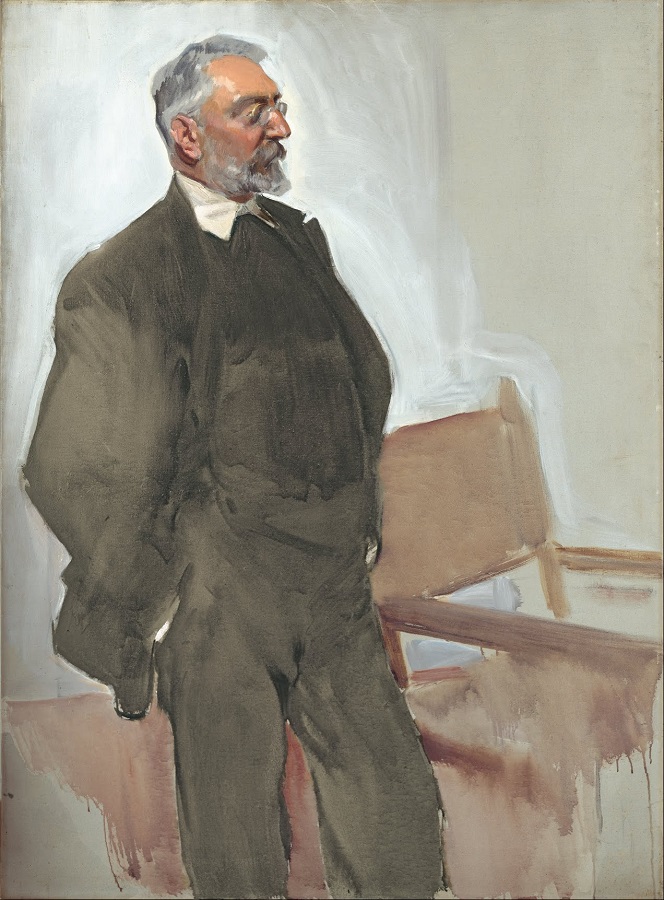
Portrayed by Joaquin Sorolla (c. 1912). Museum of Fine Arts of Bilbao.
Quixotism as the essence of Spanish philosophy
Unamuno represented a turning point in Spanish philosophy; he never shunned the label of intellectual, addressed a broad public and took part in the great cultural and political debates of the age, getting philosophy out of the university lecture halls and driving a modernization that would be continued by Ortega y Gasset. However, he never wanted that renewal of Spanish philosophy to depend on the rear-view mirror of European modernity: as against the Europeanization of Spain, he wagered on a Hispanicization of Europe; hence, alongside the project of spiritual regeneration that would delve into one’s own tradition, he linked that philosophy to the locus of Quixotism, an idea set out in The Life of Don Quixote and Sancho (1905). It is a profound exegesis of Cervantes’s novel, as free as it is personal, for although “one must respect the infallible authority of the Cervantine text […] we are free to interpret it to our own taste and counsel” (2004b, 157). Now then, how are we to approach this Quixotism today?
For the Bilbao-born thinker, Quixotism is the very essence of authentic Spanish philosophy: it functions as the myth of Spanish thinking, in which the key to our destiny as individuals and as a people is summed up. His polemic against his intellectual age was, of course, assured here: Spanish philosophy can never be found in the universities, and still less in motley tomes of abstract Scholasticism, just as it cannot be tied to a hollow traditionalism or nationalism. Rather, Spanish philosophy is the philosophy of intense living and dreaming, the philosophy of Don Quixote:
Is there a Spanish philosophy, my Don Quixote? Yes, yours -the philosophy of Dulcinea, that of not dying, that of believing, that of creating truth. And this philosophy is not learned in lecture halls, nor is it set out by inductive or deductive logic, nor does it arise from syllogisms, nor from laboratories, but rather it arises from the heart (ibid., 241 f.).
Unamuno, who throughout his prolific output practiced a literary hermeneutics as personal as it was existential, will not regard Don Quixote and Sancho as literary characters to be judged according to what they say or how they say it. He addresses them as living men of flesh and bone, symbolic figures who act in a certain way, possessing a soul that longs to be, to dream, to live: only by virtue of that will and force poured out into their world should their deeds be valued. Both are incarnations of a life based not on ideas but on ethical ideals: they perform actions guided by a logic of the heart, by a faith that spurs men to live and to act.
Thus, while Sancho symbolizes a faith strongly besieged by doubt, Don Quixote represents the knight of faith invaded by an active resignation. Is he not a figure of combat and agitation, of the will to adventure, of a passionate inner life that undertakes a crusade against vulgarity, against the lack of passion and hope? For Unamuno, indeed, he represents a utopian struggle against the world in search of the ultimate meaning of existence and of one’s own destiny, revealing a personality that reaffirms its way of being against all insistence on facts and ideas, against the common sense of the coarsest reason. For his heroism is tragic, but not deluded; committed, but not mad. At bottom, the hidalgo of La Mancha gives his whole being in each of his acts, in a desperate wanting to live and endure, struggling against all manner of resistances and affirming his identity against them:
“I know who I am” […] Don Quixote reasoned with the will, and in saying “I know who I am!” he said nothing other than “I know who I want to be!” And this is the very hinge of all human life: for a man to know what he wants to be. The being that you are is no more than a fleeting and perishable being, who eats of the earth and whom the earth will one day eat: the one you want to be is your idea of God (ibid., 3).
In sum: Don Quixote does not embody just any kind of ethical ideal, but ideals such as personal immortality and goodness. Indeed, his madness shows a craving for immortality based on a creative faith that lives agonically, not free of risks or uncertainty. In the Unamunian interpretation, Don Quixote’s passionate faith creates its object -as in his visions in the cave of Montesinos, a reality believed and lived by him- and that object is real and valid for him; and that gesture, based on a strong and sincere willing, he carries out looking to the future, convinced that goodness makes us eternal; his actions seek not fame but the goodness of the heart, the goodness that immortalizes and is passed on: “The root of your madness of immortality, the root of your longing to live throughout the endless ages, the root of your craving not to die, was your goodness, my Don Quixote” (ibid., 257).
Bibliography
Cerezo, P. (1996). Las mascaras de lo tragico. Filosofia y tragedia en Miguel de Unamuno, Madrid: Trotta.
De Unamuno, M. (2004a). Del sentimiento tragico de la vida, en Obras Completas X, ed. de R. Senabre, Madrid: Fundacion Jose Antonio de Castro.
– (2004b). Vida de Don Quijote y Sancho, en Obras Completas X, ed. de R. Senabre, Madrid: Fundacion Jose Antonio de Castro.
– (2007). En torno al casticismo, en Obras Completas VIII: Ensayos, ed. de R. Senabre, Madrid: Fundacion Jose Antonio de Castro.
– (2008). “Mi religion”, en Obras Completas IX: Ensayos, articulos y conferencias, ed. R. Senabre, Madrid: Fundacion Jose Antonio de Castro.
– (22015). Mi confesion, ed. de A Villar Ezcurra, Salamanca: Sigueme/Universidad Pontificia Comillas.
– (2017). Escritos sobre la ciencia y el cientificismo, ed. de A. Villar Ezcurra, Madrid: Tecnos.
Ferrater Mora, J. (1985). Unamuno. Bosquejo de una filosofia, Madrid: Alianza.
Jimenez Moreno, L. (1991). Practicas del saber en filosofos espanoles. Gracian, Unamuno, Ortega y Gasset, E. d’Ors, Tierno Galvan, Barcelona: Anthropos.
Juaristi, J. (2019). Miguel de Unamuno, Madrid: Taurus.
Rabate, C. y J.-C. (2019). Miguel de Unamuno (1864-1936). Convencer hasta la muerte, Barcelona: Galaxia Gutenberg.
Zambrano, M. (2003). Unamuno, edicion e introduccion de M. Gomez Blesa, Barcelona: Debate.
– Miguel de Unamuno: A Philosophical Approach – – Alejandra de Argos –