Goethe in Weimar
Weimar celebrates in 2025 the 250th anniversary of Goethe’s arrival with a thematic year dedicated to his masterpiece, “Faust”. Exhibitions, debates and installations pay homage to a monumental drama that occupied the author for more than six decades. Inspired by the medieval legend and the pact between Faust and Mephistopheles, the work addresses universal themes such as love, guilt, the desire for knowledge, temptation and redemption, keeping its relevance and its power of fascination intact.
The German city of Weimar is celebrating the thematic year “Faust 2025”, which commemorates the 250th anniversary of the arrival, in this city, of its author the writer, philosopher and poet Johann Wolfgang von Goethe (Frankfurt, 1749 – Weimar, 1832). It is a year dedicated entirely to his masterpiece, Faust, with the celebration of literary exhibitions, debates, installations and events. Goethe had already begun this universal work, par excellence, of German literature in Frankfurt, before moving to the small duchy of Saxony-Weimar in 1775, and it would occupy his whole life since he finished it in the year of his death. It was more than sixty years in which he interspersed its elaboration with the production of many other pieces. Therefore, if we attend to the time and care with which its author dedicated himself to this dramatic work in verse, its reading should never be hurried. But he did not make it easy for the reader either. Faust is a very complex work, it is not uniform with a traditional structure and a narrative thread, which throws off the reader with its spatial-temporal leaps. It is advisable to let oneself be carried away by the aesthetic beauty of the scenes and not so much by the search for meaning, above all until one has finished it. The ideas emerge like lighthouses in the nuances of the profound dialogues, from the popular ones, in the tavern scenes or songs, to the most sublime such as the dialogues with the Tempter, Mephistopheles.

An aspect of the exhibition dedicated to Goethe at the National Museum of Weimar.
The work is based on the character of the medieval German legend of Faust and on the traditional biblical pact between God and the Devil: Satan is asked by Yahweh: Have you considered my servant Job?, likewise the Lord asks Mephistopheles in the “Prologue in Heaven” of Goethe’s work: Do you know Faust?. The difference lies in that, in the case of Job, Satan will strip him of everything to test his fidelity to God, and in the other case the Devil will grant Faust all pleasures in exchange for his soul, snatching it from God. Mephistopheles will end up making a pact with Faust, who has not found in knowledge the truth nor existential satisfaction. “Why must the stream dry up so soon and we suffer once more?”, argues Faust in the Study. This theme is always very present in the work; the tireless chain of human desire, which when it manages to be satisfied, tedium arrives, as Schopenhauer thought, and the machine of need sets in motion again to never feel fullness. Faust, a sage in subjects such as Philosophy, Jurisprudence, Medicine, or Theology suffers an existential crisis that leads him to think of suicide since he cannot manage to find the full meaning of life, and for this reason he accepts the pact.
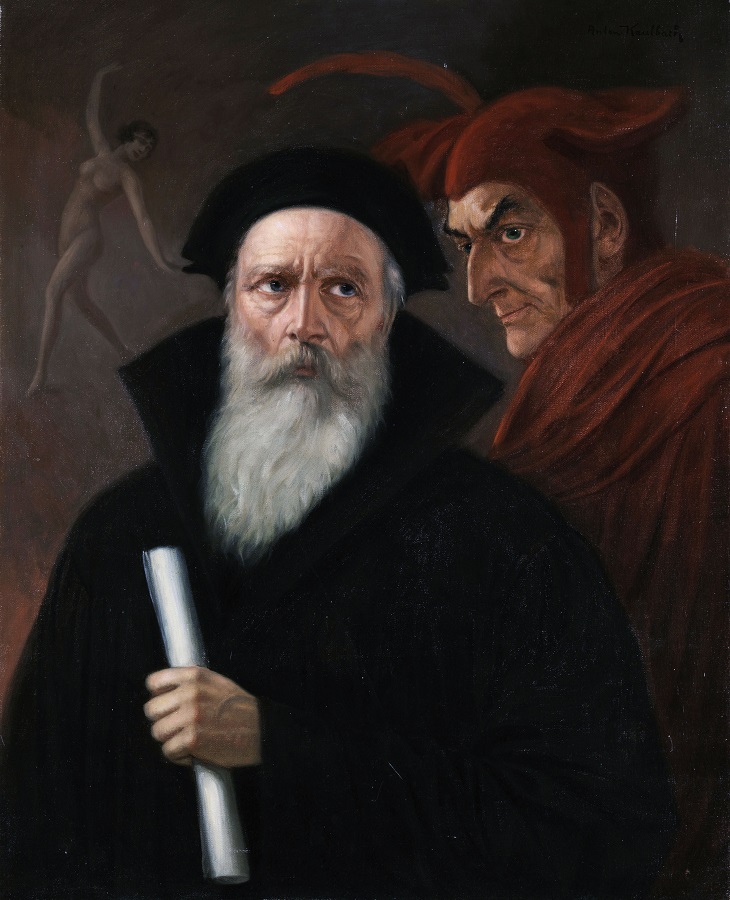
Faust and Mephisto, oil on canvas. Signed upper right by Anton Kaulbach.
There exist numerous interpretations and references of this monumental work of literature, based on the analyses of the experts, that help to better understand its richness both stylistic and philosophical.
Faust is a drama in two volumes, which keep neither continuity nor clear union but which are linked by the characters and the pact between Faust and Mephistopheles, in which the whole philosophy of Goethe over time underlies. In each of its episodes such universal themes of the human condition as love, guilt, the desire for knowledge, temptation or redemption are dealt with, universal questions that make this work never have lost its relevance.
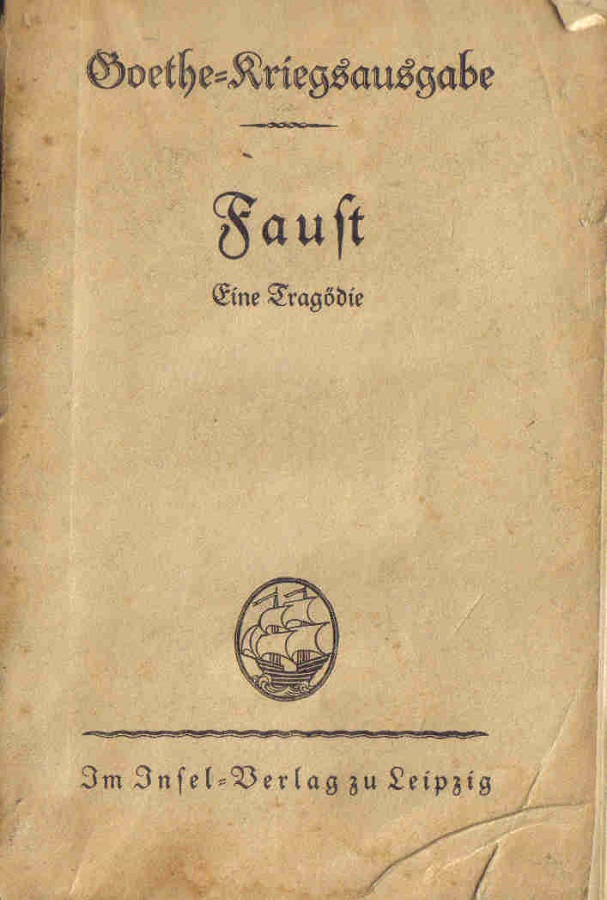
Cover of Faust, Leipzig edition, 1932.
But we also observe social criticism in episodes such as the seduction of the innocent Margarita by Faust, which covers the first part of the tragedy, in which she will end up drowning the son she had with Faust and being executed. Faust tries to help her escape, but she rejects him because she can only be saved by being executed: “Judgment of God, to you I have entrusted myself!”, cries Margarita. Mephistopheles: she is condemned. Voice (from above): she is saved. This first part of the work speaks to us about the injustice of the social exclusion to which women who became pregnant and abandoned were subjected. Goethe, who studied and practiced as a beginning lawyer, had witnessed in 1772 the execution of the infanticide Susanna Margaretha Brandt in Frankfurt. She insisted that she had acted under the coercion of the devil. This will be Mephistopheles in Goethe’s Faust, as Rudiger Safranski relates in his splendid and documented biography: “Goethe: Life as a Work of Art” (Tusquets Editores).
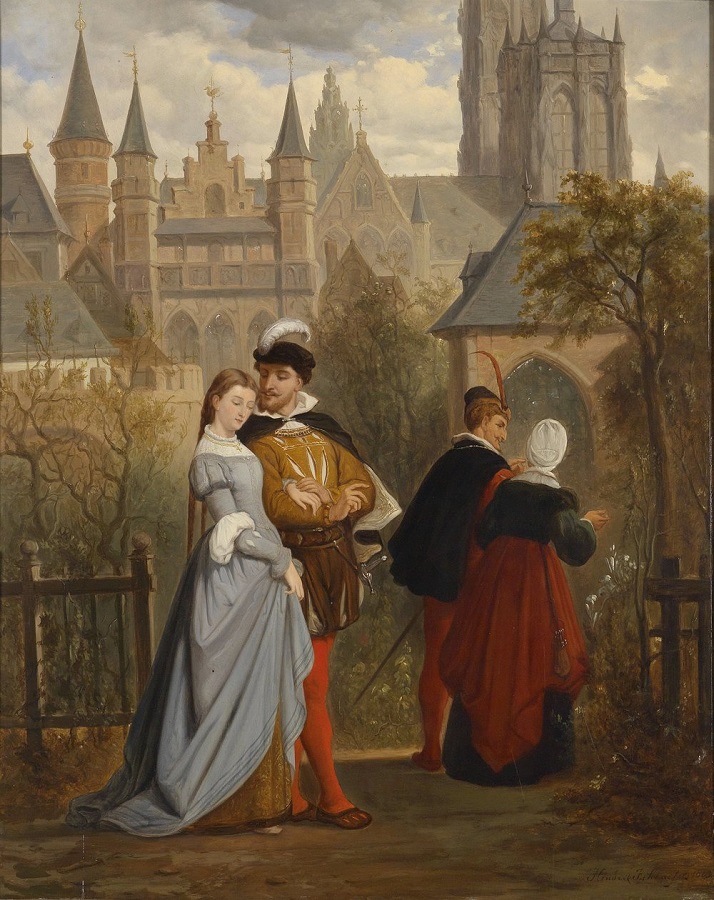
Faust seducing Margarita, by Hendrik Frans Schaefels.
In the second part of the tragedy, it jumps in time to Ancient Greece. He falls in love with Helen of Troy, immortal beauty, art. He will also achieve political power in the imperial Palace, but none of this will produce his full satisfaction, that moment so excellent, so full of meaning that one would want its repetition eternally. When that moment arrives he will pronounce the words: “Stay, you are so beautiful”. It will be the moment of surrender to the devil. It will occur when, according to Faust, he manages to live in a free land, with a free people. Accompanied by the maxim “only he deserves life and freedom who has to conquer them every day”.
Considered a genius by his contemporaries, by himself, and by history, Goethe closes this work with the salvation of Faust, which has led to multiple interpretations. Mephistopheles is seduced by the angels and in the distraction the noble soul of Faust is taken from him. His immortal part is raised by the angels and redeemed, why?. “He who always desires, aspires and struggles, deserves to receive salvation”. In the beginning was the Deed, and also the way in which life must be lived.
– Goethe in Weimar – – Alejandra de Argos –