Tamara de Lempicka
Legend has it that the Greek philosopher Empedocles of Agrigentum (5th century BC), according to Diogenes Laertius, took his own life by throwing himself into the bowels of the volcano Etna. The lyric poet Friedrich Holderlin considered that this death gathered all the eminent Romantic characteristics, the return to nature as reconciliation between man and the gods. The elegant and extravagant Polish artist, Tamara de Lempicka (1898-1980) made known to her last life companion, the Mexican sculptor Victor Contreras, protege of the Russian prince Felix Yusupov in Paris, and to her daughter Kizette, her wish to be cremated when she died and her ashes scattered on the summit of the Popocatepetl volcano, near Cuernavaca, Mexico, where she lived the last years of her life until her death. At the origin of this volcano lies the tragic mythology of two lovers.
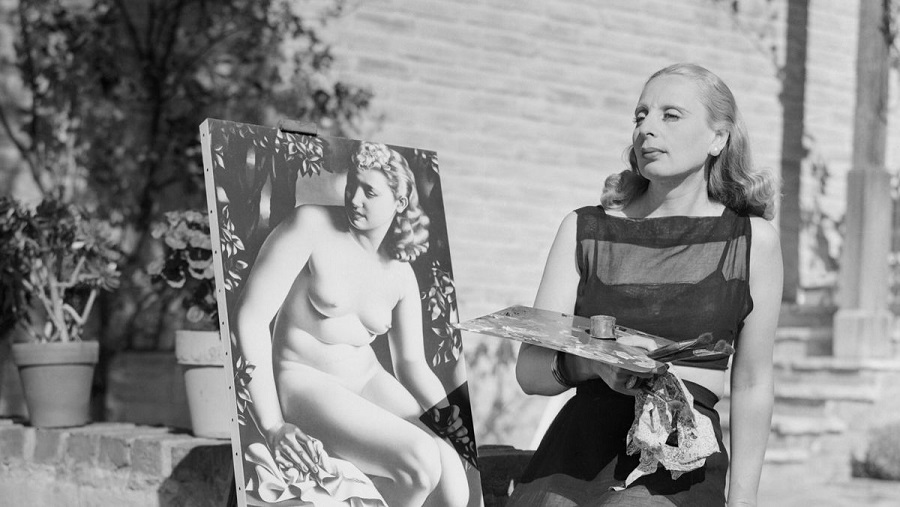
Tamara de Lempicka painting “Susanna Bathing” (1938).
The Young Museum in San Francisco exhibits the first major retrospective in the United States, with more than a hundred works and unpublished biographical details of Tamara de Lempicka. It will end in February. From there, on 9 March it will travel to the Museum of Fine Arts in Houston, the city where the painter’s archives are kept, since she lived several years there before moving to Mexico where she would die three years later.
At the same time the documentary “The True Story of Tamara de Lempicka & the Art of Survival”, by filmmaker Julie Rubio and narrated by Anjelica Huston, will make its debut in New York at the 34th Jewish Film Festival on 28 January, contributing recently discovered material. It has the collaboration of her granddaughter Victoria and her great-granddaughters Cristina and Marisa de Lempicka, who reveal new biographical details about the artist. Despite her exposure to the tabloids, the life of Tamara Lempicka has always been surrounded by mystery. It has just been discovered that her birth name was Tamara Rosa Hurwitz. She was born in 1898 into a privileged Jewish family in Warsaw, Poland. The painter tried to hide it because of the growing antisemitism in early 20th-century Eastern Europe.

But behind her beautiful paintings there is a fascinating life. On a holiday at the home of her uncle and aunt Stefa and Maurice Stifter in Saint Petersburg, Tamara attended a society party in whose Tsarist salons she met the handsome lawyer Tadeusz Lempicki, belonging to a Polish noble family. She fell in love with him immediately and would marry him at eighteen in 1916. A year later her daughter Kizette would be born. With him she led a life of luxuries, parties and amusement until the Bolshevik Revolution broke out. Tadeusz was probably a member of the Tsarist secret police. One night the Cheka, the anti-revolutionary police, broke into their house and he was arrested accused of spying for the Tsar. He was taken to the terrible Russian prison Lubyanka. Tamara would manage to free him with the help of the Swedish consul and they will flee to Paris where they would begin a new life as refugees. But Tadeusz did not manage to adapt. The aftereffects of prison and his refusal to accept jobs he considered beneath his lineage caused the family to suffer hardships. This led Tamara to consider seeking her economic independence through her art, advised by her sister.
Lempicka created a personal style combining elements of neoclassicism, post-cubism and that formal simplicity of modernity that are manifested in her paintings of erotic gesture. Her elegant Art Deco portraits of high society had dazzled in a Paris in ferment in some frantic 1920s and 1930s. A singular artist, with a refined technique who created her own unique style and ended up becoming one of the most recognized representatives of Art Deco. She began to accumulate successes and recognitions. Her work Portrait de Marjorie Ferry (1932), nicknamed the “Art Deco Mona Lisa”, became the third best-paid work in the world by a woman artist, reaching the figure of 17 million euros at the Christie’s Auction House in 2020.

Portrait of Marjorie Ferry
In 1929, Lempicka would paint one of her iconic works Self-Portrait in a Green Bugatti, for the cover of the German magazine Die Dame. In this painting Tamara de Lempicka makes a nod to the tragic death of the American dancer Isadora Duncan, who died strangled when her long shawl got caught in one of the rear wheels of her Bugatti. The car was for Tamara a symbol of the emancipation of women.
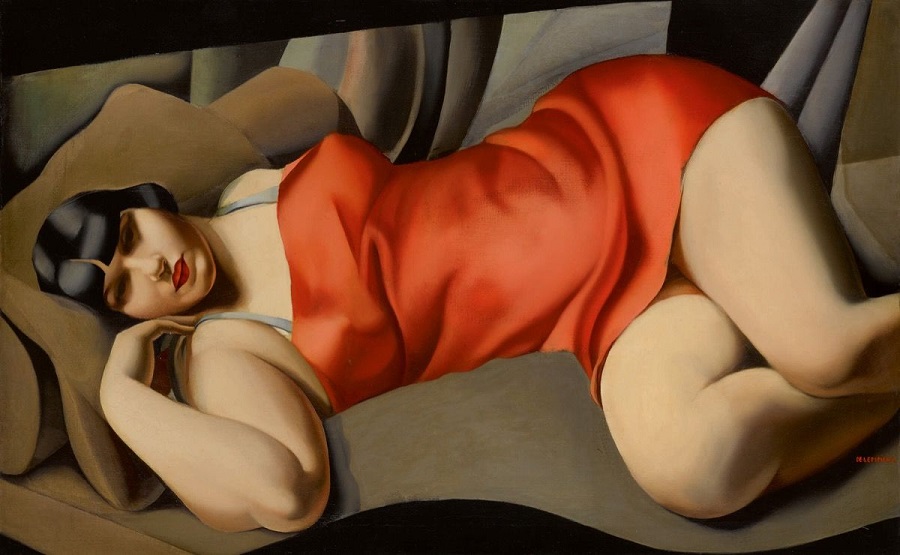
La Belle Rafaela (1927)
In that same year Tamara divorces Tadeusz and meets the Hungarian baron Raoul Kuffner de Dioszegh (1886-1961) whom she will marry in 1934. After having survived her destiny and created a new life in Paris, she had to abandon everything again. The outbreak of the Second World War in 1939, the advance of the occupation of the German troops in Paris in 1940 and her Jewish ancestry made them flee to the United States. They settled in Los Angeles where Tamara Lempicka again conquered Hollywood society. But the new American artistic movements such as Abstract Expressionism, Pop Art or pictorial Abstraction produce an isolation of her style that would lead her to a creative and therefore existential crisis. From this period date her religious paintings such as the portrait of Saint Teresa. New York, Houston and Mexico await her. A fascinating life that Laura Claridge recounts with all the passion the character requires in her book Tamara de Lempicka (Editorial Circe).

Portrait of Ira
Tamara Lempicka is one of the great representatives of modernism. One of the best female artists of the 20th century who portrays a new model of woman that emerges after the First World War. She seduced with her talent, her strong character and freedom. She broke all the conventions of her time as a woman artist with a painting celebrating female sexuality, Jewish and immigrant. A survivor who managed to assert herself in the face of all the adversities of a politically convulsive 20th century.