Fra Angelico: Divine Reflection
Florence hosts until 25 January the extraordinary exhibition “Fra Angelico”, devoted to one of the great masters of the Early Renaissance. Spread between the Palazzo Strozzi and the Museum of San Marco, the show brings together more than 140 works and allows one to enter into the spiritual, aesthetic and theological dimension of a painter who knew how to harmonize monastic devotion with the modern language of the Renaissance. In a journey of great beauty and recollection, Fra Angelico reveals himself as a creator of light, serenity and transcendence, whose painting still moves us by its purity and depth.
Florence, the humanist city par excellence, hosts until 25 January “Fra Angelico”, the extraordinary and dazzling exhibition of one of the most celebrated masters of Early Renaissance art. And it does so in two emblematic institutions such as the Palazzo Strozzi and the Museum of San Marco, where the friar’s sacred painting still resonates in its frescoes, both in the cells and in the common spaces. We can still steep ourselves in the monastic stillness of this old convent of the Observant Dominicans.
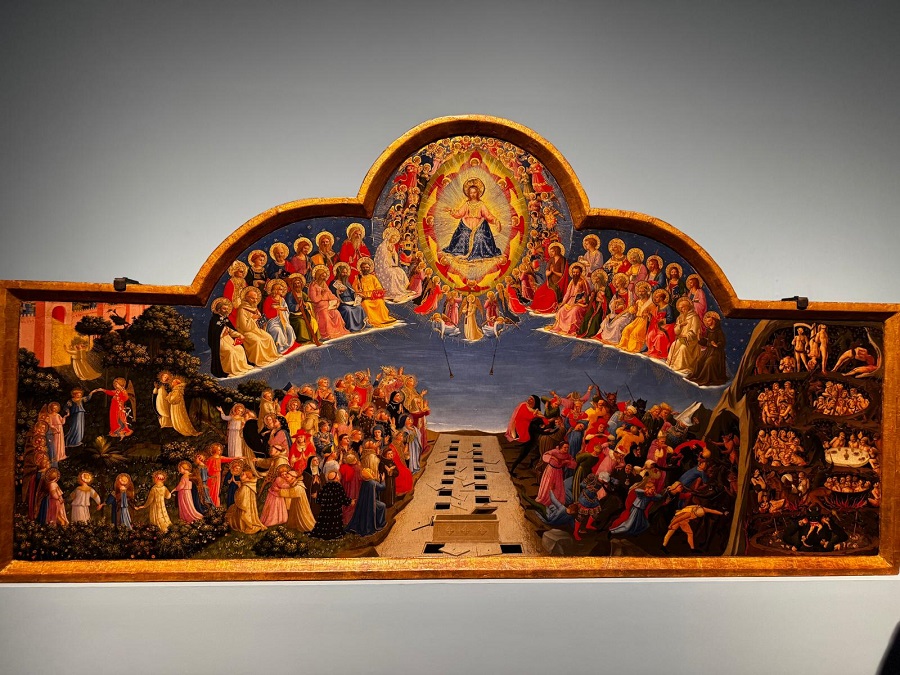
Fra Angelico ‘The Last Judgment’, c.1425-1431. Photo by Elena Cue.
Fra Angelico was born as Guido di Piero (Vicchio di Mugello, 1395 – Rome, 1455) but would later adopt, as a Dominican, the religious name of Fra Giovanni when he entered the convent of San Domenico di Fiesole, on the outskirts of Florence. Here he would establish a workshop and had a very prolific artistic life, notably the commission of the Fiesole Polyptych for the convent church, which can be seen in the Uffizi Gallery. Posthumously he would be known as Fra Angelico. He was officially beatified in 1982 by John Paul II in recognition of his pious and exemplary life of holiness, prayer, obedience and personal charity. The adjective Angelic had already been used to nickname him by the Renaissance artist and historian Giorgio Vasari (1511-1574) in his famous book devoted to Cosimo de’ Medici “The Lives of the Most Excellent Painters, Sculptors and Architects” (1555).
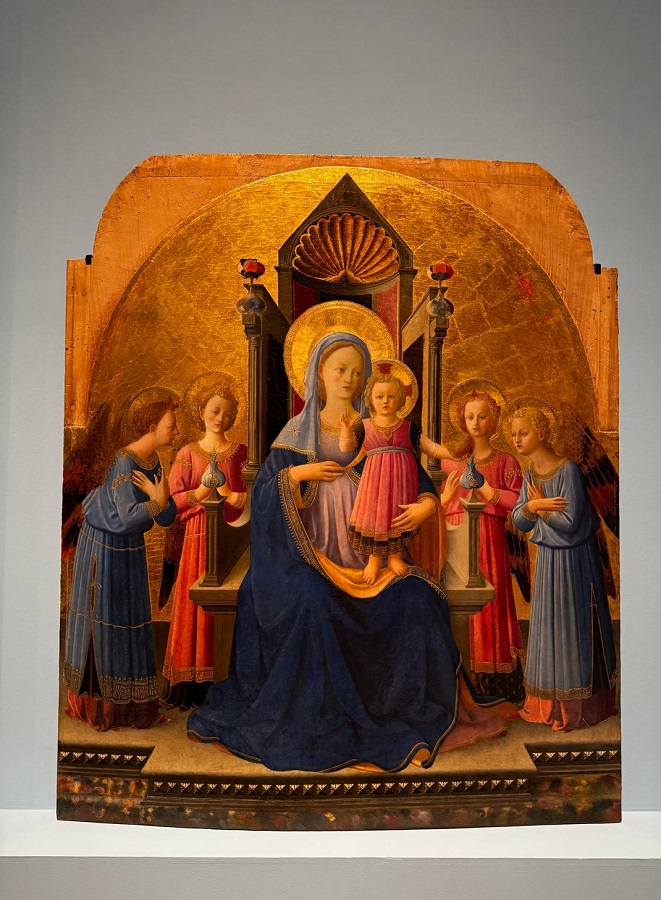
‘Virgin and Child with Angels’, created by the painter Zanobi Strozzi around 1434. The work was executed in Fra Angelico’s workshop, reflecting the style of the early Italian Renaissance. Photo by Elena Cue.
Vasari describes Fra Giovanni (Fra Angelico) as a humble, holy man, removed from worldly ambitions. A man who rejected riches, honors and posts within and outside his order, affirming that his only goal was to avoid sin and attain salvation. He lived with sobriety, chastity and serenity, convinced that the religious painter should work in silence, without worries and with Christ always in mind. He did not retouch his paintings because he believed they should remain according to the first intention, since in this way they answered the will of God. And according to some, he painted only after praying and wept before the Crucifixes. This aspect has been corrected later when the restoration (2010-2011) of “The Annunciation”, which is exhibited in the Museo del Prado, was carried out, and which partly contradicts Vasari’s testimony. The material evidence of the Prado restoration demonstrates that he did make modifications. With some understandable errors of the period and trivial biases, Vasari describes Fra Angelico with an aura of mystical emanation, who put his life at the service of God.
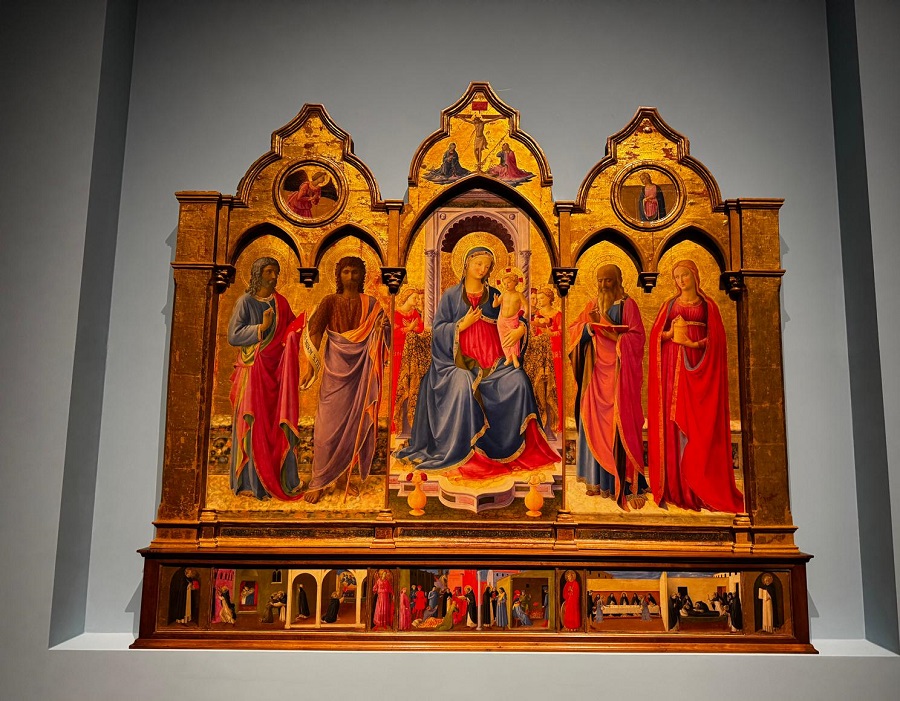
‘Cortona Triptych’ by Fra Angelico. It is an altarpiece from the church of San Domenico in Cortona, Italy, created around 1433-1434. Photo by Elena Cue.
What makes this show an exceptional cultural event is the magnitude of the gathering of more than 140 works of art, including paintings, sculptures and illuminated manuscripts, from important international museums, churches or libraries. But the most exceptional thing is the four fruitful years of preparation of the show, in which works have been restored with excellent results and altarpieces that were dispersed have been reunited. In this exhibition we can understand Fra Angelico’s essential theological-artistic contribution to the history of Art. Arranged chronologically, the show reveals his technical and pictorial evolution, from a late Gothic style to an emerging Renaissance, reaching a style that synthesizes the traditional of monastic devotion with the modern pictorial language.
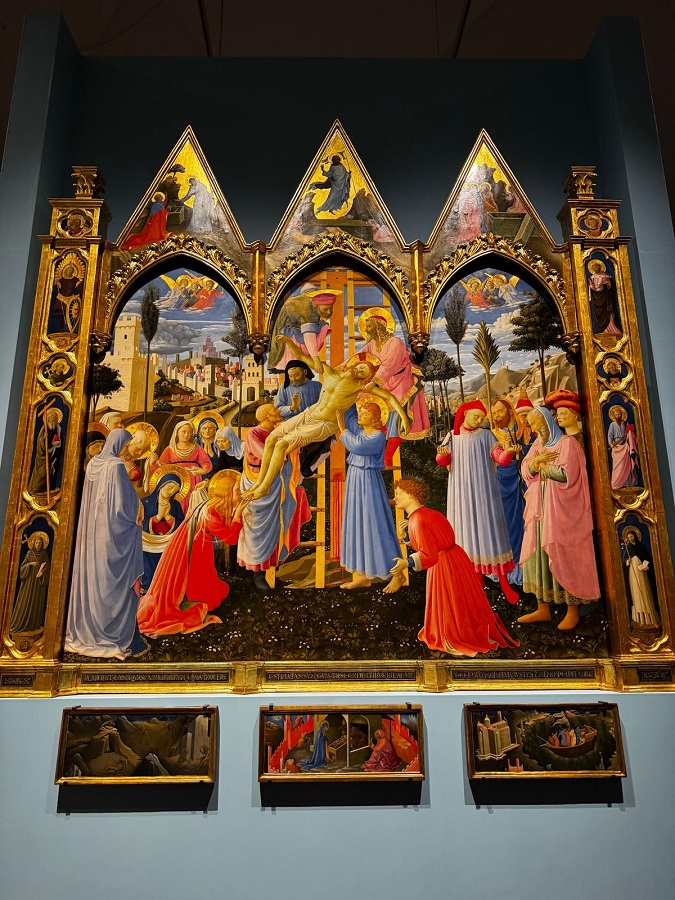
‘The Descent from the Cross’ by Fra Angelico, executed between 1432 and 1434. Photo by Elena Cue.
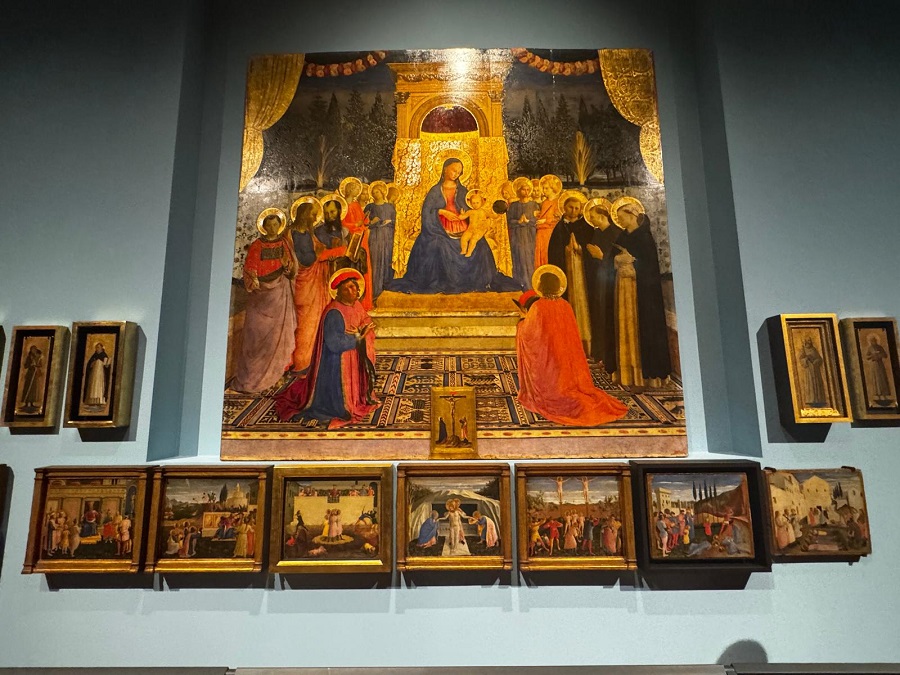
‘San Marco Altarpiece’ by Fra Angelico, completed between 1438 and 1443. Photo by Elena Cue.
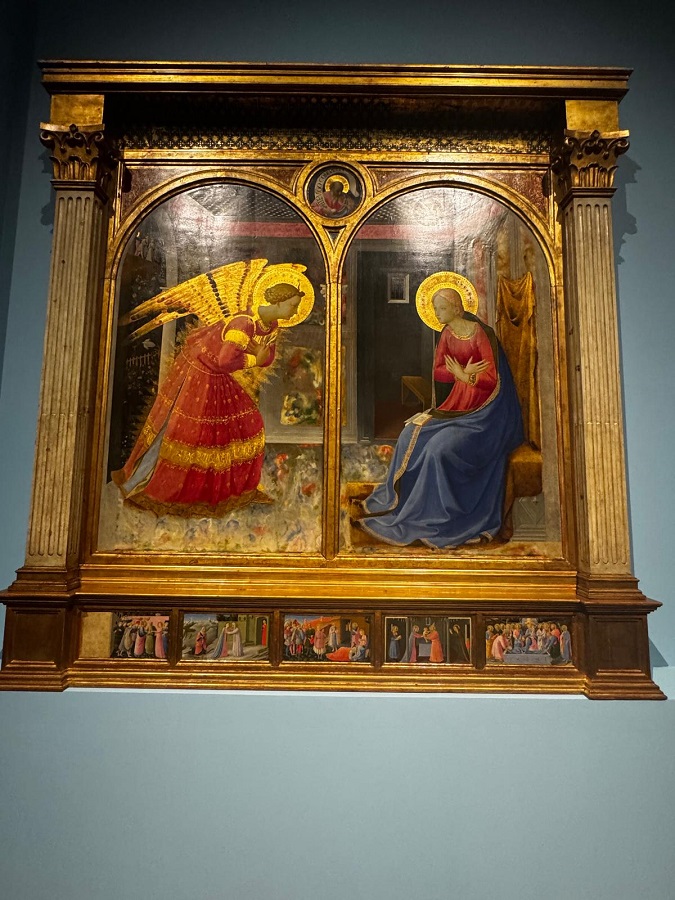
‘Annunciation of San Giovanni Valdarno’ by Fra Angelico, dating from around 1430-1432. Photo by Elena Cue.
Fra Angelico’s pictorial spirituality overwhelms us by the scale of the exhibition. A contemplative atmosphere of serenity and meditation is created. At a moment of transition in Italian painting, the passage from medieval symbolism to Renaissance realism, Fra Angelico adopts linear perspective, a skill in the treatment of light that would influence Piero della Francesca, Perugino and Raphael. His work also stands out for the use of gold, typical of the Gothic, which dazzles us in each of his works. But the most surprising thing is his virtuosity in the portrayal of the figures, figures of a luminous beauty and serenity that transcend the sensible world, the material and perishable realm, and bring us closer to the Platonic Idea of Beauty, a reflection of the divine.
– Fra Angelico: Divine Reflection – – Alejandra de Argos –