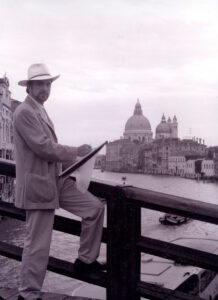
Raimundo de Madrazo
The exceptional exhibition “Raimundo de Madrazo”, organized by the Fundacion MAPFRE and the Meadows Museum, brings together more than a hundred works in the largest retrospective devoted to date to the refined Madrid painter. the technical virtuosity and the sophisticated world that Madrazo immortalized, revealing the legacy of an essential artistic dynasty and recovering for our time the exquisite sensibility of one of the great names of 19th-century Spanish painting.
For those who have not yet visited the exhibition “Raimundo de Madrazo” I recommend that you do not fail to do so. The Fundacion MAPFRE and the Meadows Museum have managed to bring together more than 100 works, some of them previously unseen, by the painter Raimundo de Madrazo (Rome, 1841 – Versailles, 1920), in a magnificent retrospective that can be visited until mid-January. The extraordinary thing about this show is the scope of what can be seen, never achieved until now, of a painter belonging to one of the most significant dynasties of artists in 19th-century Spanish art. Therefore, the exhibition catalog will undoubtedly become an obligatory reference on the work of this elegant and refined painter.
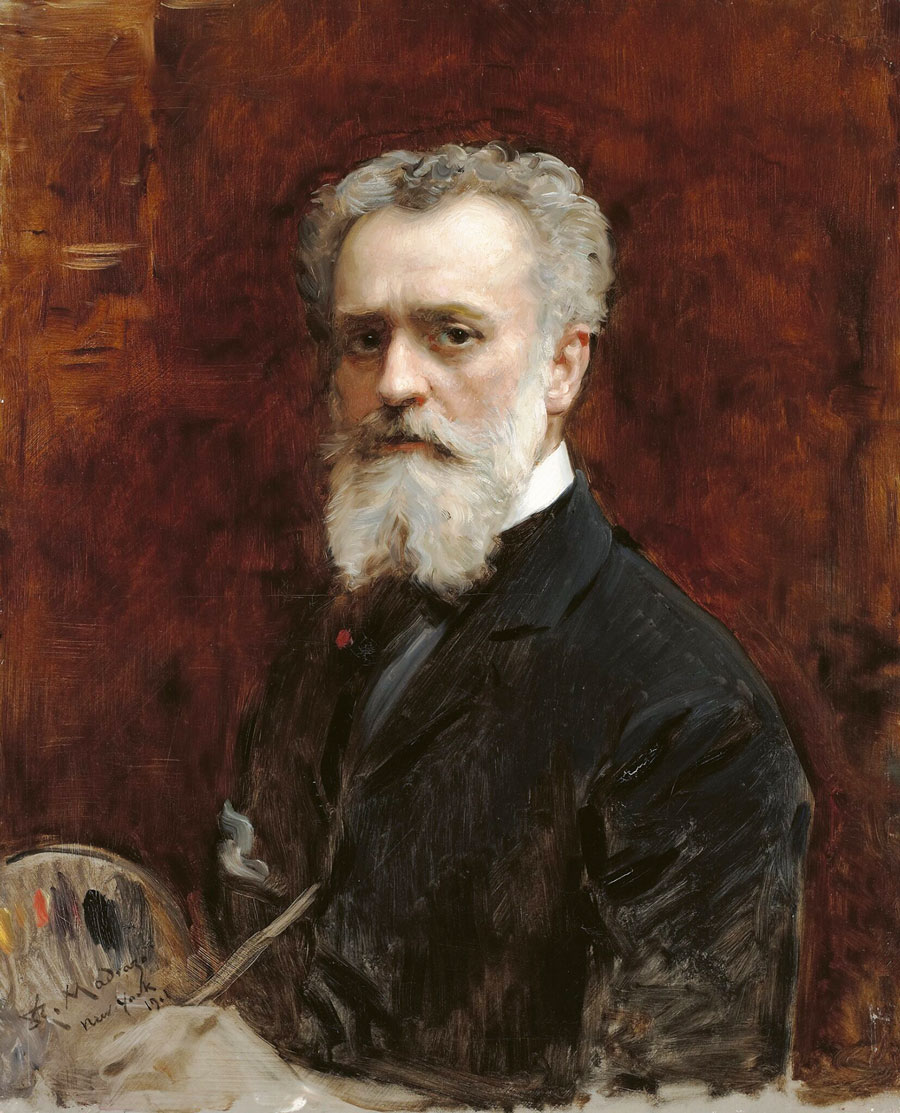
Self-portrait of Raimundo de Madrazo y Garreta, 1901.
Raimundo grew up under the powerful influence of the styles that characterize the members of the Madrazo family, in a transition from the neoclassicism of his grandfather Jose de Madrazo to the romanticism of his father Federico de Madrazo. Both held the prestigious post of director of the Museo del Prado. Through them, therefore, he received a training based on academic tradition in tune with the classical canons, to which would be added Raimundo’s great skill in drawing and his talent from the age of seven. All this allowed him to enter the Royal Academy of Fine Arts of San Fernando very young. At the age of twenty he went to Paris, a decisive destination in his career as a portraitist, where he ended up specializing in 1866 in genre painting. From then on he depicted scenes of everyday life with a more intimate language than that of historical or mythological painting, which he soon abandoned and which his father so defended. Raimundo coexisted in the French capital with modern currents of the late 19th century such as impressionism, which would open the doors to the avant-gardes of the 20th century. However, he remained faithful to his own style, in continuity with the past. He oriented his art to the taste of the new bourgeois public, with intimate and worldly scenes of high society, elegant portraits and paintings full of material virtuosity. His cosmopolitan vision would make him the favorite portraitist of international high society, to whose salons he was invited. Very integrated into Parisian cultural life, this way of life and its aesthetic were the great source of inspiration for Madrazo’s paintings, in which musicians, writers, aristocrats and models gathered. He attended Parisian soirees and masked balls, masterfully capturing the frivolous and elegant atmosphere as reflected in his work Fiesta de carnaval, which we can contemplate in the show.
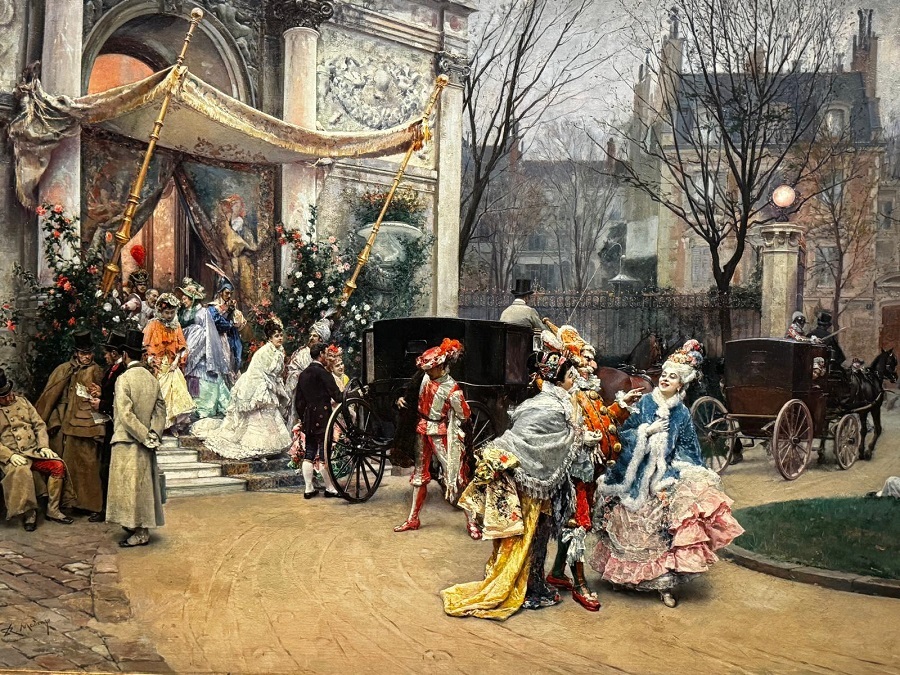
‘Salida del baile de mascaras’, 1878, by Raimundo de Madrazo y Garreta.
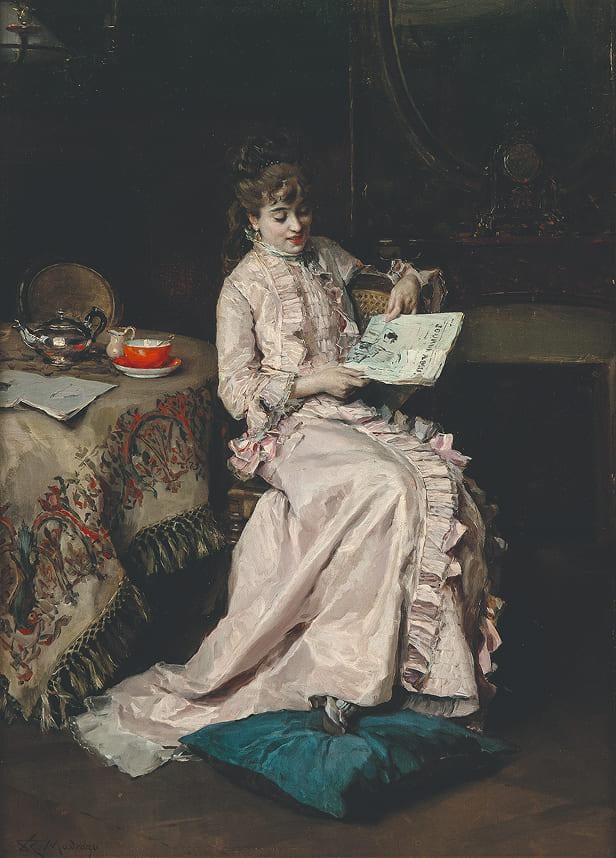
Aline Masson Leyendo, Raimundo de Madrazo y Garreta, 1890-1891.
His art aroused great interest in Marcel Proust, who met Madrazo through Maria Hahn, an intimate friend of the painter. But not only his own works, but also those the artist collected in his home, and which we will also be able to find in the exhibition. Proust wrote: “What a museum! A truly divine Greco,… A small Tiepolo, drawings by Raphael, compositions by Titian that he never got to paint…, engravings and drawings by Goya of a delicious obscenity and, finally, a La Tour. In short, everything interesting one can imagine,…”. All this atmosphere served Proust as material for later descriptions of characters from those portrayed by Raimundo, such as Jacques de Waru and his wife, who directly inspired in Proust the characters of the princesses of Orvillers and Nassau, in his monumental novel “In Search of Lost Time”.
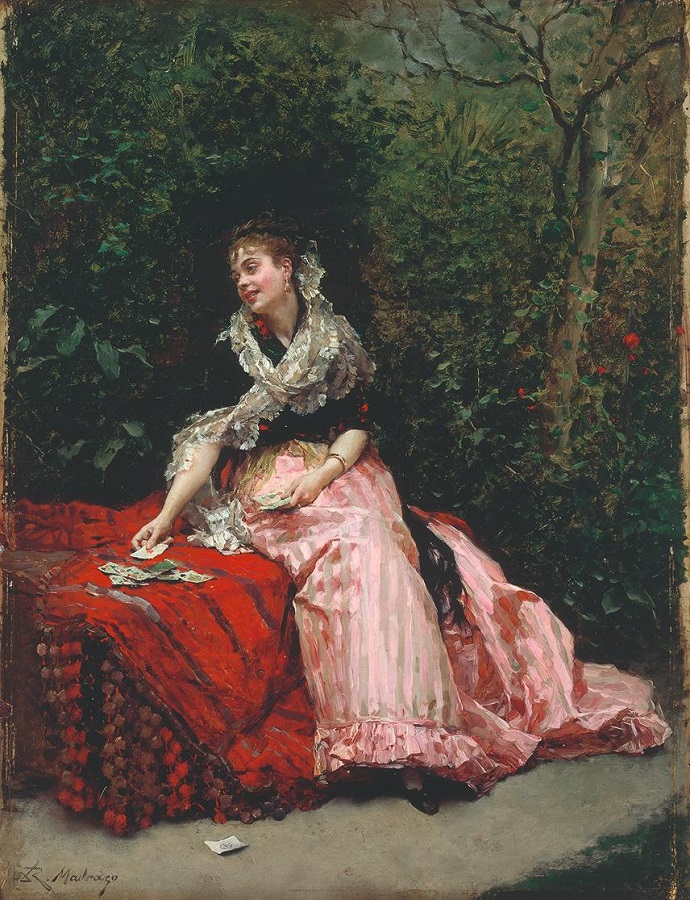
‘Mujer en el jardin’, Raimundo de Madrazo y Garreta, 1872-1875.
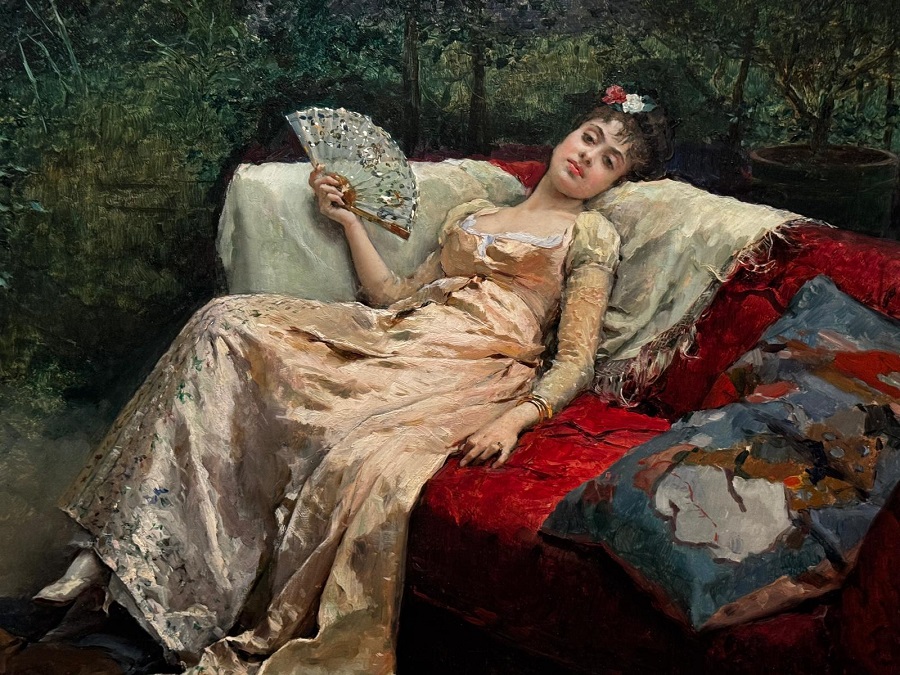
‘La Siesta’ Raimundo de Madrazo y Garreta.
This entire life and artistic journey, of one of the great figures of Spanish painting, is revealed through the paintings of this show, which gradually recount the art of living in that elegant and ephemeral world. Raimundo de Madrazo remained forgotten for decades, but now his refined sensibility shines again with force in each of his canvases.
– Raimundo de Madrazo: Costumbrista Elegance – – Alejandra de Argos –