Banksy: Biography, Works and Exhibitions
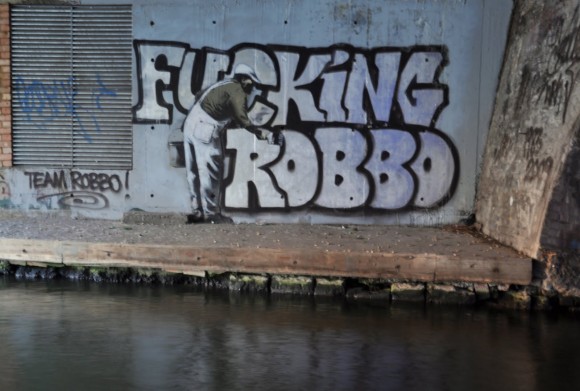
Banksy is the pseudonym of the most high-profile graffiti painter in contemporary Street Art. Although there are no concrete biographical facts to go by, it is believed he was born in the outskirts of Bristol in 1974, later moving into the city where he spent his adolescence. A recent study by Queen Mary University in London identified the artist as Robin Gunningham and confirmed he grew up in Bristol. According to the illustrator and graphic designer Tristan Manco, one of the most ardent researchers into urban art, the controversial Banksy was an apprentice butcher before getting into graffiti during the 80’s “aerosol boom”. In the 90’s, he was a gang member of Bristol’s DryBreadZ crew, aka DBZ, at which time his fame began to spread like wildfire, mainly due to his tit-for-tat overpainting war with the top graffiti artist of the day, King Robbo.
Banksy is the pseudonym of the most high-profile graffiti painter in contemporary Street Art. Although there are no concrete biographical facts to go by, it is believed he was born in the outskirts of Bristol in 1974, later moving into the city where he spent his adolescence. A recent study by Queen Mary University in London identified the artist as Robin Gunningham and confirmed he grew up in Bristol.
available at widewalls.ch
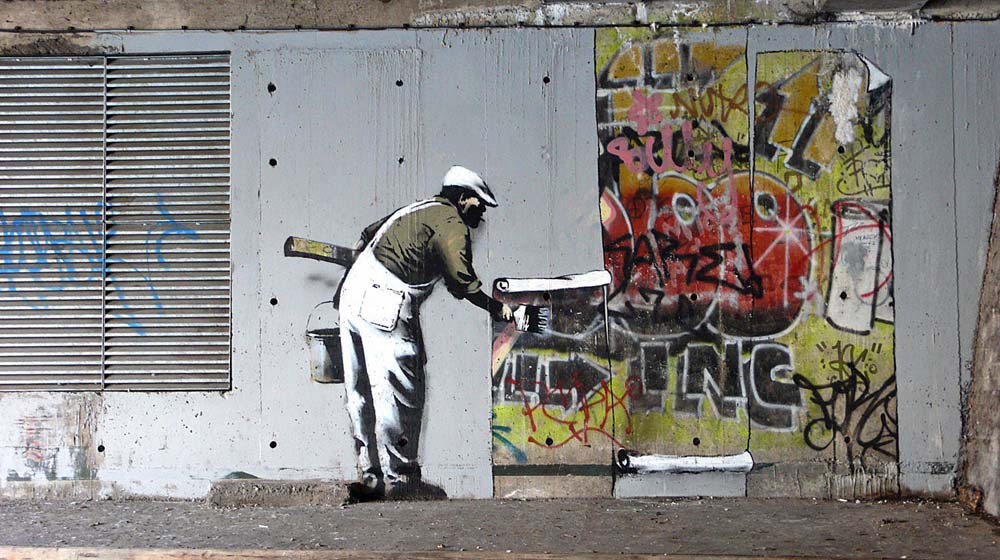
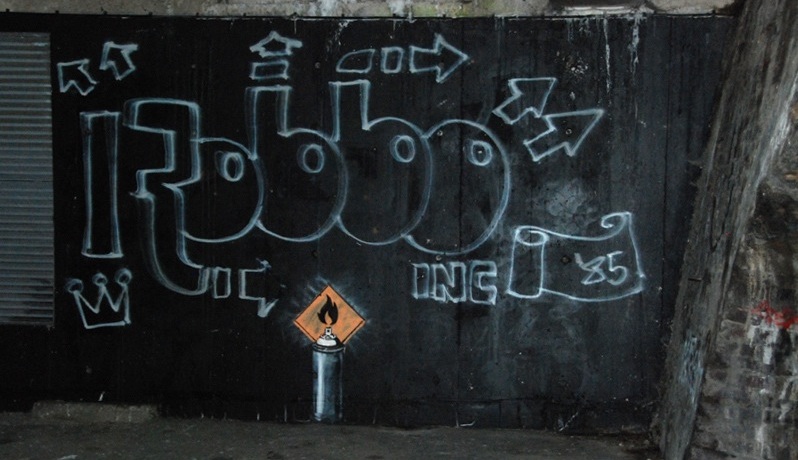
According to the illustrator and graphic designer Tristan Manco, one of the most ardent researchers into urban art, the controversial Banksy was an apprentice butcher before getting into graffiti during the 80’s “aerosol boom”. In the 90’s, he was a gang member of Bristol’s DryBreadZ crew, aka DBZ, at which time his fame began to spread like wildfire, mainly due to his tit-for-tat overpainting war with the top graffiti artist of the day, King Robbo, whose work along Regent’s Canal in Camden Banksy took the liberty of “revamping” repeatedly until, on learning of the late Robbo’s comatose condition, he put an end to their feud and paid his rival a series of heartfelt tributes.
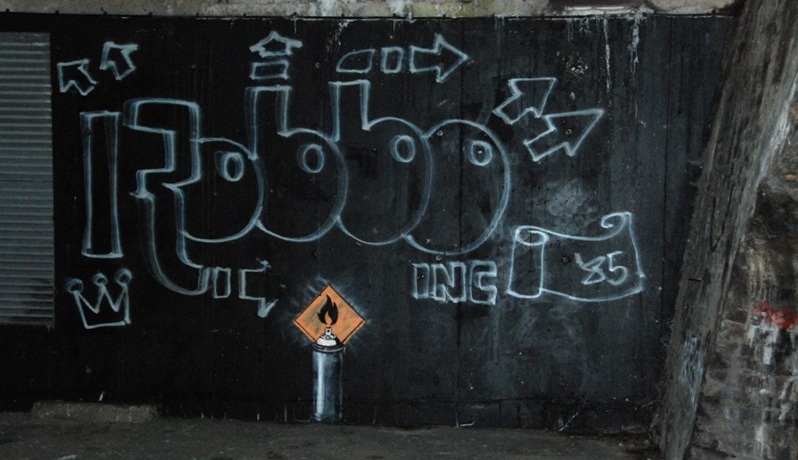
Robbo inc, availible at streetartlondon.co.uk
On the 12th of July 2008, the Mail on Sunday announced it had discovered his real identity, revealing his name as Robin Gunningham, which the actual Mr Gunningham has always denied when questioned. According to other sources, his real name might be Robert Banks or Robin Banks although the latter would appear to be a play on the words “robbing banks”.
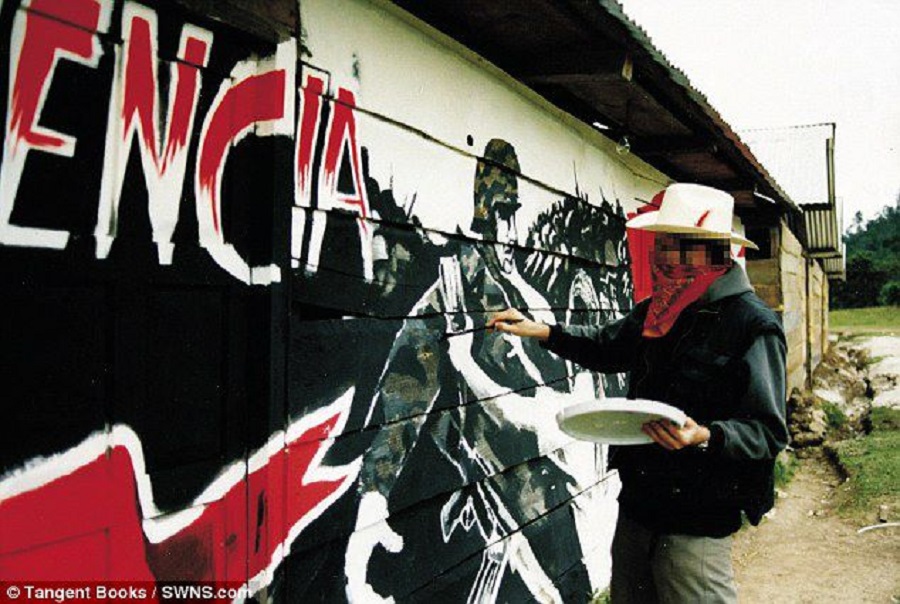
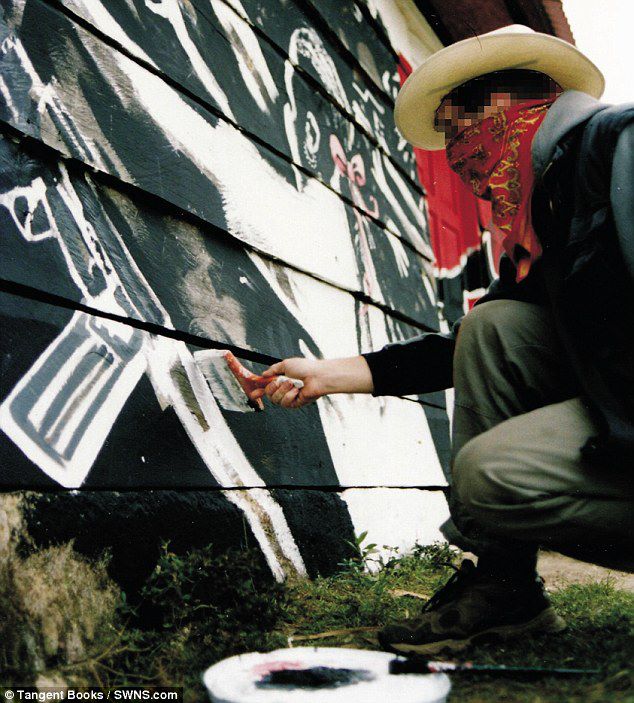
Whatever the case may be, mystery still surrounds him. According to Will Simpson, secretary of the Bristol Easton Cowboys and Cowgirls football club, the artist accompanied them on a 2001 tour of Mexico in which he played matches against the Zapatista Liberty Fighters. There exist photographs of him painting a wall mural in honour of their cause, his pixelated face well-hidden under a handkerchief and no other discernible clues to his identity whatsoever. Those photos were published in the book ‘Freedom Through Football: The Story Of The Easton Cowboys & Cowgirls’.
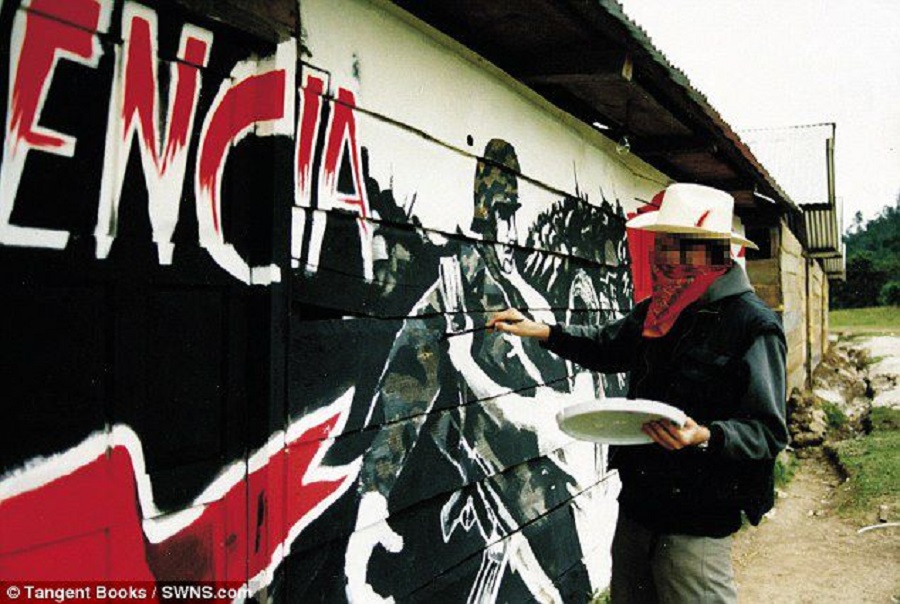
Banksy painting a mural in Mexico, availible at www.12ozprophet.com
In his book ‘Wall And Street’, Banksy remembers his early days as a street artist spraying the paint directly onto the wall. This technique required time, however, which posed a risk as graffiti was neither art nor legal at that time. He, therefore, began handcutting and using cardboard stencils and carspray to speed up the process and which had the added bonus of making his murals look far more ‘accomplished’.
The term ‘Street Art’ encompasses all forms of artistic expression whose setting is outdoors, urban and, ostensibly, illegal. At the start, these paintings or texts left on walls, buildings and train carriages were given the name graffiti. Their origins can be traced back to the Afro-American and Latino ghettos of 60’s New York as a reaction to the conditions and oppression they were living in. The earliest graffiti artists shared cultural tastes in music, dance and fashion and it was here that hip-hop was born. Later on, more artistic techniques came to be used, namely stencilling, wheat-pasted poster art, templates, installations, sculpture and sticker art.
The messages implicit therein were invariably politically or socially critical, as are Banksy’s: “A wall is a very large weapon. It’s one of the most unpleasant things you can hit someone with.”
Few images illustrate this idea better than his “Maid In London” mural where a uniformed maid sweeps rubbish behind a wall as if to say: what we don’t want to see, we hide from view.
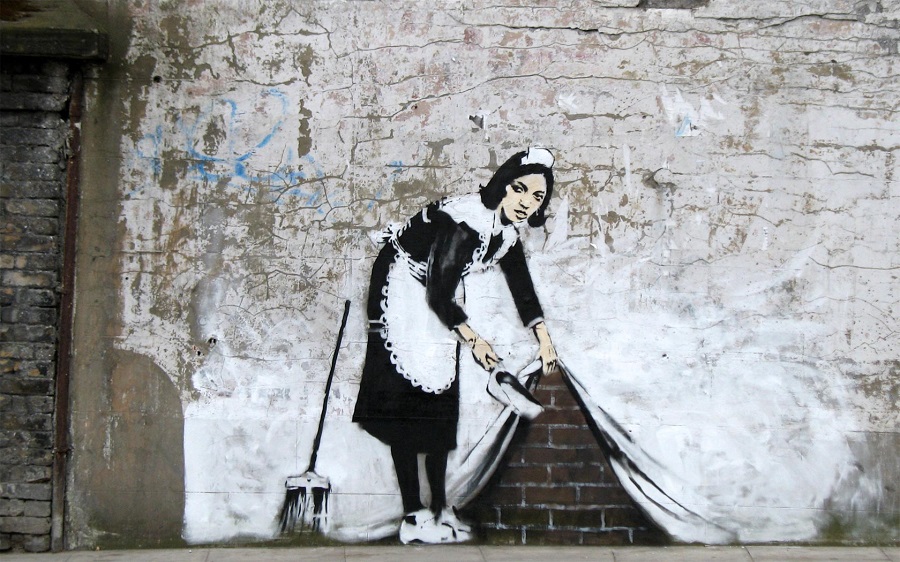
Maid in London, availible at academics.skidmore.edu
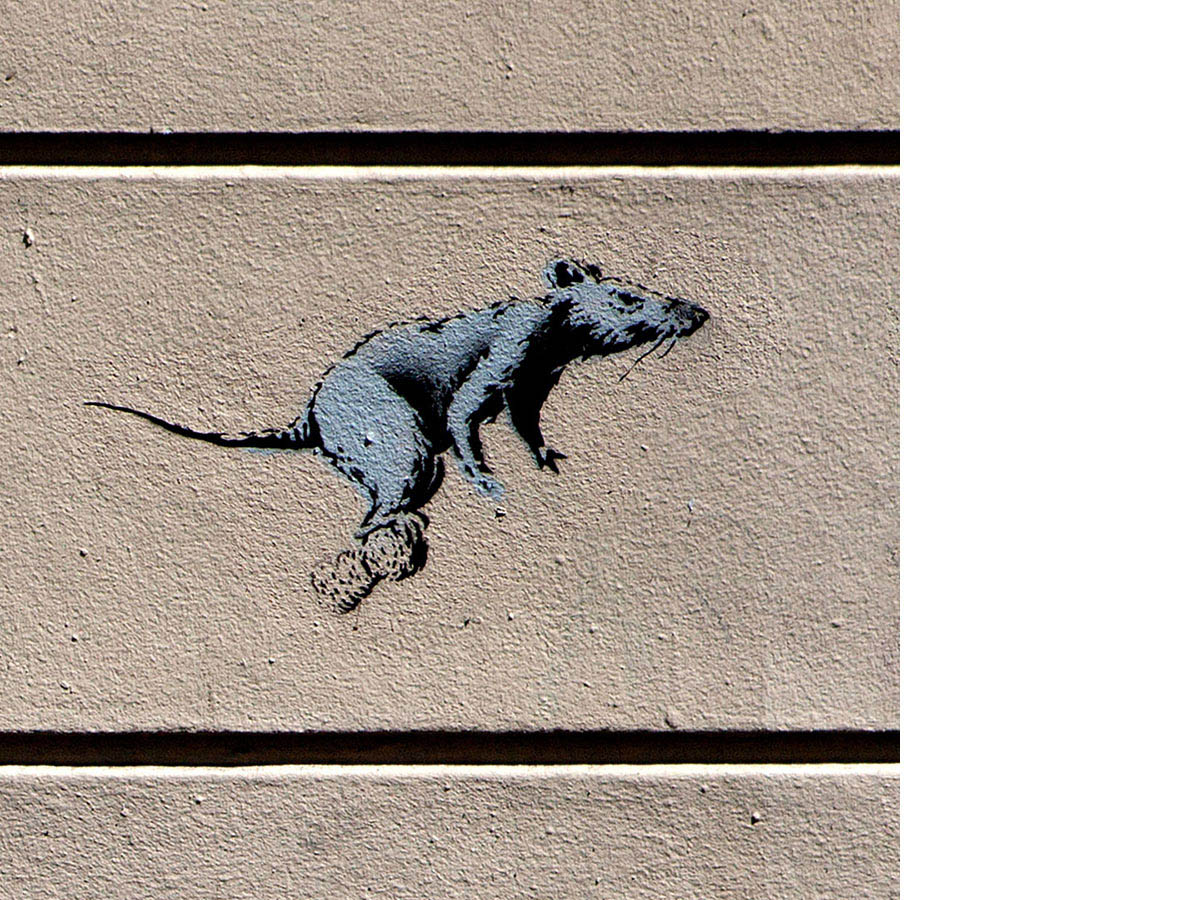
Banksy began by painting rats all over the streets of Bristol which served as his instrument of ridicule against ‘The System’. Influenced by, among others, the punk band Crass and the Ad Jammers movement which focused on deforming and transforming publicity images and thereby their message, Banksy’s work has always sought out a social or moral criticism, in the guise of irony or satire, in the form of writing, stencilling or graffiti.
But if anyone was ever Banksy’s inspiration or influence, it was Blek le Rat, a prolific Parisian graffiti artist of the early 80’s. It was from him that he copied the stencil and aerosol technique as a means of expressing his criticisms and complaints: “Every time I think I’ve painted something vaguely original, I find out Blek already did it, better, 20 years earlier.”
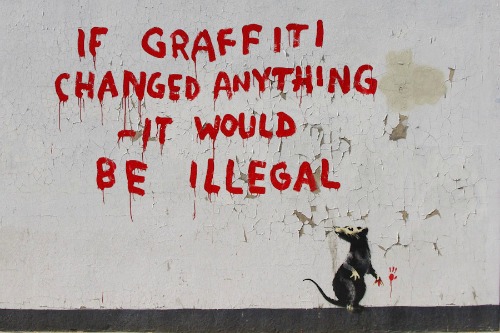
If graffiti changed anything – It would be illegal, availible at news.fitzrovia.org.uk
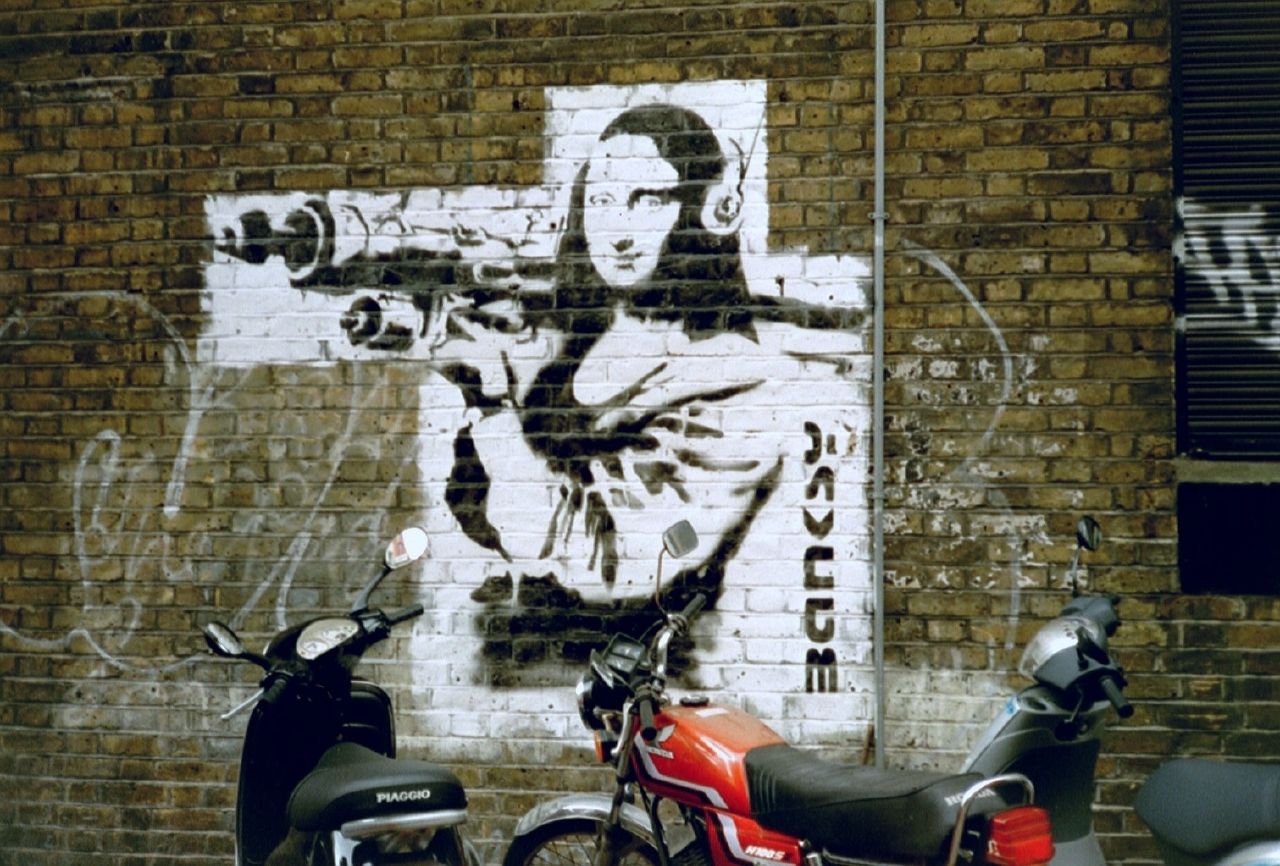
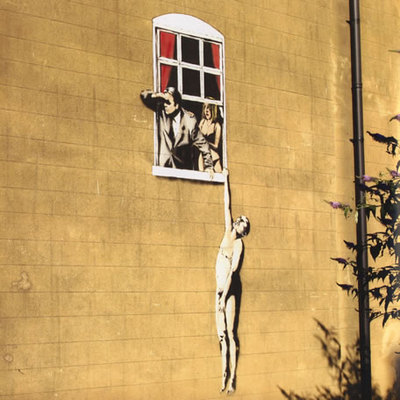
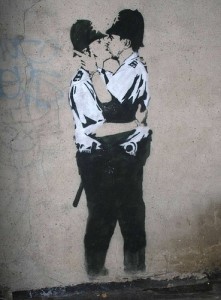
After those initial rat-taking-photos-of-passers-by or rat-listening-to-music graffitis came more work that continued to criticise social hypocrisies, only now they were also appearing on postboxes, doorways and drains. His 1988 “Naked” can still be seen on the façade of Park Street Clinic and it’s not alone: a whole series of creations decorated first Bristol and then London, well-known examples being the two policemen kissing, the MonaLisa with bazuka rifle or the fleeing natives chased by a supermarket trolley.
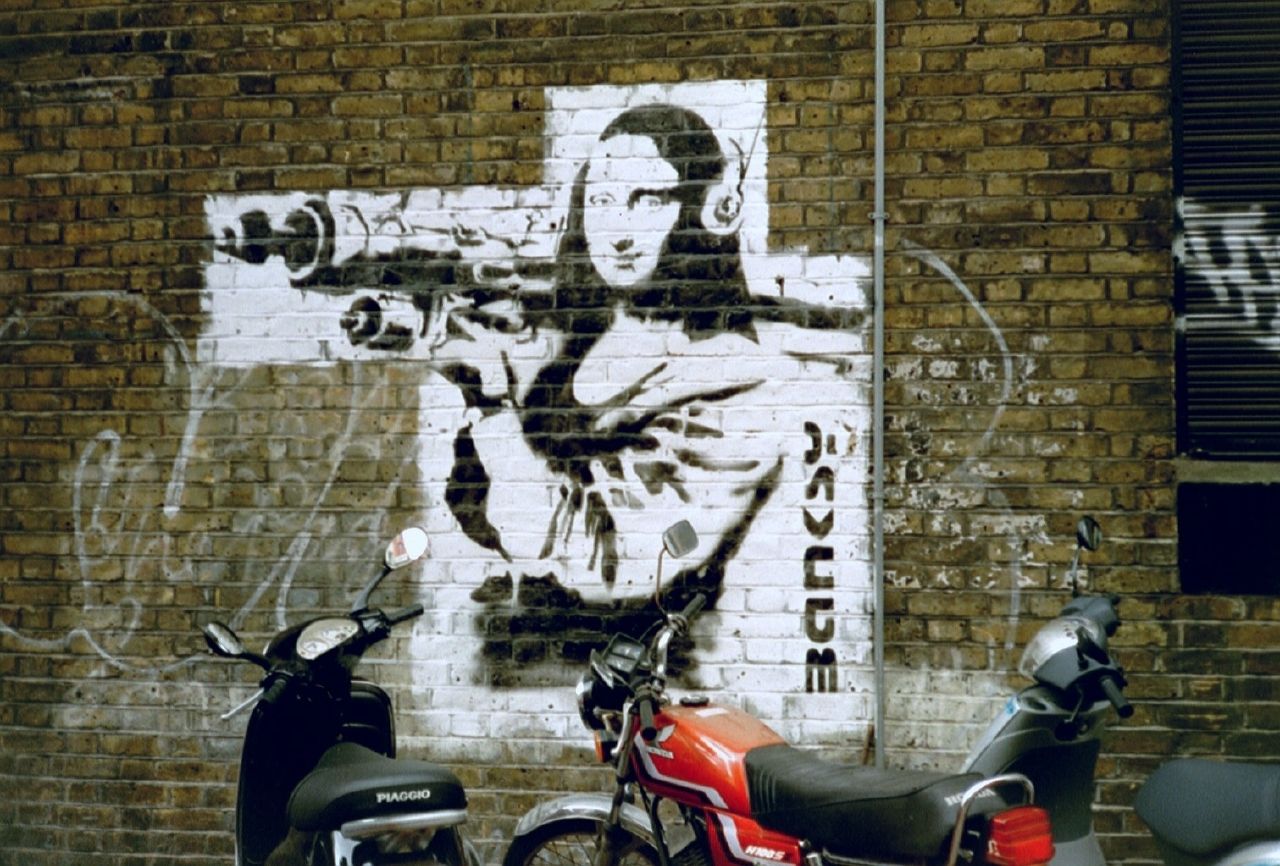
Mona Lisa With Bazooka Rocket, availible at nohaycomolodeuno.blogspot.com.es
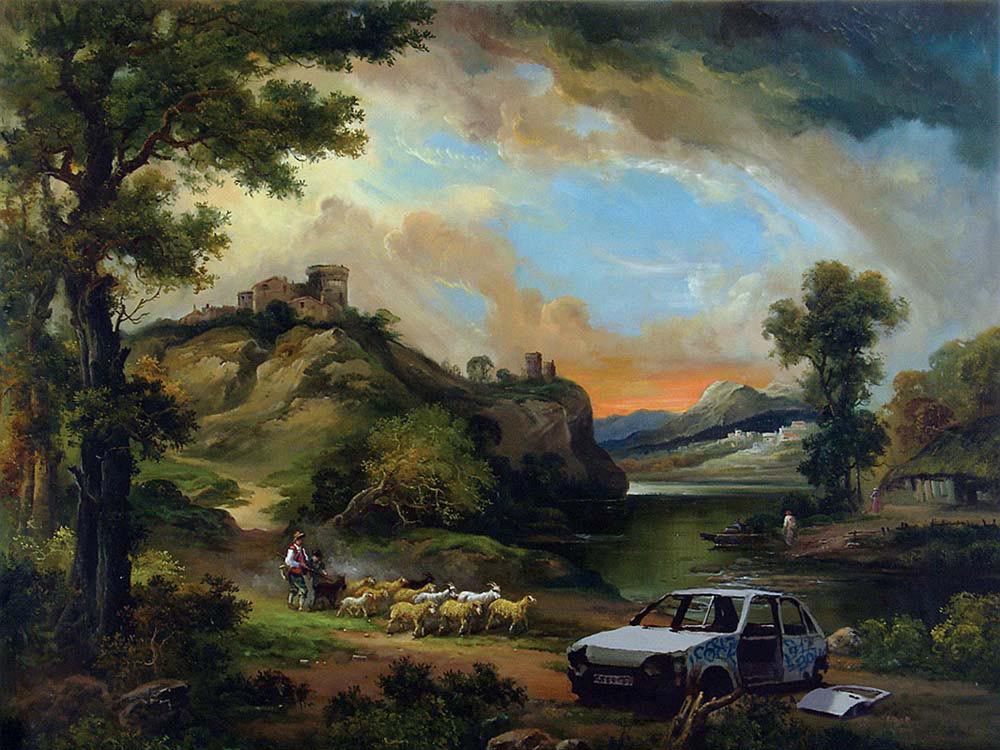
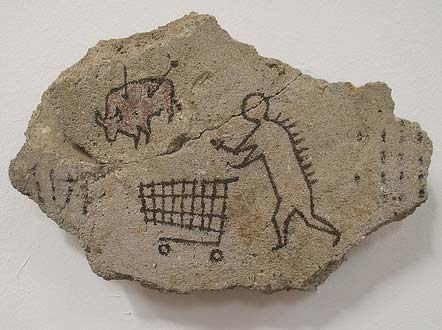
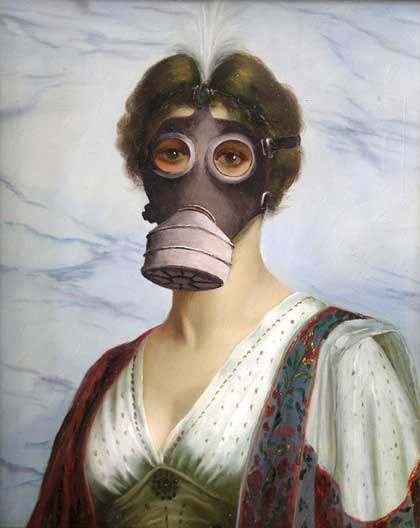
By then, he was already collaborating with an agent, Steve Lazarides, a former photographer who had documented Banksy’s first teenage forays into graffiti art and with whom he shared the running of his website where both of them added photographs of each and every new creation and thanks to which there is still a record of those that have since been erased, demolished or painted over. Lazarides confesses to having helped organise the infamous stunts which involved infiltrating the world’s most famous museums and dislaying Banksy art clandestinely, as happened at London’s Natural History Museum with a dissected rat pinned inside a frame. And that was not all. In the British Museum, for instance, they managed to hang an apparent landscape painting that on closer inspection revealed a hunt scene with a supermarket trolley. New York’s MOMA unwittingly displayed his portrait of a lady in period costume wearing a gasmask. “Art will be neither beauty nor novelty. It will be effective and it will be troubling,” according to the artist.
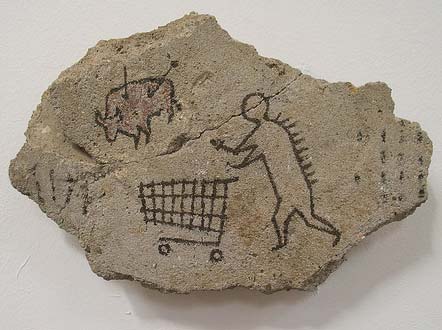
His work reached another level after being installed surreptitiously and viewed in four New York museums (the Metropolitan, Brooklyn, Natural History and Modern Art) and also when his street art started being seen across the world in other large cities like Melbourne and París. Come the year 2000, he decided to organise a solo exhibition and did so on the Severnshed, a floating restaurant, thereby distinguishing himself from all other street artists. Then, in 2003, came another exhibition, this time in London while later, in 2005 and 2007, two of the most important and striking creations of his career ~ the Gaza and West Bank murals.
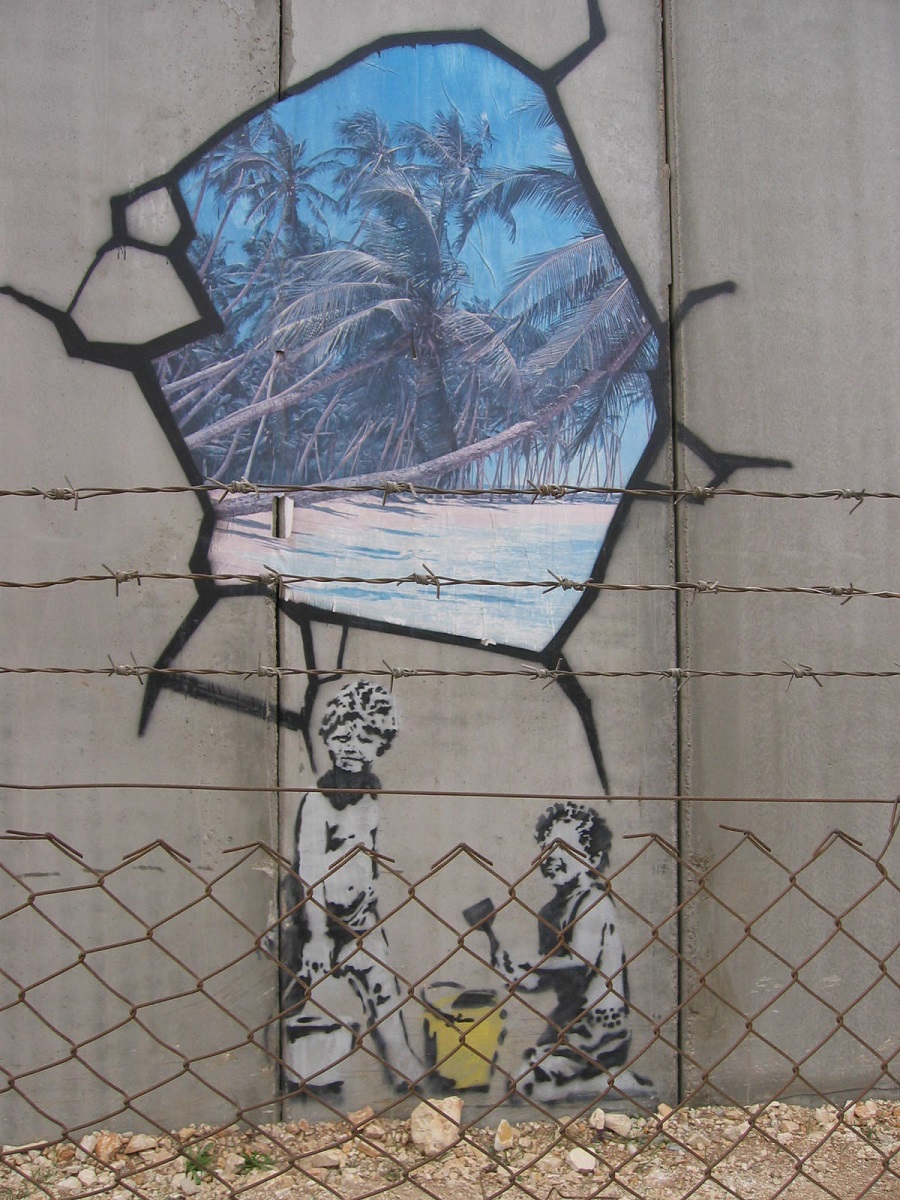
Banksy, availible at prospectornow.com
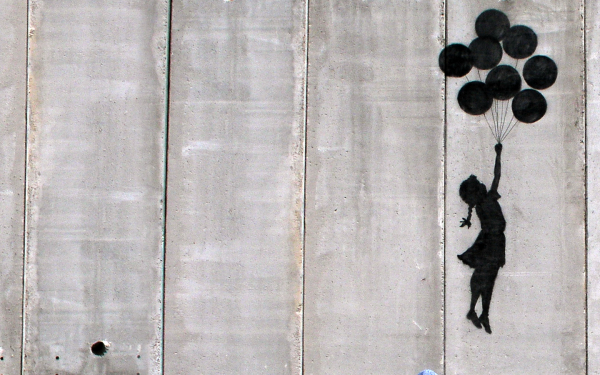
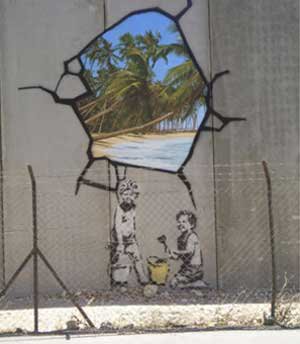
Banksy, who considered it “the world’s largest open-air prison”, covered the ‘Wall Of Shame’ on the West Bank with al fresco paintings that spelled out his opposition. Pictures of little girls clutching balloons in an attempt to escape, glimpses of blue sky and idyllic landscapes seen through holes and cracks are a cry for attention against its construction and existence. The repercussions were such that, even today, there is an alternative sightseeing tour to visit them.
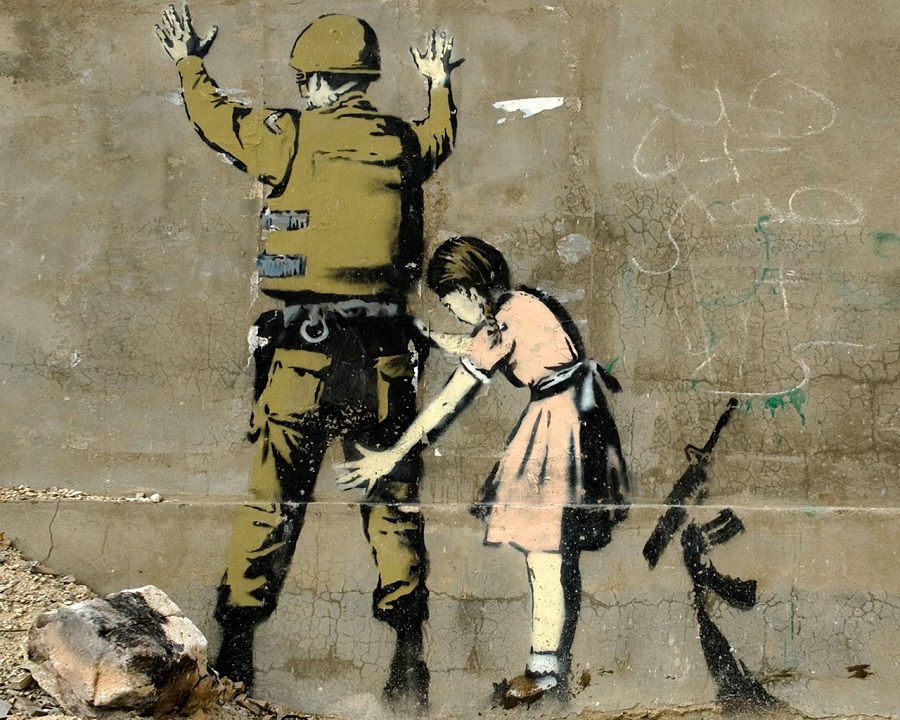
Girl and Soldier by Banksy, availible at http://www.stencilrevolution.com/
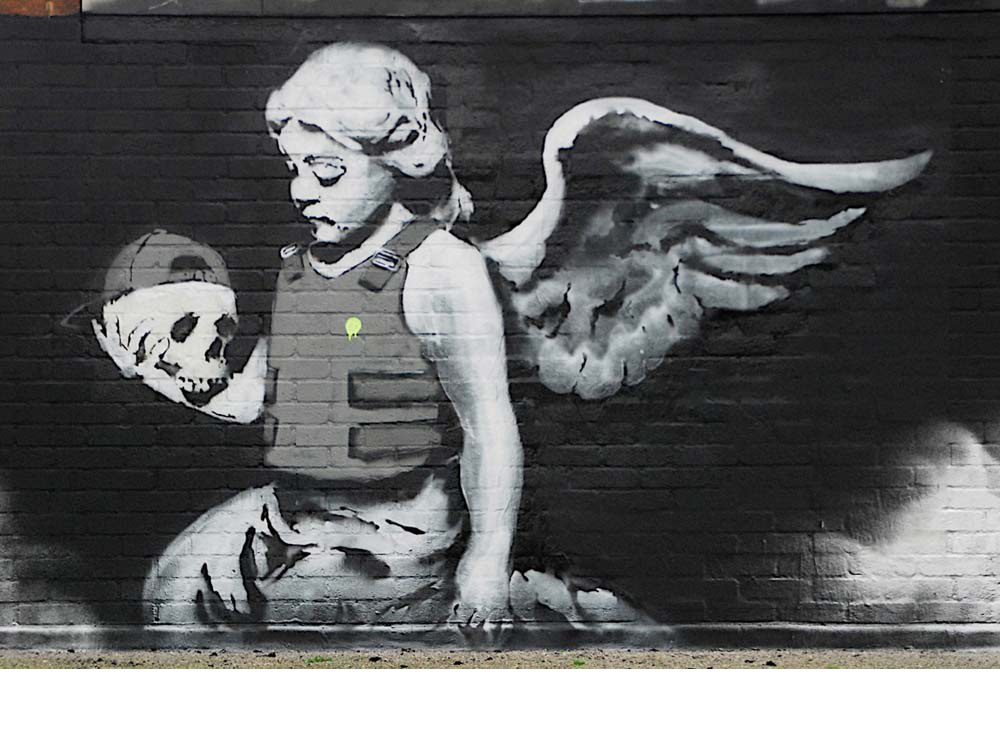
By this point, Banksy’s works could be found all over the world, everywhere from Los Angeles to Barcelona. Amongst them, imitations of Miguelangelo’s “David” wearing a bullet-proof vest and Van Gogh’s “Sunflowers”, completely withered. In 2006 he painted an emaciated, malnourished black child wearing that crown associated with a very well-known fast-food chain.
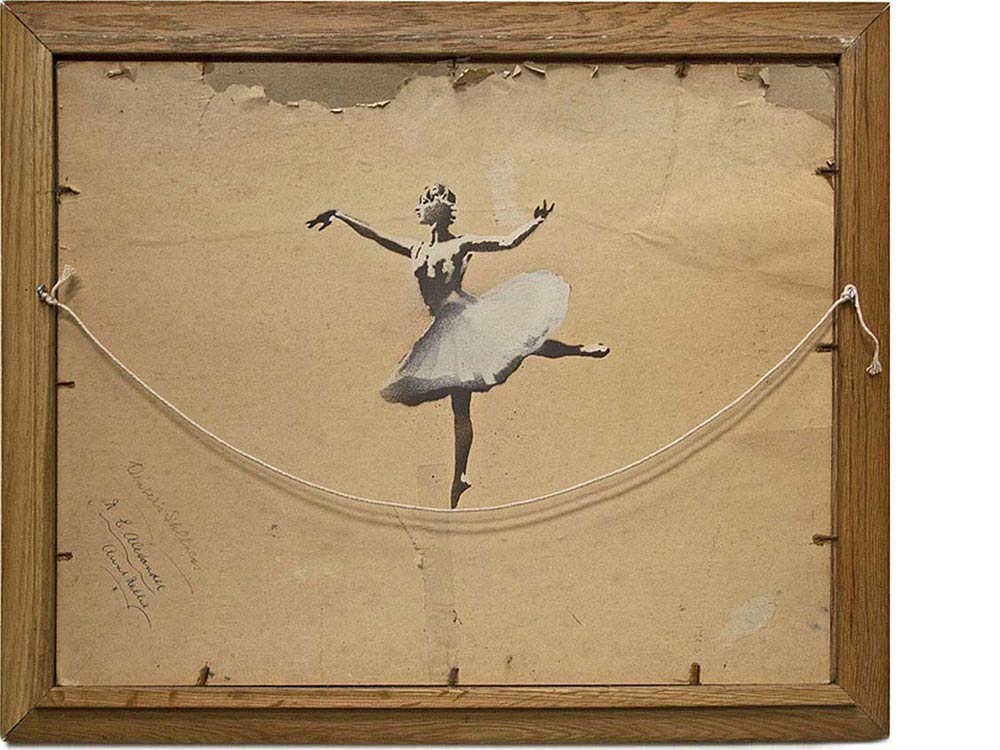
One successful show that stands out is his ‘Banksy Versus Bristol Museum’ in 2009 which involved closing the building to the public for three days while secret, large-scale preparations were made. The irony of this all being financed by those who had previously censored him was not lost on Banksy who remarked: “This is the first exhibition I’ve ever held where the donors’ money has been used to display my work rather than erase it.”
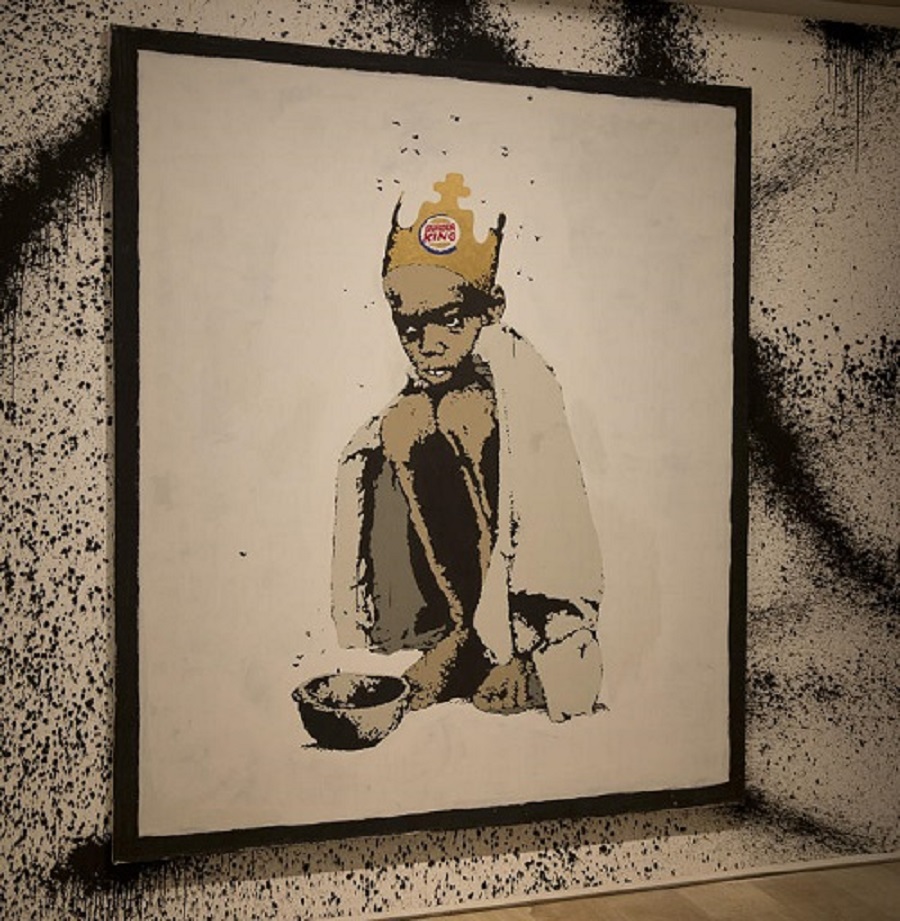
Availible at www.plataformadeartecontemporaneo.com
One of the main bones of contention between his followers and detractors is the extortionate price paid for some of his work. For such an anti-establishment and stern critic of capitalism, it seems to some rather ironic that his works are amongst the most expensive on the market. For this reason, some street artists accuse him of having “sold out” to the powers that be. Banksy, who once said that “Commercial success is a disaster for graffiti artists”, saw his set of portraits of Kate Moss in the style of Warhol’s “Marilyn Monroe” sell for $80,000 at Sothesby’s in 2006. And then again in April 2007, his “Space Girl & Bird” (spray paint on steel) sold for half a million dollars. A few months later, Bonham’s sold ten of his works for a total of half a million pounds sterling (€700,000). And the bids show no sign of stopping there. Nevertheless, in 2013, Banksy decided to open a pop-up street stall near Central Park selling original, signed canvasses for $60 each. Oddly, only eight of them were ever bought.
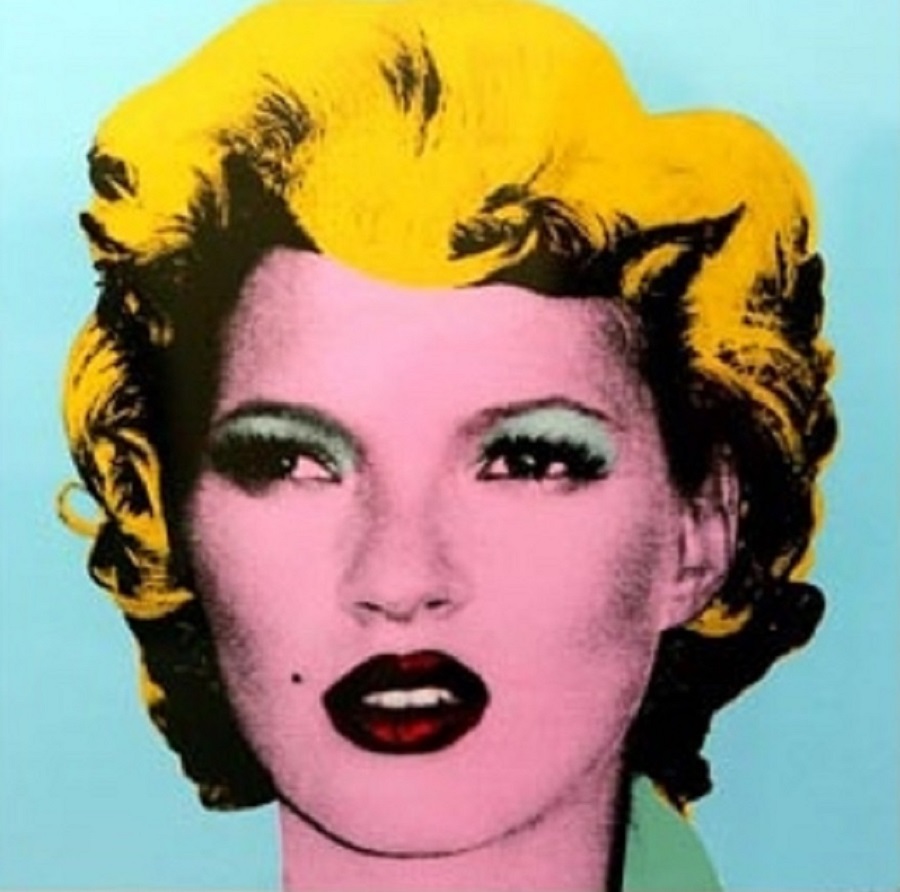
Kate Moss, availible at www.banksy-prints.com
During his New York tour that same year, Banksy carried out an illegal exhibition called “Better Out Than In” whereby he created a different artwork every day somewhere on the city streets. He tweeted: “Looking forward to getting my hands dirty tonight!” And he most certainly did, using graffiti, sculpture and even video to get his characteristically sarcastic humour across.
Never far from controversy, there are many who have denigrated his work: some calling it vandalism; others pure hypocrisy for criticising capitalism whilst working for large corporations like Puma and MTV. For others, take for example Gareth Williams, head of Urban Art at Bonham’s in London: “The most incredible thing about the Banksy phenomenon is not his meteoric rise, nor the high prices collectors pay, but the fact that the very establishment he satirises has welcomed him with open arms.”
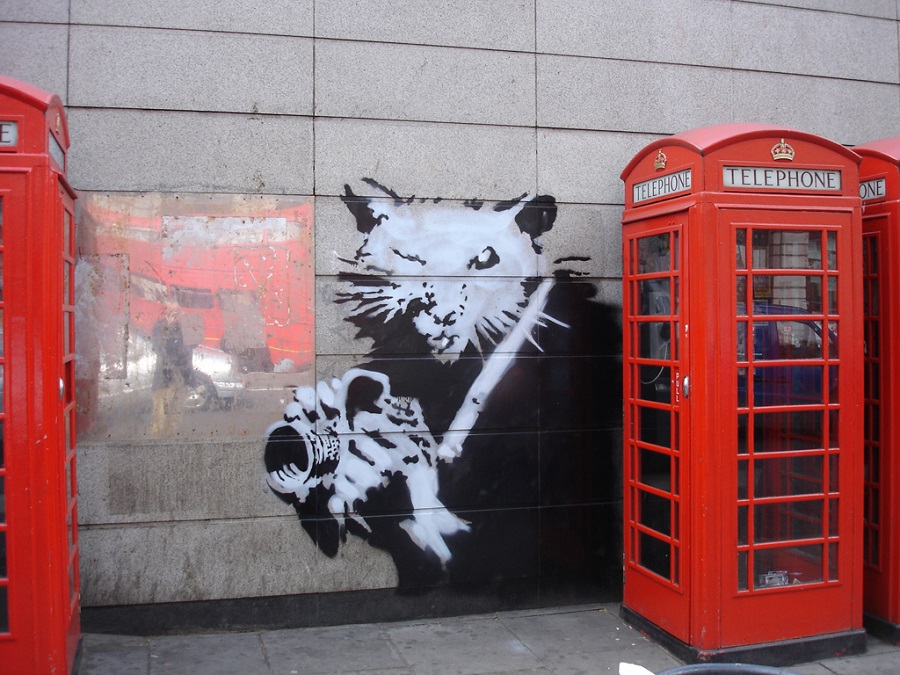
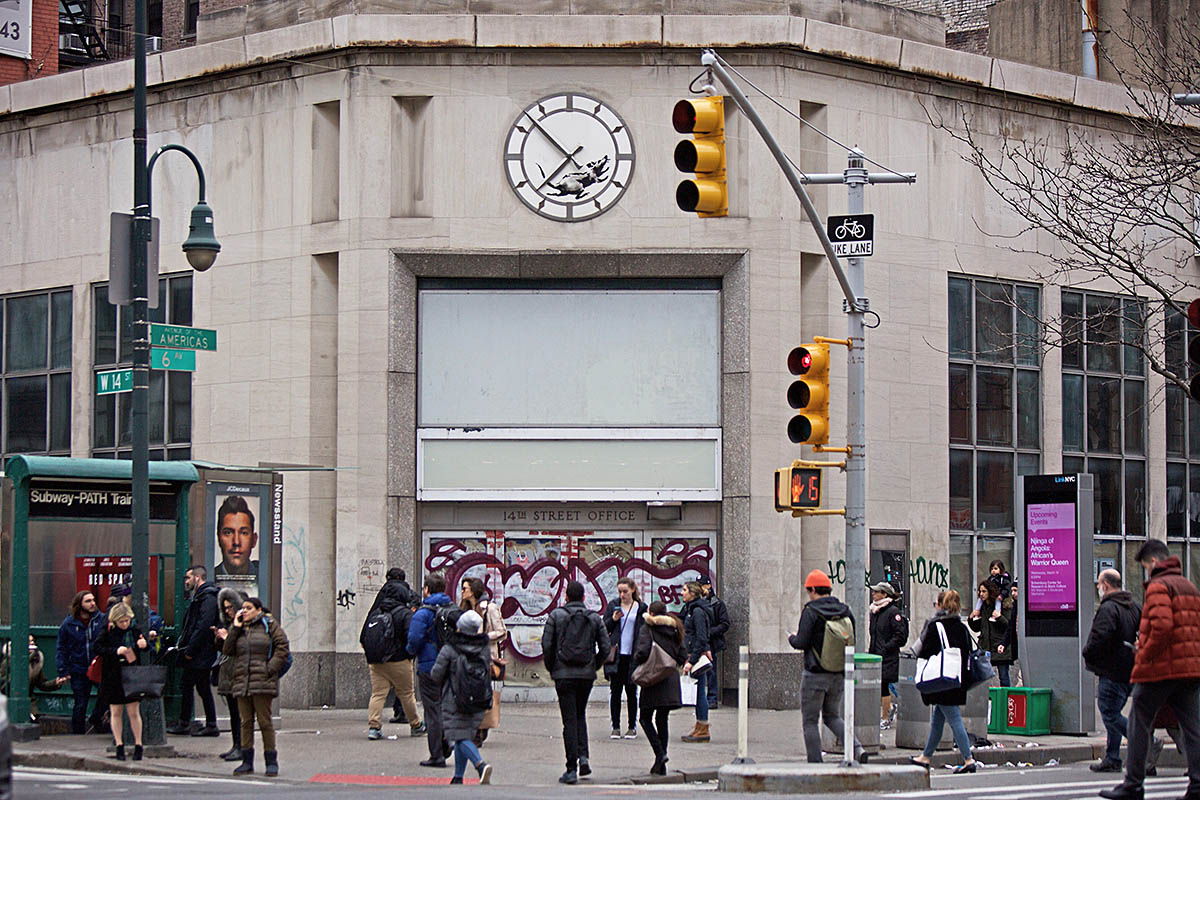
Rat Photographer,availible at www.whatsonyourwall.com
And so to the controversy surrounding his 2010 documentary entitled “Exit Through The Gift Shop”. Many were hoping for all to be revealed about their mysterious artist but hoping was as far as they got. The documentary was nominated for an Oscar, as well as an Independent Spirit Award and a BAFTA, and got excellent newspaper reviews in the Los Angeles Times and the Chicago Sun Times to name but two. In it, Banksy introduces us to Thierry Guetta, a French man living in Los Angeles, whose unique obsession is filming the artist on video. The two meet and Banksy decides to turn the camera instead on Guetta, persuading him to infiltrate the Urban Art world with the alias Mr. Brainwash and turning him into a celebrity in his own right.
Clips from “Exit Through The Gift Shop” (Thierry, Banksy: Can marketing create an artist?)
And this is where the controversy took off. Is what the documentary says about Mr. Brainwash fact or fiction? Is he an actor or for real? For many, it was just an elaborate montage of Banksy’s to show what has become of street art, namely just another consumer product, an investment opportunity seized upon by the upper classes and Thierry Guetta or Mr. Brainwash was nothing other than the alter-ego of Banksy himself. And to thicken the plot further, the artist Ron English confirmed that Thierry Guetta was totally real and that Banksy himself had explained in conversation his motives for making the film ~ to ridicule Guetta for his egoism in refusing to share hundreds of hours worth of filming the artist in action.
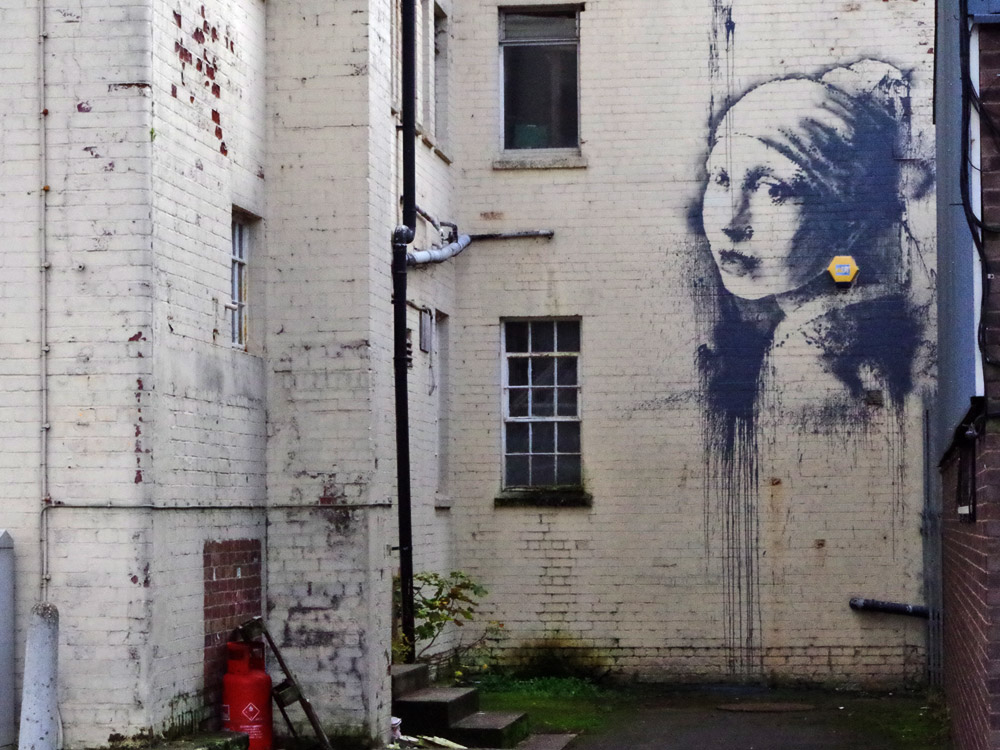
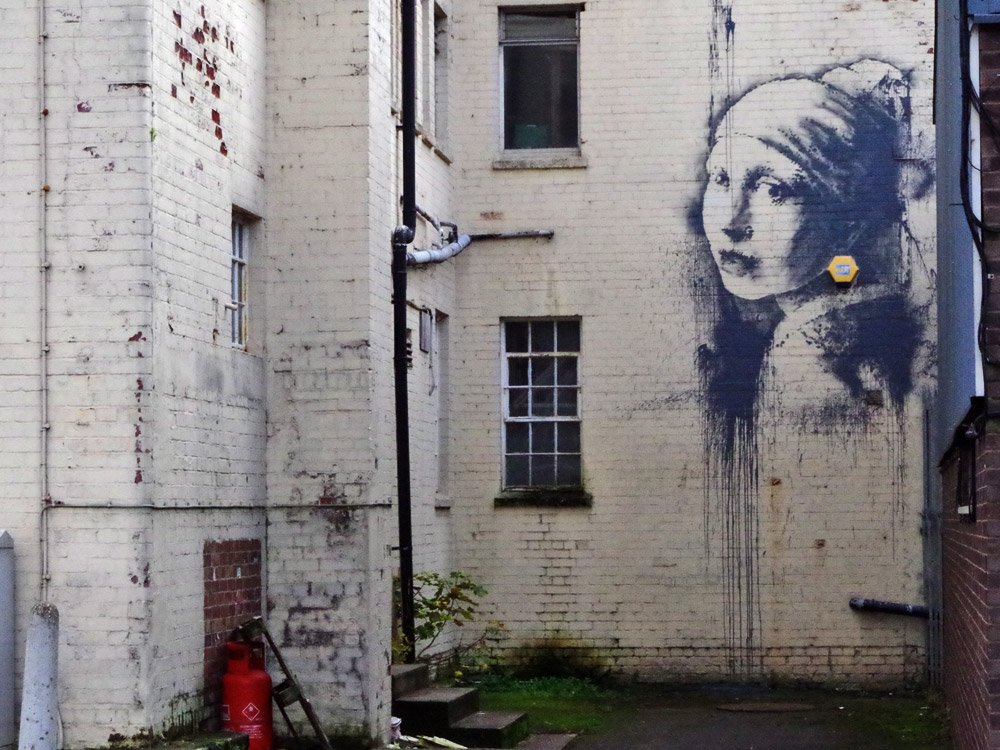
Girl with a pierced Eardrum found at Banksy.co.uk
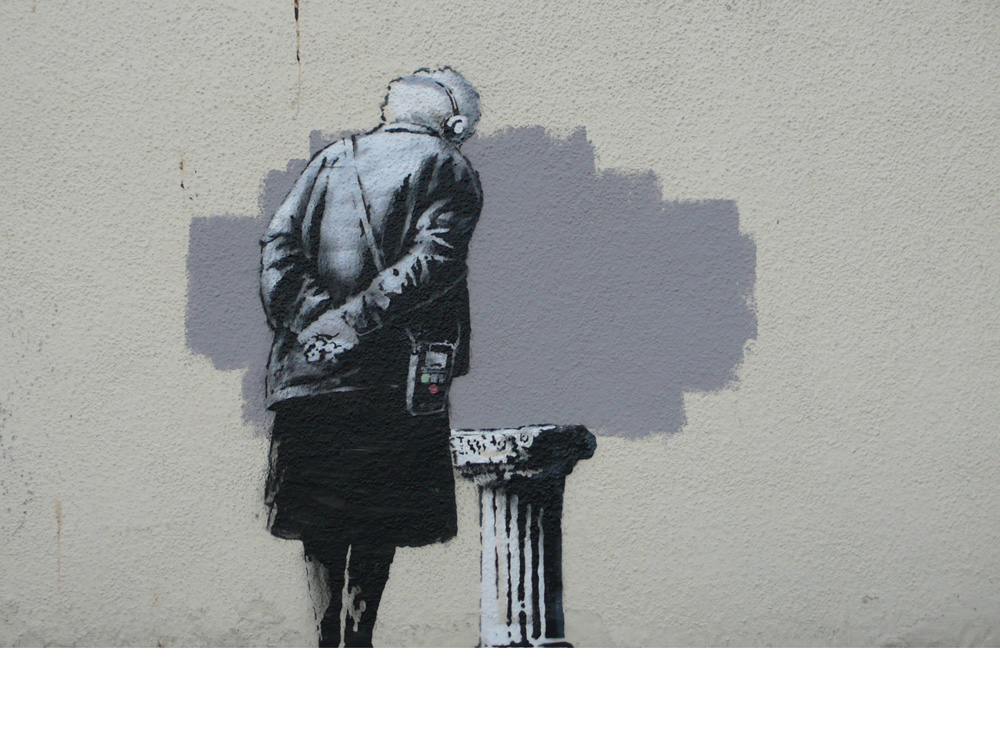
In October 2014, Banksy created a new graffiti ‘portrait’ of “Girl With A Pierced Eardrum”, a parody of Vermeer’s” Girl with a Pearl Earring” in which he exchanged the jewel for a security alarm on the front wall of a recording studio in Hanover Place, Bristol. The work got a lot of media attention, especially because it was done back in the artist’s hometown and shortly after the rumours of his alleged arrest started to circulate. 24 hours later, however, the work was ruined by black paint in a clear act of vandalism and antagonism towards its author. And nor was this the first, last or only time Banksy’s work would be damaged: his “Art Buff” in Kent, for one instance, was vandalised with a crude penis. Due to the prominence he has achieved over the last few years, however, some of his public artworks are now protected behind sheets of clear perspex, allowing them to be protected or restored more easily.
One of Banksy’s murals before being cut into 3 pieces and moved to an exhibition. Found at banksy.co.uk
One of the most recent exhibitions on the artist, set up by The Sincura Group under the title “The Stealing Banksy”, took place in London in 2014, exhibiting 7 street artworks that were then to be auctioned afterwards. Not for the first time, Banksy vociferously rejected the whole project despite the organisers assuring him of the building owners’ consent. He is quoted as calling it “simply disgusting that anyone can take art off walls without permission.”
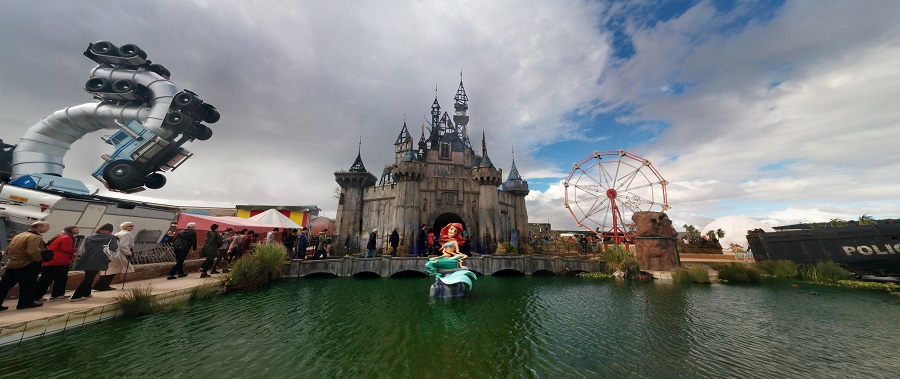
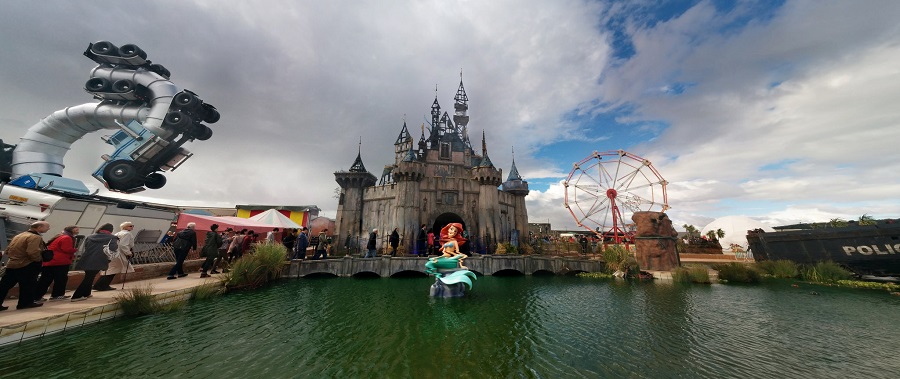
Banksy’s Dismaland. Published in Flickr by Peter Gasston
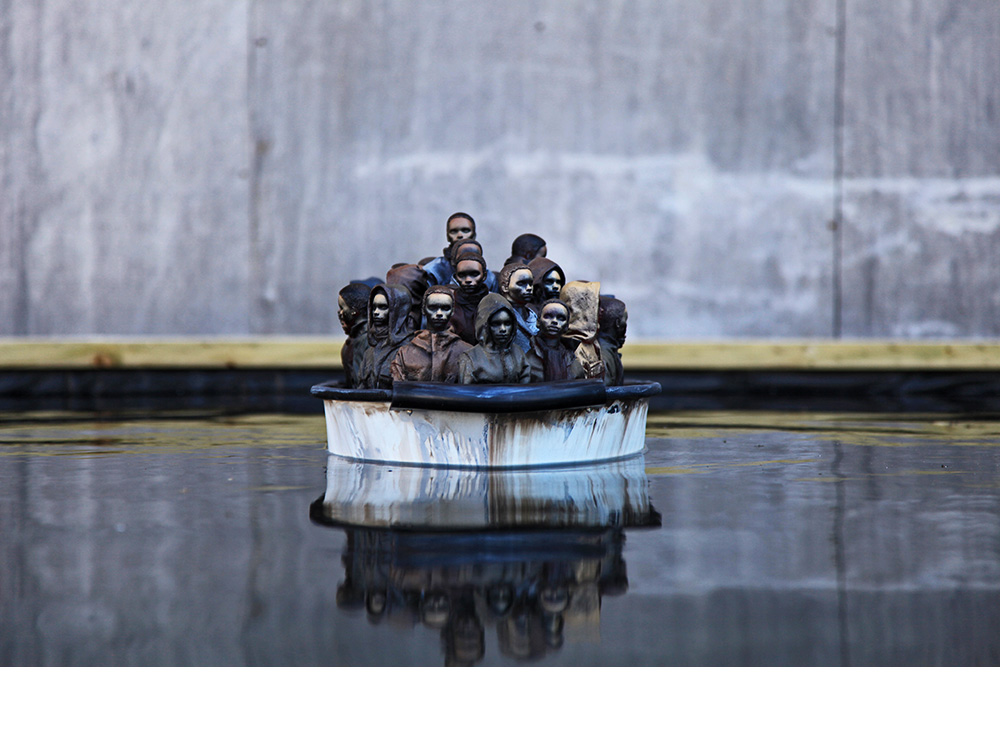
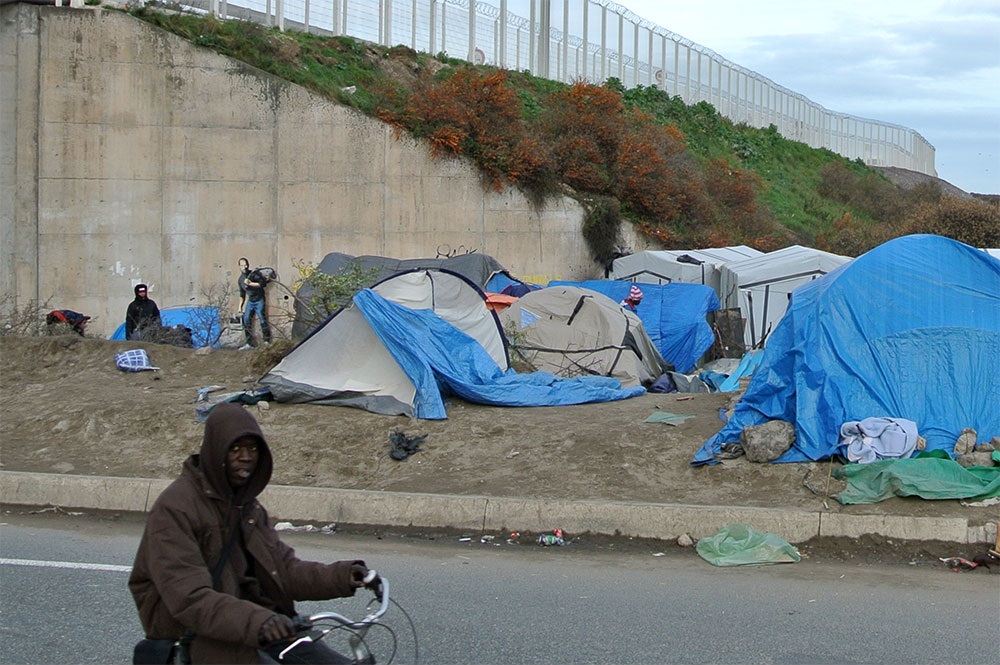
In August 2015, Banksy inaugurated the temporary, theme-park-styled installation “Dismaland” in collaboration with 58 other artists. When this closed its doors, the construction team moved what they dismantled to a refugee camp in Calais and built various housing units and a playground funfair for refugee families. After the recent, forced evacuation of the camp, the official Dismaland website (http://www.dismaland.co.uk/) says simply: “Dismaland Calais has now closed”.
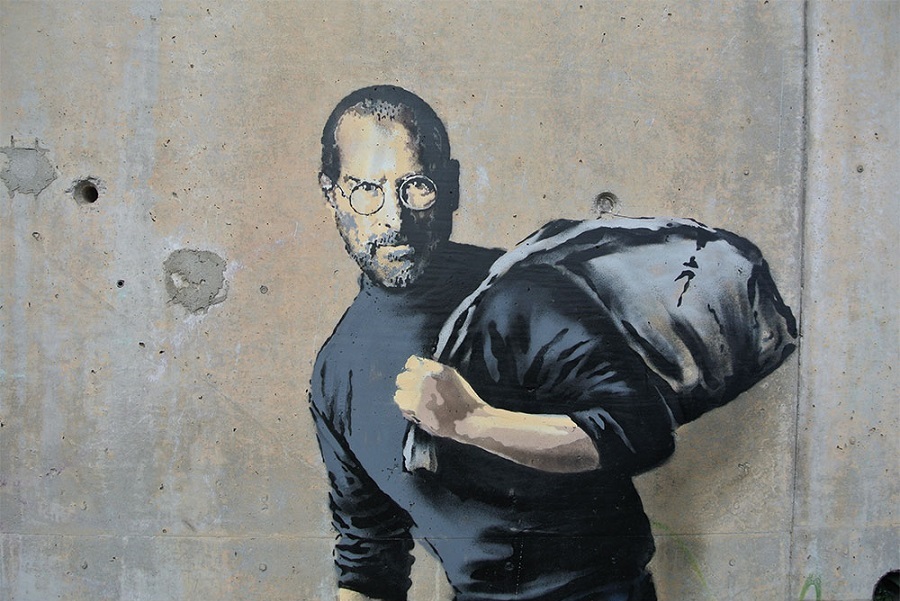
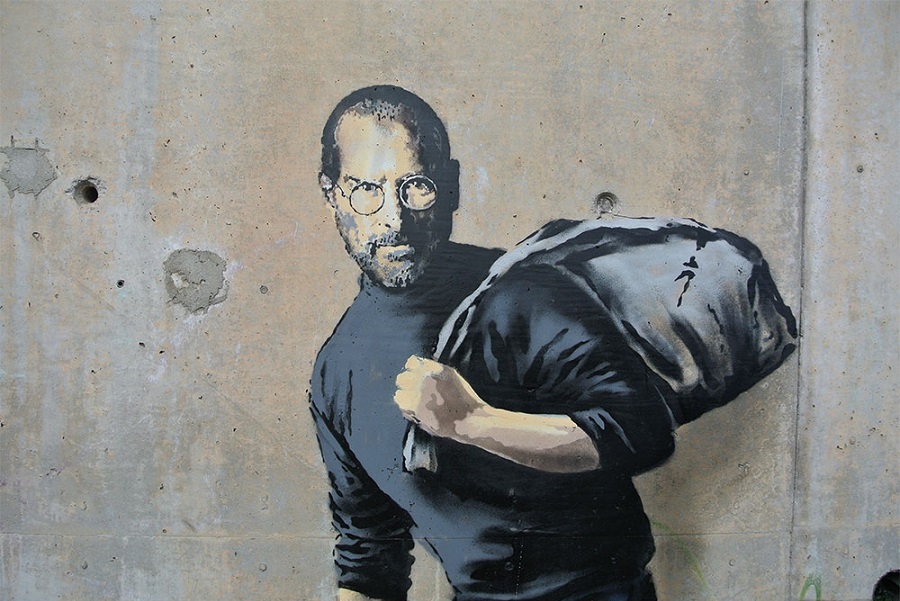
Son Of A Syrian Immigrant. Found at Banksy.co.uk
That December, a new Banksy painting entitled “The Son of a Syrian Immigrant” appeared on a camp wall, picturing the late billionaire Apple founder Steve Jobs with a bag of belongings slung over his shoulder. It is a clear attack on the conditions endured by Syrian migrants in the infamous “Jungle” camp at the French port.
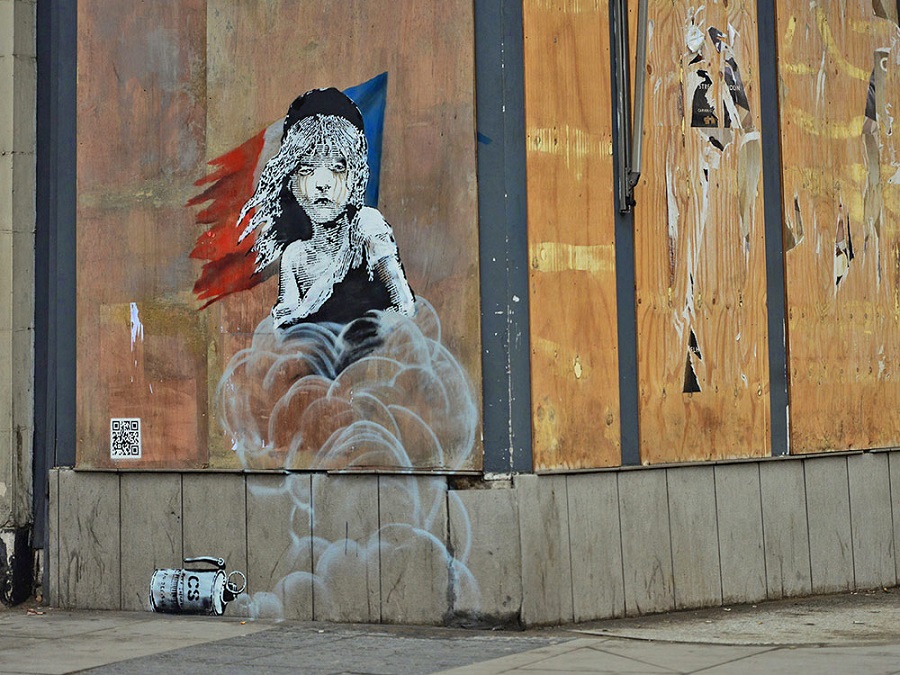
Found at banksy.co.uk
His criticism of the situation continued into January of this year when his first interactive artwork appeared. On a wooden board placed outside the French Embassy in Knightsbridge, he painted Cosette, the little girl from the “Les Misérables” poster, with a ripped French flag behind her, tears rolling down her cheeks and a billowing canister of teargas below. A scannable QR code at the bottom of the picture links to a Youtube video showing police firing teargas whilst raiding the camp in Calais, on 5th January 2016. Photos of the picture went viral and 42 hours later, thieves attempted to steal it which meant the Metropolitan police were forced to intervene and safeguard it.
In February, the portion of wall in question was completely covered over by Cheval Property Management Limited who own the land the building stands on. They confirmed this as a temporary measure, however, until such time as the “future plans for the work are decided”.
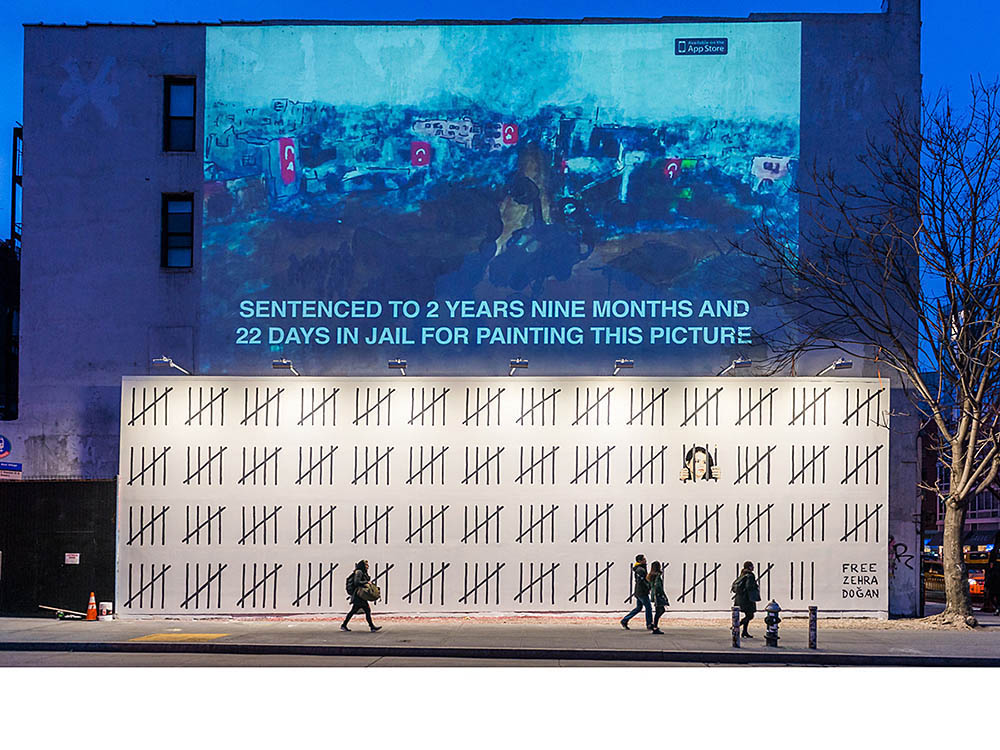
From 13th January til 29th February 2016, Banksy’s works were on show for the first time in Istambul in the exhibition “The Art of Banksy” with the patronage of the Turkish Ministry of Culture. The exhibition, coinciding with the inauguration of the Global Karaköy gallery, took a group of 80 experts almost a year to set up, taking it upon themselves to track down, requisition and catalogue the artist’s last 15 years of work. “Banksy has done a huge amount of artwork, the majority of which has never been seen by many people. I’ve managed to get hold of it thanks to collectors who made a massive effort to reveal the pieces and their whereabouts,” said Steve Lazarides, the exhibition’s curator, who also confirmed it as the most extensive ever undertaken of the work of the elusive Banksy.
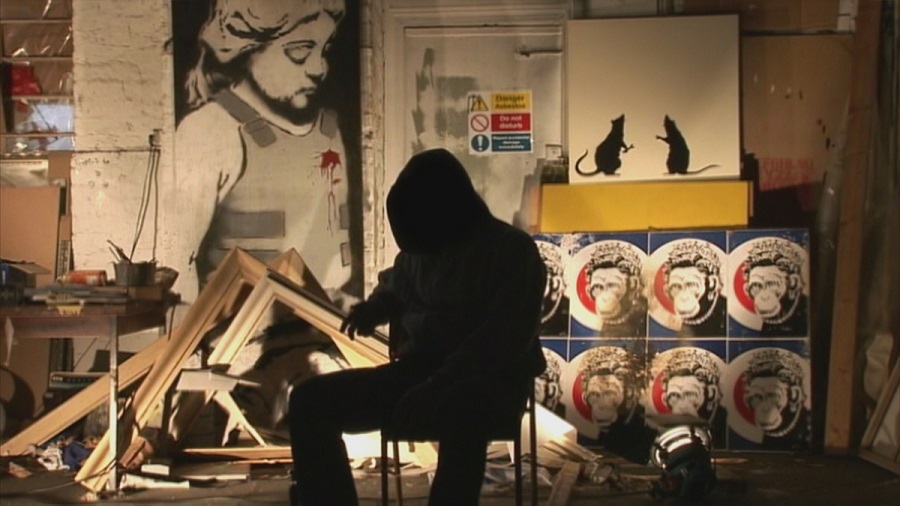
Visitors to the exhibition were able to enjoy it in singular fashion as it included detailed replicas of both the streets of London and Banksy’s studio workshop, allowing them to access more closely and experience more vividly the context of the graffiti’s creation and the poetic, critical and humorous energy of this mysterious and much-talked-about artist.
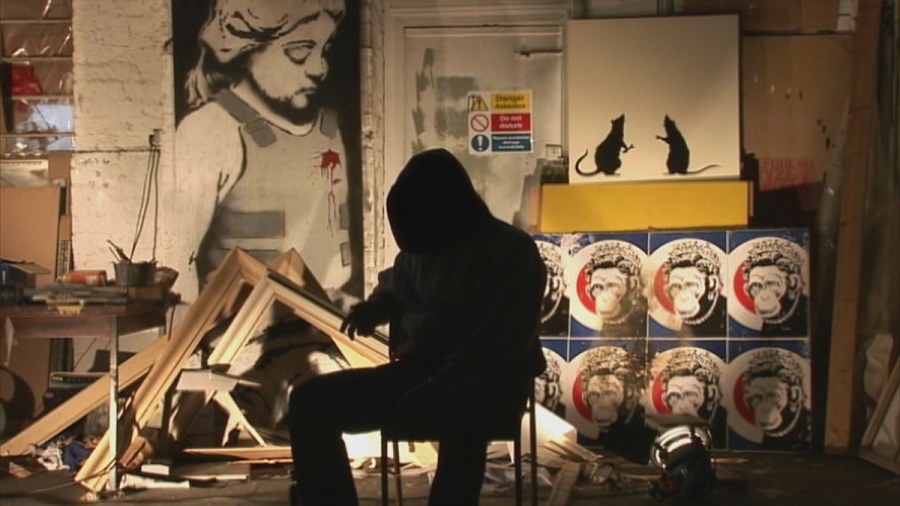
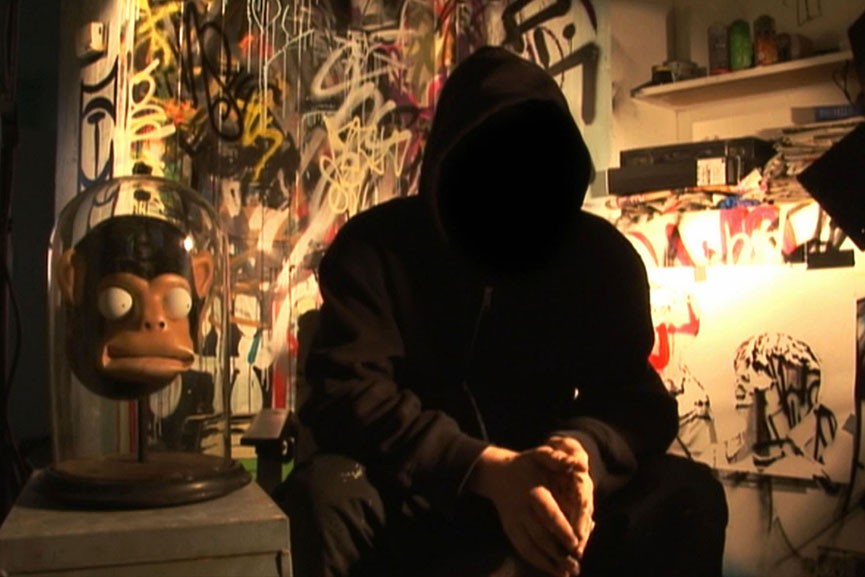
The artist in his studio
Whatever might or might not be going on around him, it’s undeniable that Banksy is the most sought-after, controversial and admired artist in his field. He doesn’t need publicity, nor does he seek approval because his creations speak for themselves and provoke reflection in those who view them. Too many of his pictures have disappeared, like, for instance, nearly all of those to do with the 2012 London Olympics. People have tried to thwart him by ruining his work, destroying and damaging it or stealing it to sell on at exhorbitant prices. Many others, however, find his work and words inspiring, aspire to follow in his footsteps and imitate his unmistakable style.
A decade on: the artist who became unstoppable
What came next confirmed something that was already in the air: Banksy no longer needed a Bristol back street to shake up the public conversation. It was enough for a new image to surface on his Instagram account (his only acknowledged channel, alongside the banksy.co.uk website and Pest Control, the office that authenticates his work) for any old wall in England, Ukraine or Palestine to become front-page news overnight. The decade that followed 2016 has been the one of his definitive coronation as the most talked-about living artist on the planet and, at the same time, of his most political and most personal gestures.
The hotel with "the worst view in the world" (2017)
In March 2017, in occupied Bethlehem, Banksy opened the doors of his most ambitious work: The Walled Off Hotel, a real nine-room hotel pressed right up against the concrete barrier that separates the West Bank from Israel. The name is a pun on the luxurious Waldorf, and the joke holds in every detail: a self-playing piano, portraits of cherubs in oxygen masks and, above all, the promise of "the worst view in the world", because every window looks onto the wall. Part art installation, part political statement, part museum of the occupation, the hotel ran for years as one of the strangest experiences in contemporary tourism, until it closed at the end of 2023 as the conflict in the region escalated. It was, perhaps, the most literal way the artist has ever found of making the visitor sleep facing the problem.
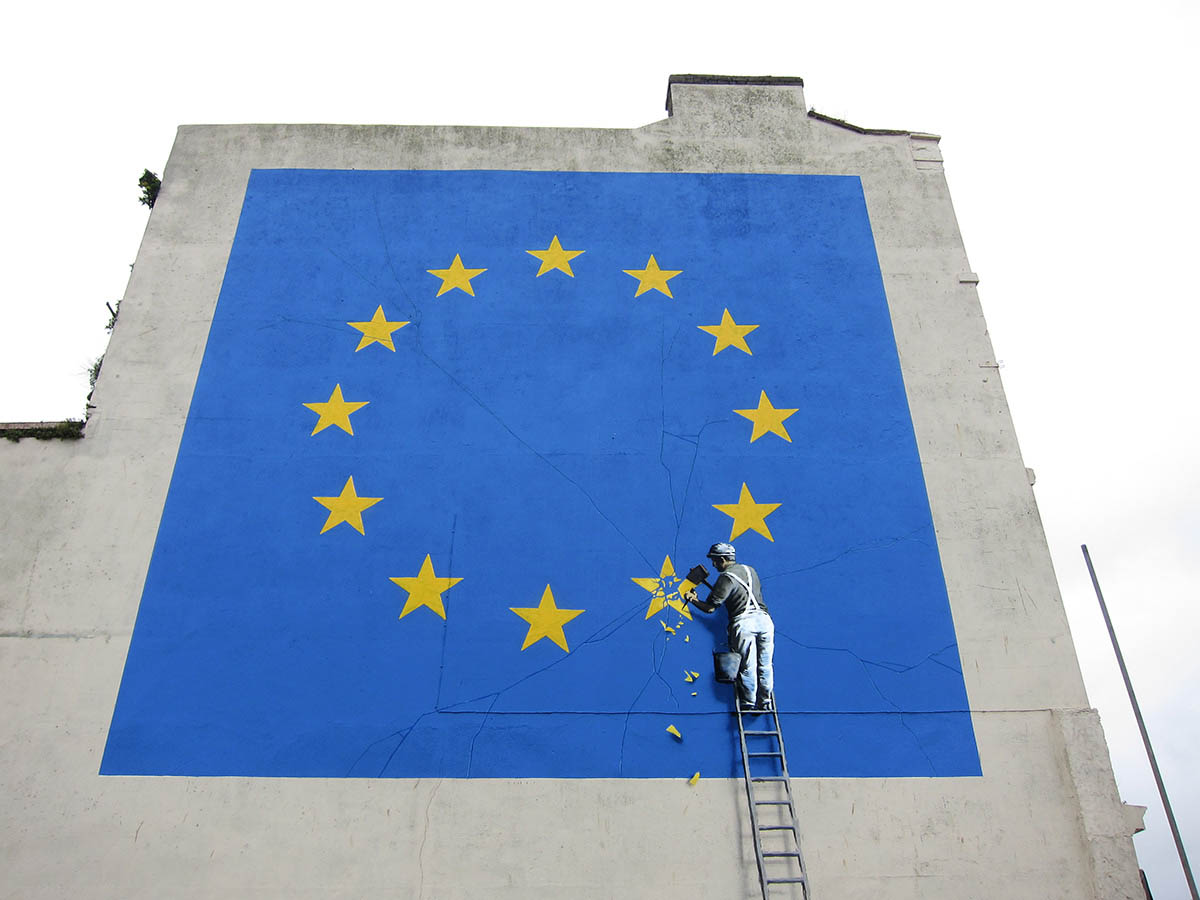
That same year, with the United Kingdom tangled up in Brexit, Banksy painted an enormous European flag on a building in Dover, with a workman up a ladder chipping away one of its stars. A widening crack, a Europe missing a piece. The work vanished under a coat of white paint in 2019, in what many read as a comment on the country itself, as involuntary as it was accurate.
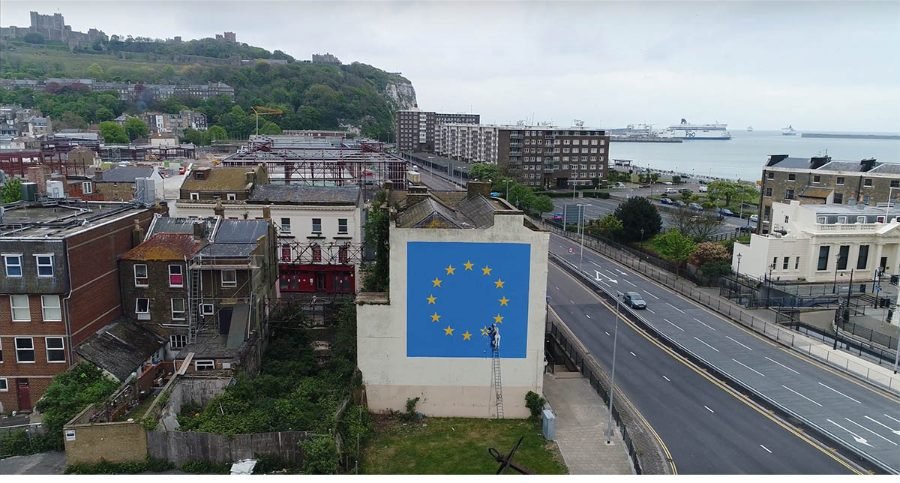
Brexit mural, Dover (2017). Image: banksy.co.uk
The black snow of Port Talbot (2018)
On Christmas morning 2018, on a garage in Port Talbot, the Welsh town that is home to the largest steelworks in the United Kingdom, what looked like a tender scene appeared: a child with arms outstretched, seemingly catching snowflakes. But turning the corner of the garage broke the spell. The "snow" was in fact ash drifting up from a burning skip. Season's Greetings was really a denunciation of the pollution the town's residents breathe every day. The piece forced the council to protect it behind a sheet of perspex and was eventually bought and moved for safekeeping, proving once again the paradox that dogs Banksy: every critique he aims at the system ends up turned into a prized asset.
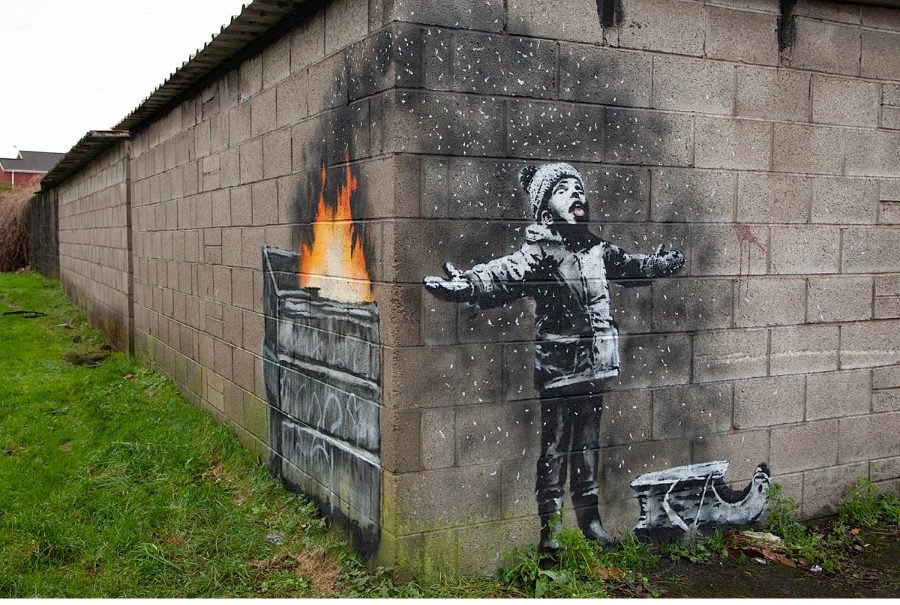
Season's Greetings, Port Talbot (2018). Image: banksy.co.uk
The artwork that shredded itself (2018) and the one that broke his record (2021)
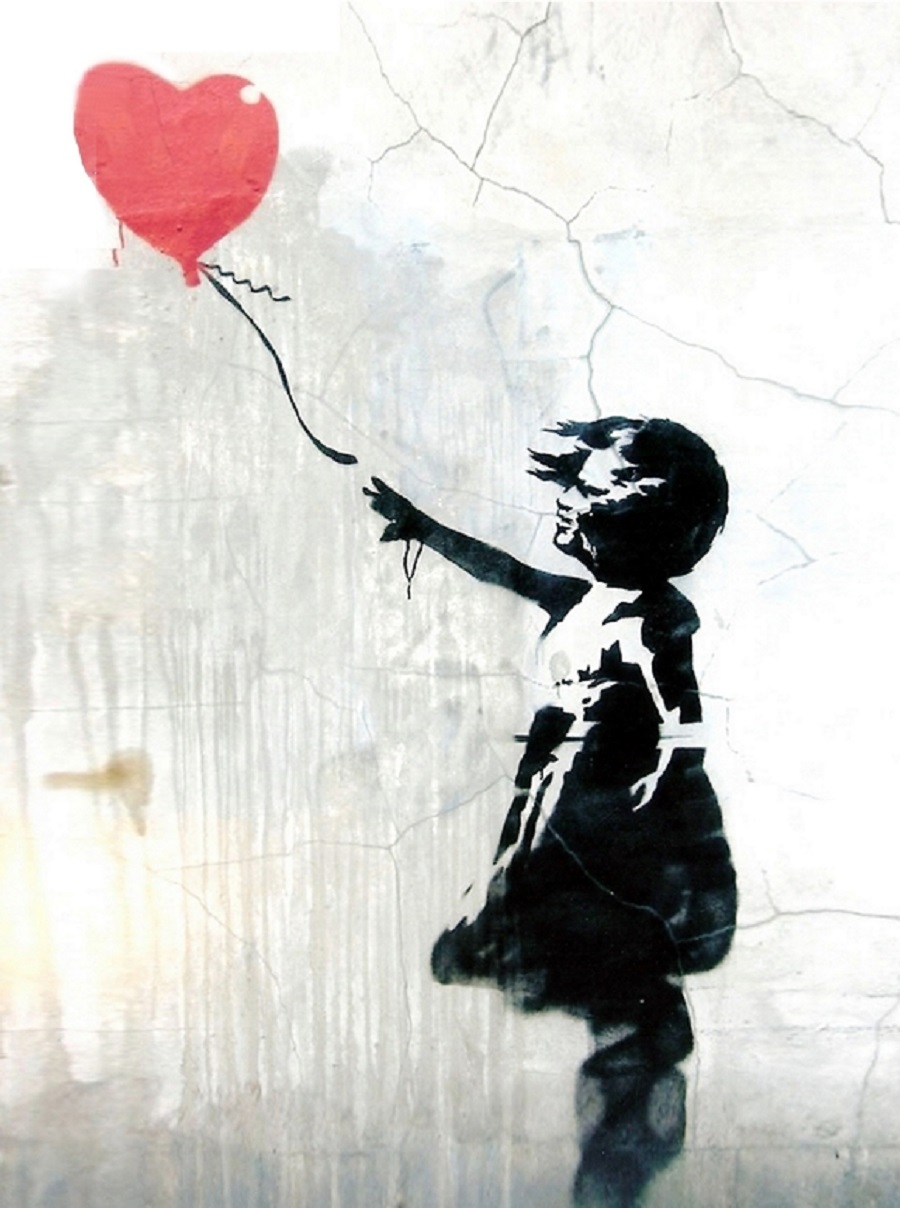
And then came the night that changed everything. On 5 October 2018, at Sotheby's in London, a framed version of Girl with Balloon (the girl letting go of, or reaching for, a red heart-shaped balloon, probably his most popular image) sold for just over a million pounds. The instant the hammer fell to close the sale, a mechanism hidden in the thick gilt frame began to slide the canvas downwards and shred it into strips before the stunned saleroom. The destruction stopped half-way. Banksy had turned an auction into a piece of performance art and, in passing, into the first artwork in history created live during a sale.
Far from ruining the piece, the gesture multiplied its legend. The buyer kept the work, the auction house itself renamed it Love Is in the Bin and, three years later, in October 2021, it returned to Sotheby's to sell for a staggering 18.5 million pounds, a record for the artist. The critic of capitalism had signed, whether he meant to or not, one of the great revaluations in recent art-market history. The irony is that the wastepaper bin turned out to be the best investment of all.
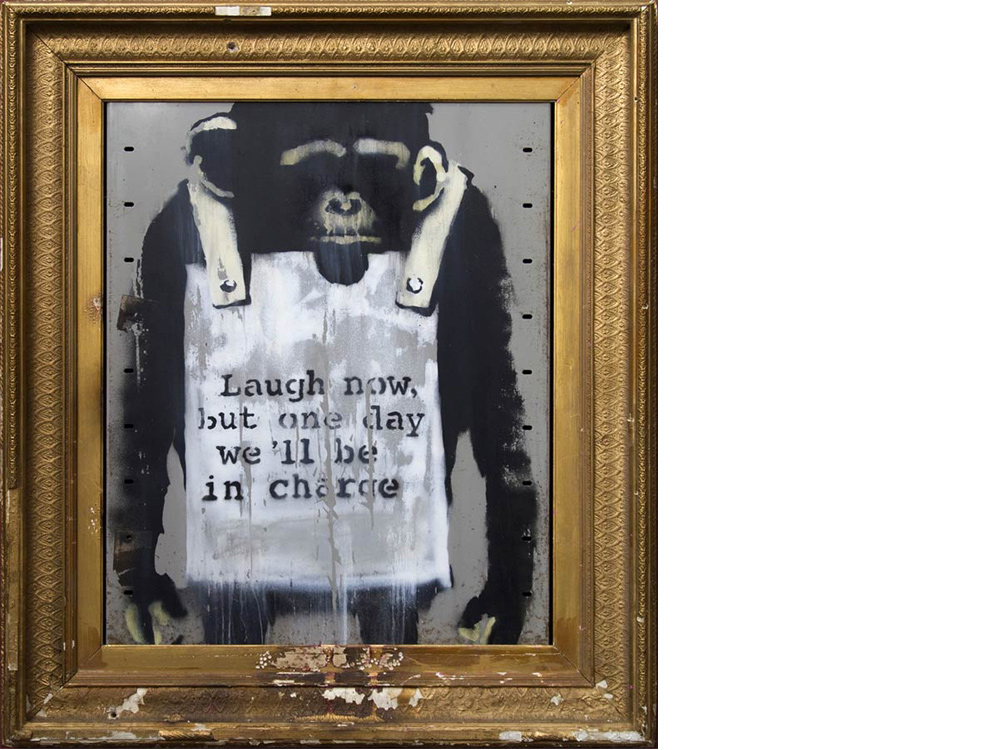
It was not his only duel with the saleroom. In October 2019, his canvas Devolved Parliament, almost four metres wide and depicting the British House of Commons overrun by chimpanzees, fetched 9.9 million pounds at Sotheby's in the thick of the Brexit turmoil. Rarely has a satire proved so profitable, or so timely.
The child who reached Venice (2019)
In May 2019, during the Venice Biennale, on a canal in the Dorsoduro district and just above the waterline, The Migrant Child appeared: a shipwrecked boy in a life jacket holding a pink smoke flare. Banksy gatecrashed the world's most prestigious art event uninvited, just as years earlier he had slipped into the great museums, to remind everyone who official art leaves outside. The work, threatened by the city's floods, was digitised in high resolution and, in 2025, carefully removed from the wall for a complex restoration. Against all odds, the migrant child of Venice has become heritage that Italy is striving to preserve.
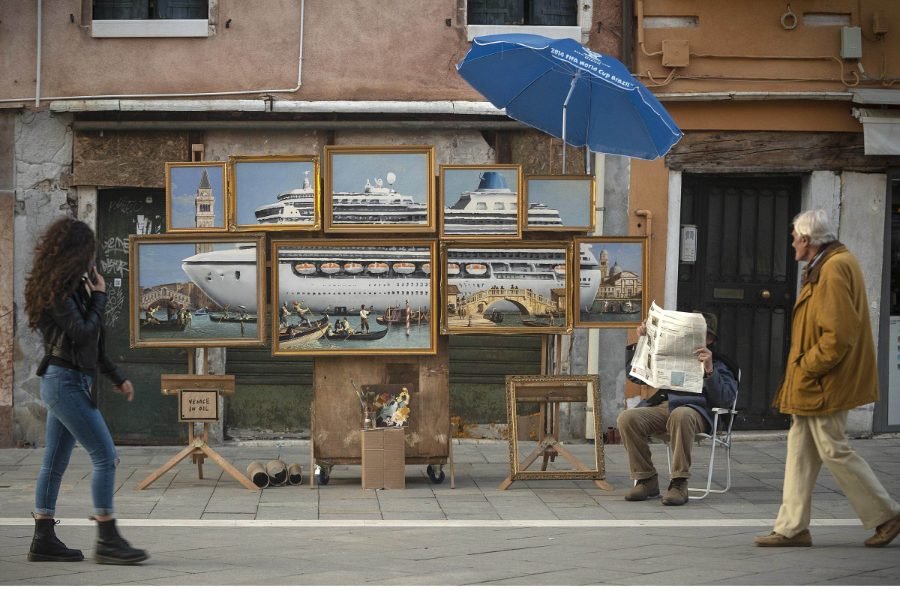
The Migrant Child, Venice (2019). Image: banksy.co.uk
That same Christmas of 2019 he signed, in Birmingham, one of his tenderest and bitterest pieces at once: two reindeer that seem to pull an empty public bench along, as if it were a sleigh. It only took a homeless passer-by sitting down on it for the scene to complete itself and travel the world. The street again, the invisible again, again without a single word.
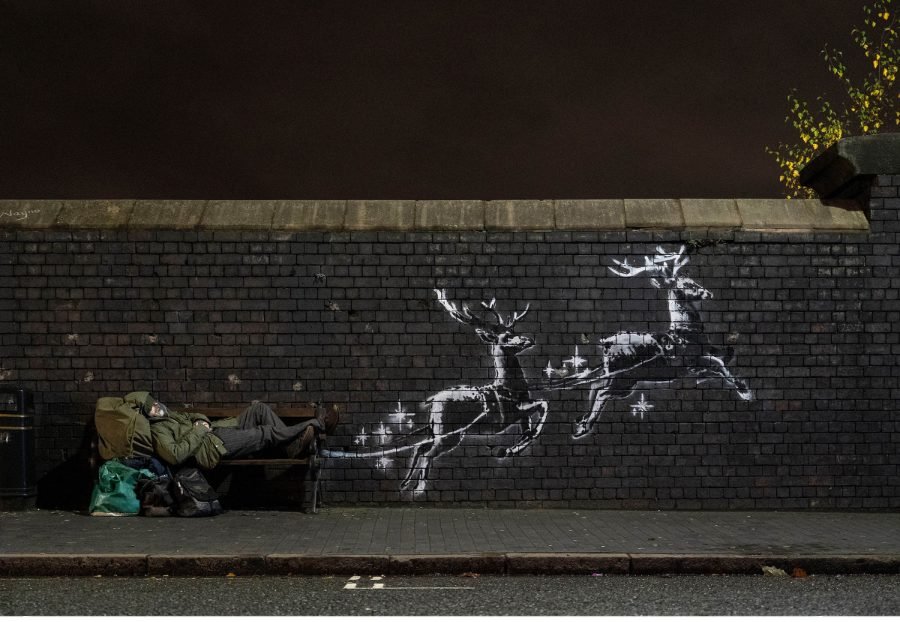
God Bless Birmingham (2019). Image: banksy.co.uk
2020: the year the world stopped
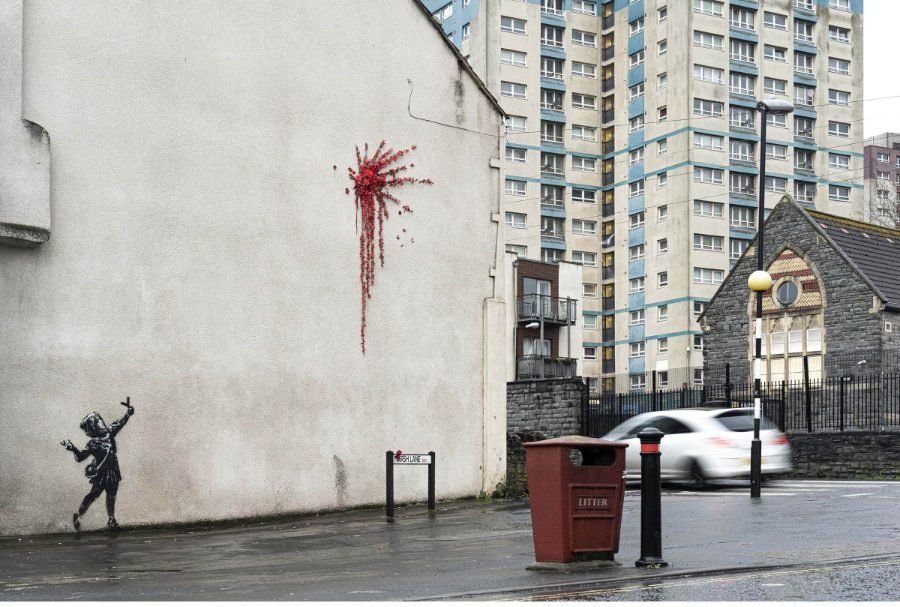
The pandemic found Banksy on top form. In February 2020, on a wall in Barton Hill (Bristol), a little girl fired a burst of real red flowers from a slingshot over a drainpipe; a Valentine as lovely as it was fleeting. Days later, in the Totterdown neighbourhood, an old woman sneezed so violently (Aachoo!!) that her dentures shot off down one of the steepest streets in the city. The humour was intact, but events were about to impose a graver tone.
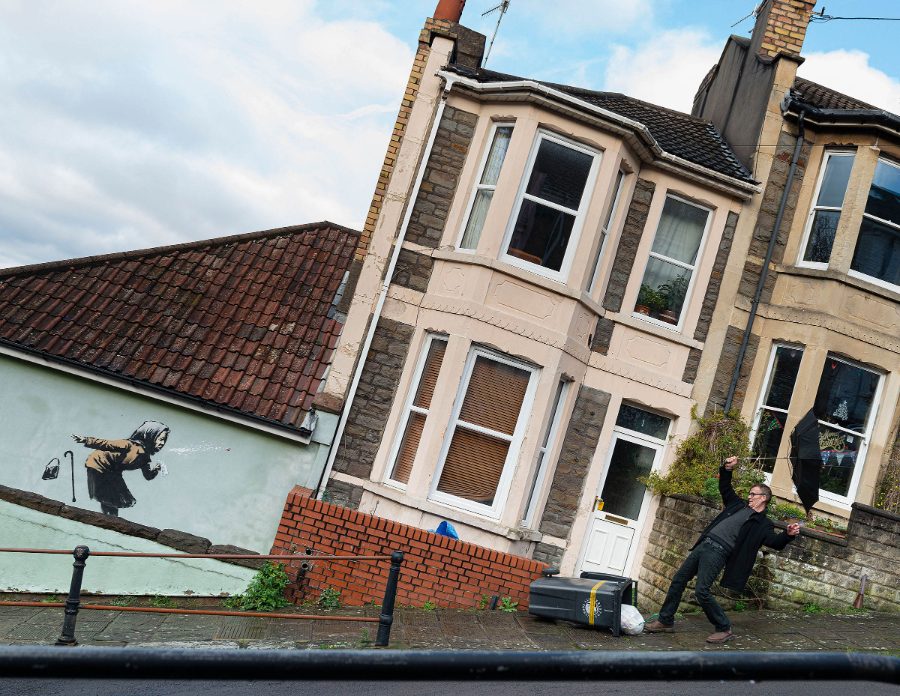
Aachoo!!, Totterdown, Bristol (2020). Image: banksy.co.uk
In May 2020, in the middle of the first wave, a black-and-white painting appeared in the foyer of Southampton General Hospital: a small boy plays with a nurse-superhero doll, cape and mask on, while the Batman and Spiderman figures lie discarded in a bin beside him. Game Changer honoured the true heroes of the pandemic, with a handwritten note: "Thanks for all you're doing. I hope this brightens the place up a bit, even if it's only black and white." In March 2021 the work was auctioned at Christie's for 16.7 million pounds, all of it for British public-health charities, becoming at the time the most expensive piece the artist had ever sold.
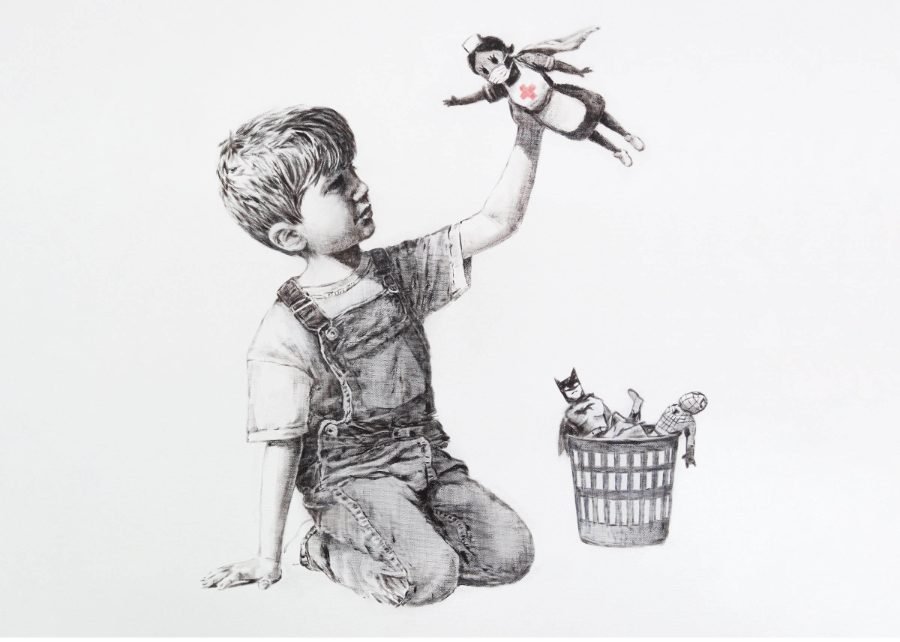
Game Changer (2020), a tribute to the public health service. Image: banksy.co.uk
And in August 2020, Banksy took one of his boldest steps: with the money from his work he funded a migrant rescue boat in the Mediterranean. The Louise Michel, named after the French feminist anarchist and painted pink with one of his stencils (a girl holding a heart-shaped life-ring), set off in secret from Spain to assist people adrift off the Libyan coast. It was not a metaphor or a piece of graffiti: it was a real boat, saving real lives. Rarely has art climbed down off the wall to wade, quite literally, into the water.
2021: the Reading escape and a Great British Spraycation
In March 2021, on the wall of the former Reading prison, where Oscar Wilde was once held, a convict appeared escaping down a rope made of knotted sheets of paper tied to a typewriter. The piece, Create Escape, was confirmed by the artist with a video narrated in the manner of the television painter Bob Ross. But the gesture went further: Banksy offered to sell the stencil to help raise the funds (up to ten million pounds) to buy the prison and turn it into an arts centre. Once again, the provocation came with a concrete proposal attached.
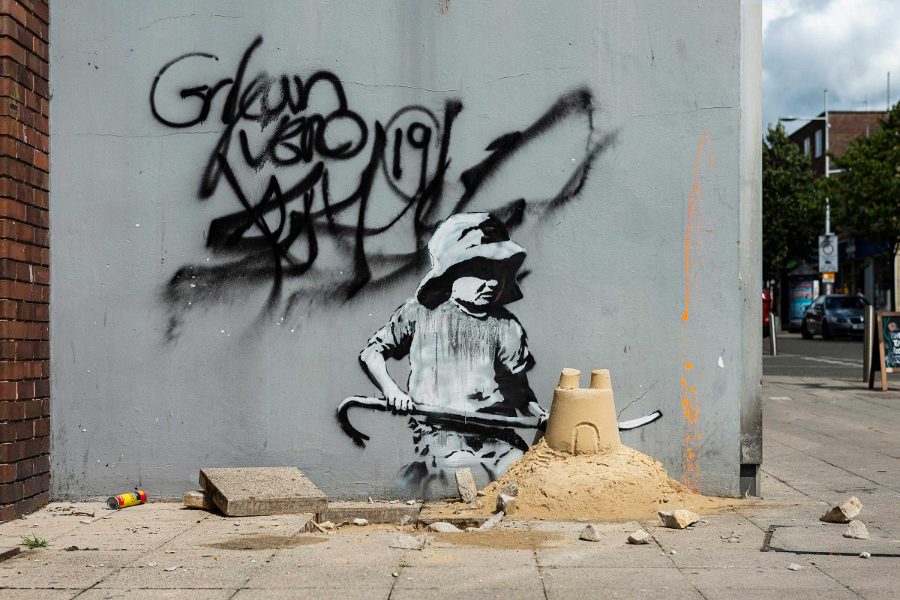
That summer he even allowed himself to play with the very essence of Britishness. Under the title A Great British Spraycation (a pun on spray and staycation), he left works dotted around the seaside towns of Norfolk and Suffolk: a rat lounging in a deckchair, a fairground grabber-claw seizing a child, an elderly couple dancing on top of a bus shelter, a crab, a sandcastle. He documented the trip like the home video of a family holiday, a reminder that behind the global phenomenon there is still a prankster with a spray can.
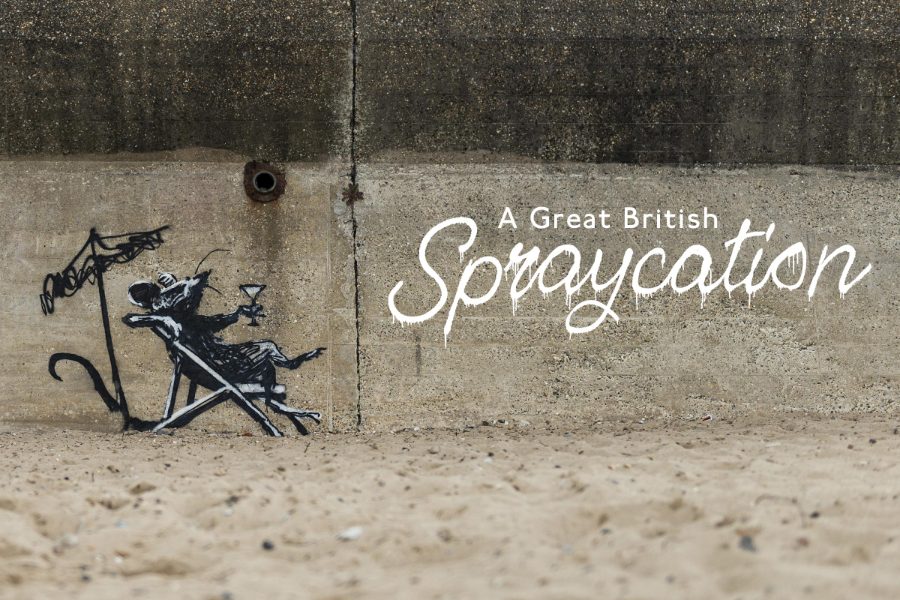
A Great British Spraycation, the Norfolk and Suffolk coast (2021). Image: banksy.co.uk
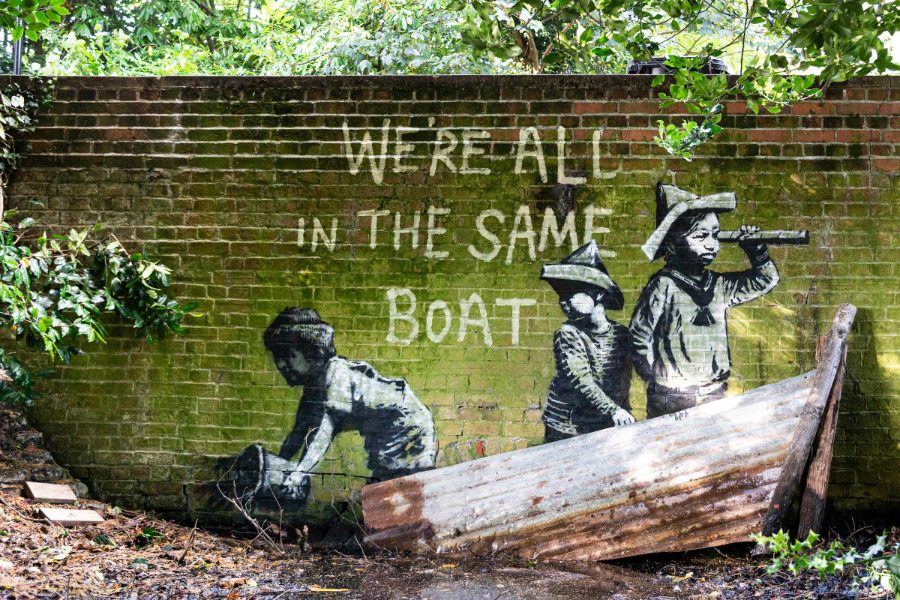
Another of the Spraycation pieces (2021). Image: banksy.co.uk
Ukraine: art among the ruins (2022)
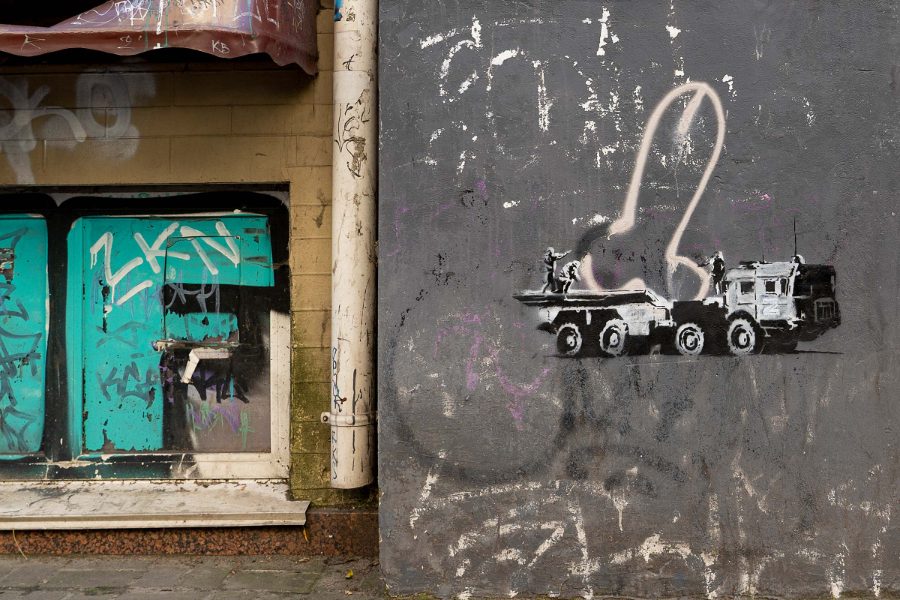
In November 2022, Banksy confirmed the authorship of seven murals painted on buildings shattered by the Russian invasion of Ukraine, in towns such as Borodyanka, Irpin, Hostomel and Kyiv itself. On concrete pocked by shellfire, a gymnast did a handstand among the rubble, a child threw a judo flip on an adult who inevitably recalls Putin, two children used an anti-tank obstacle as a seesaw. They were images of an insolent tenderness, planted exactly where barbarity had struck, and they worked as his best pieces always have: a message of resistance written over the wound.
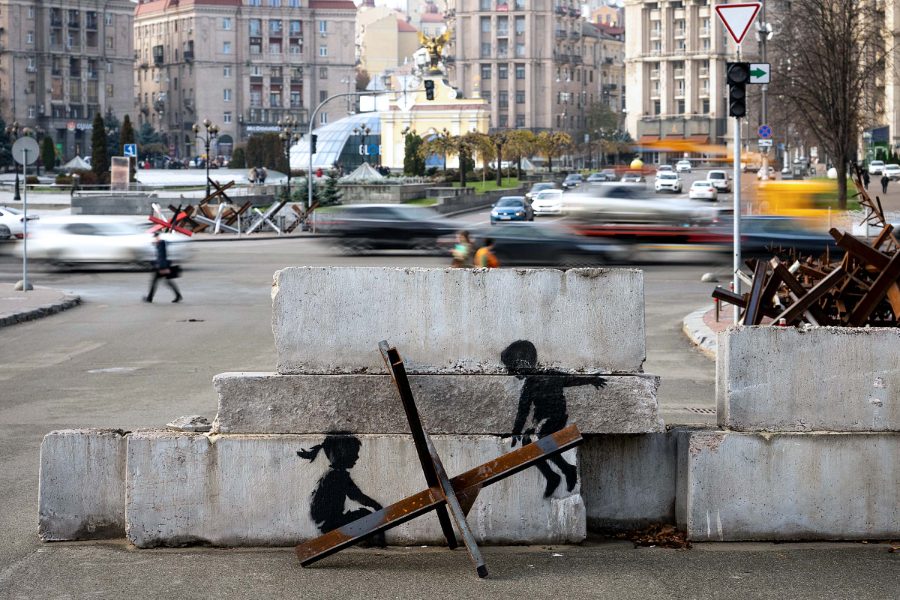
Gymnast among the ruins, Borodyanka, Ukraine (2022). Image: banksy.co.uk
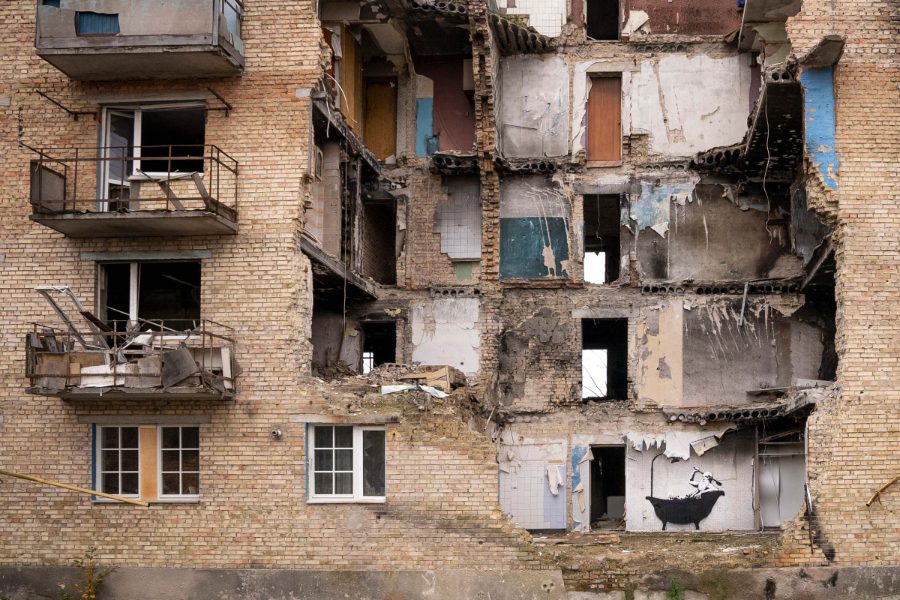
Another of the seven Ukrainian murals (2022). Image: banksy.co.uk
A Valentine in Margate and a stop sign against war (2023)
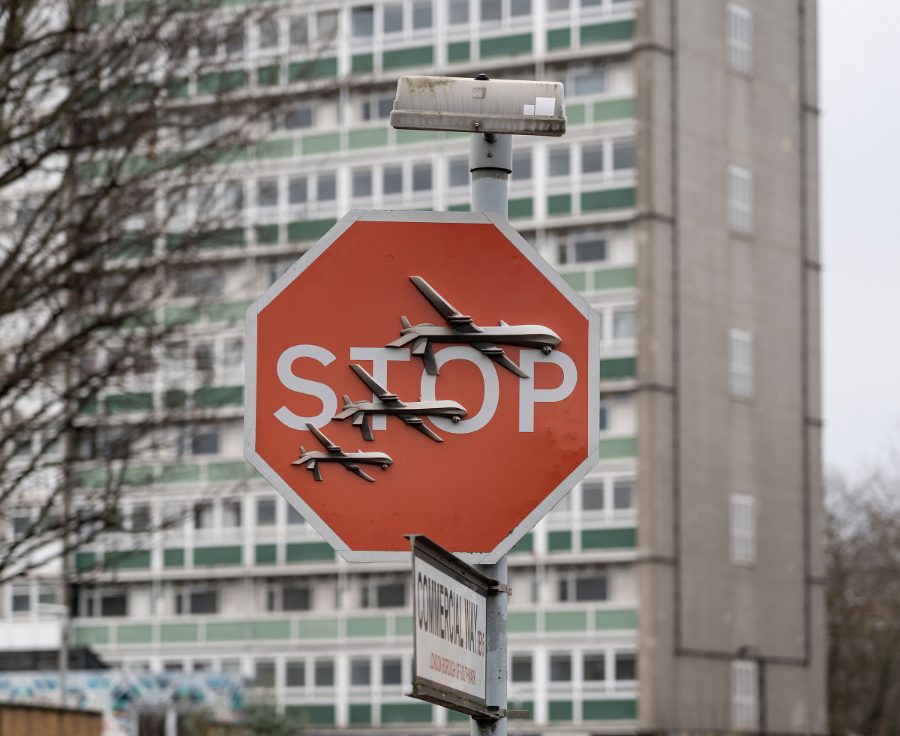
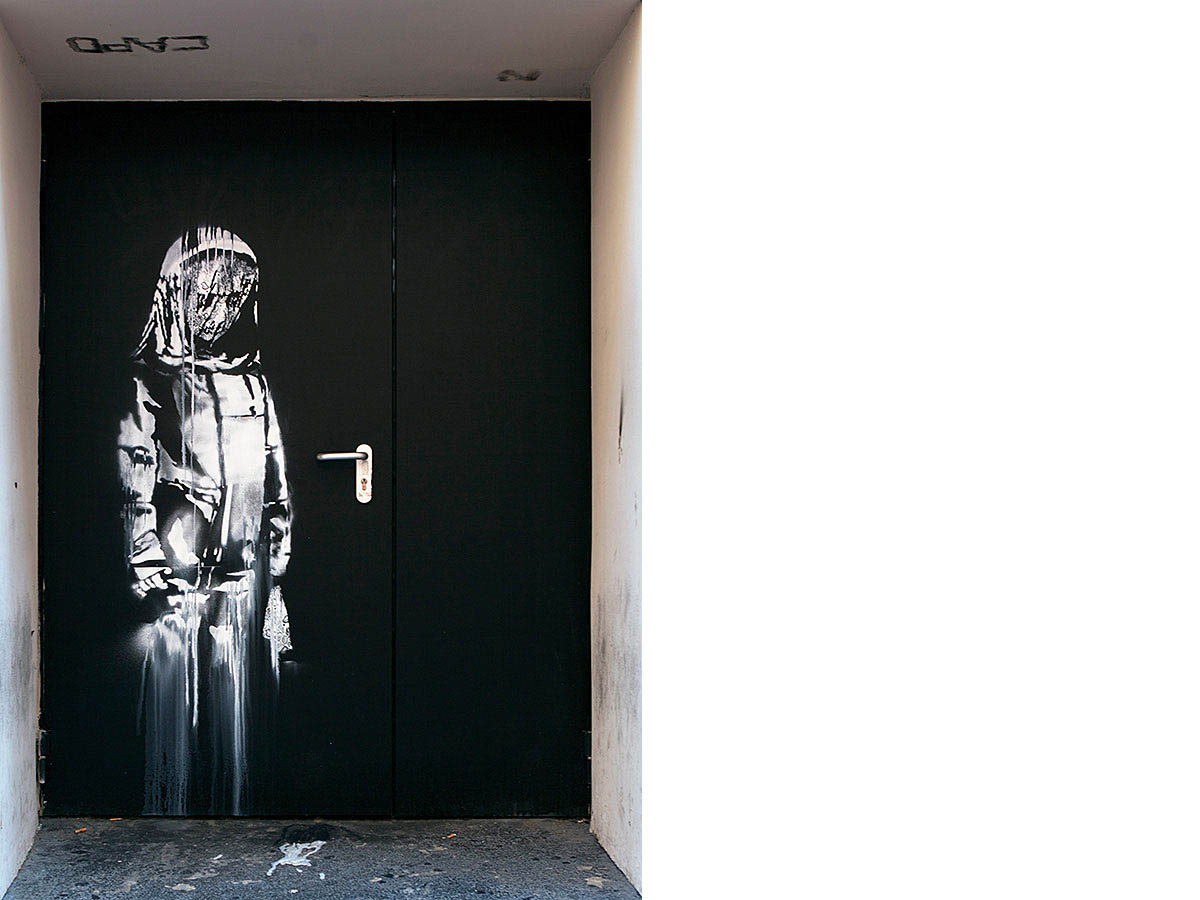
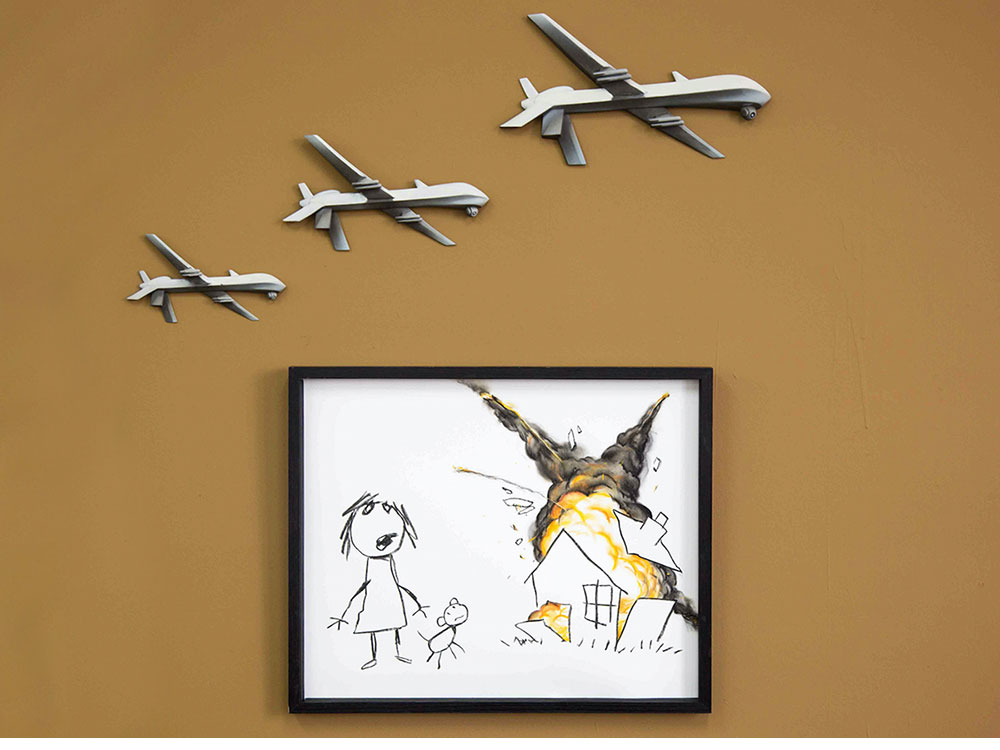
On Valentine's Day 2023, in the coastal town of Margate, Banksy again turned the calendar against itself. Valentine's Day Mascara showed a 1950s housewife, with a black eye and a missing tooth, shoving her abuser (only his legs are visible) into a real chest freezer abandoned in the street. A romantic postcard concealing a denunciation of domestic violence. In December, in Peckham (London), a stop sign covered with the silhouettes of three military drones (read at once as a call for a ceasefire in Gaza) lasted less than an hour in place: someone cut it down with bolt cutters minutes after the artist claimed it on social media.
A zoo loose in London (2024)
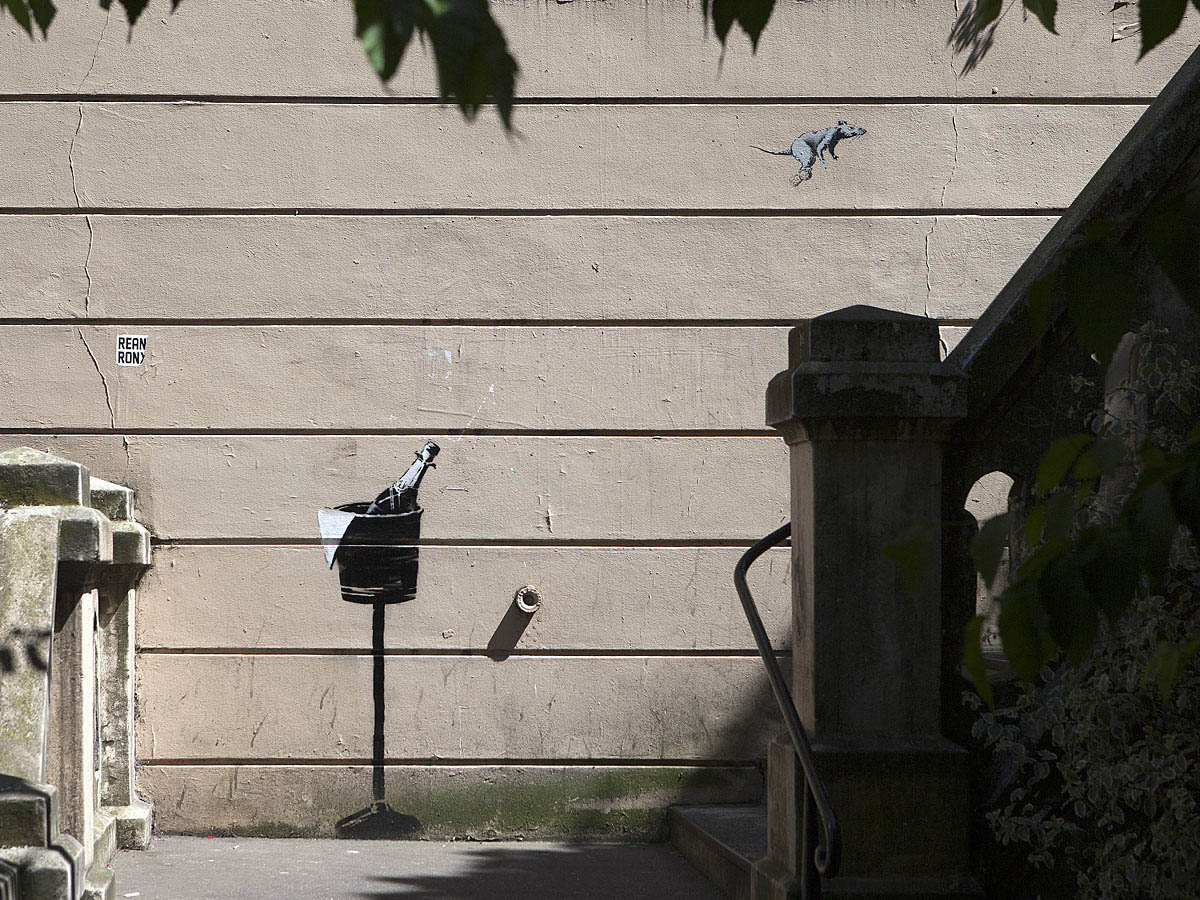
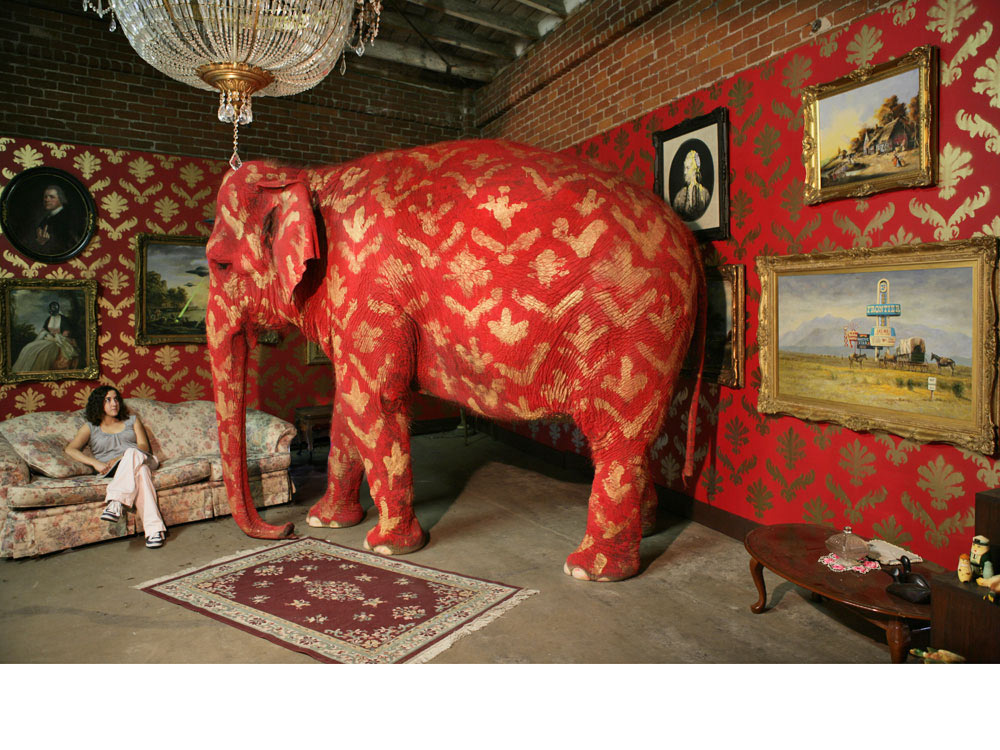
The summer of 2024 brought one of his most celebrated series and, for a change, with no obvious political reading. Over nine consecutive days in August, Banksy left nine animals around the streets of London: a goat on the edge of a ledge, two elephants leaning out of bricked-up windows, three monkeys swinging across a railway bridge, a wolf howling on a satellite dish, two pelicans stealing fish above a chip shop, a cat stretching on a billboard, piranhas turning a police sentry box into an aquarium, a rhino climbing onto a car and, as the grand finale, a gorilla lifting the shutter of London Zoo to let out a sea lion and some birds. The artist himself explained that, in a time of bleak headlines, he simply wanted to "cheer people up" and to underline the human capacity for creative play "rather than destruction". A whole city playing spot-the-next-animal: the street turned, once more, into his finest gallery.
A few months earlier, in March 2024, he had already scored one of his most discussed hits in Finsbury Park: a burst of green paint behind a pruned, bare tree gave it back, in trompe-l'oeil, all the foliage that winter (and the council's chainsaw) had taken away. Nature painted in to stand in for the nature that was missing.
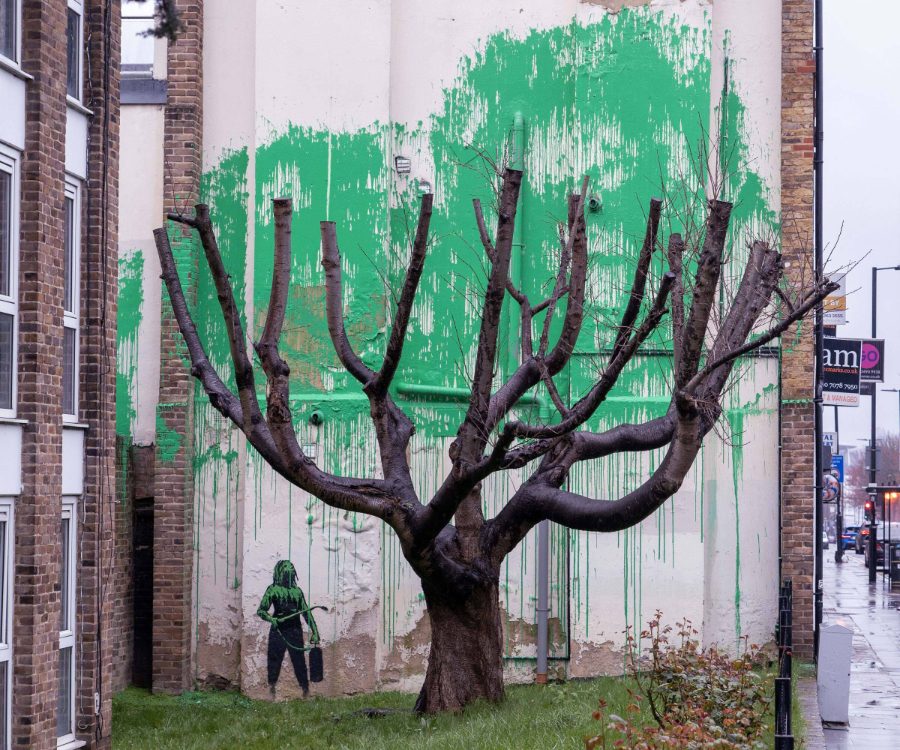
The Finsbury Park tree, London (2024). Image: banksy.co.uk
The judge, the stars and the open ending (2025)
In September 2025, on a wall of the Royal Courts of Justice in London, one of his most direct images appeared: a robed judge, gavel raised, beating a fallen, defenceless protester. The work, read as a critique of the right to protest, was covered over by the authorities almost at once and set off a debate about the limits of dissent. And as Christmas 2025 approached, Banksy changed register with two children lying on their backs on the tarmac, wrapped up in their bobble hats and wellington boots, pointing at something in the sky. An image with no slogans, almost a sigh, that many chose to read as a reminder of the thousands of homeless children who spend the winter in emergency accommodation in the capital. Tenderness as a last form of protest.
One of his most recent interventions. Image: banksy.co.uk
Copyright is for losers: the artist and the law
Anonymity, his greatest trademark, is also his greatest legal headache. Banksy wrote in his book that "copyright is for losers" and for years encouraged anyone to take and reuse his art "for their own personal amusement, but not for profit". The trouble came when firms such as the greetings-card company Full Colour Black began to exploit his images commercially and to challenge his trademarks through his office, Pest Control. European courts went so far as to cancel several of those trademarks on the grounds that they had been registered "in bad faith", precisely because defending a trademark in court clashed with the shield of anonymity: to claim authorship, he would have to show his face. Caught in his own paradox, Banksy summed up the situation with his usual sarcasm, acknowledging how awkward it is to legally protect what he himself gave away to the street.
And the mystery of his identity, far from clearing, has gone on feeding itself. In November 2023 a BBC interview recorded back in 2003 resurfaced, in which a reporter asked whether his name was Robert Banks; laughing, the artist replied that his first name was "Robbie". One more loose thread in a figure who has made not-being his way of being everywhere. More than twenty years on from those rats in Bristol, we still do not know his face and yet there is not a wall in the world where we cannot recognise his shadow. Perhaps that is his greatest triumph: to have turned anonymity into the most recognisable signature in contemporary art.
Banksy vs Bristol Museum
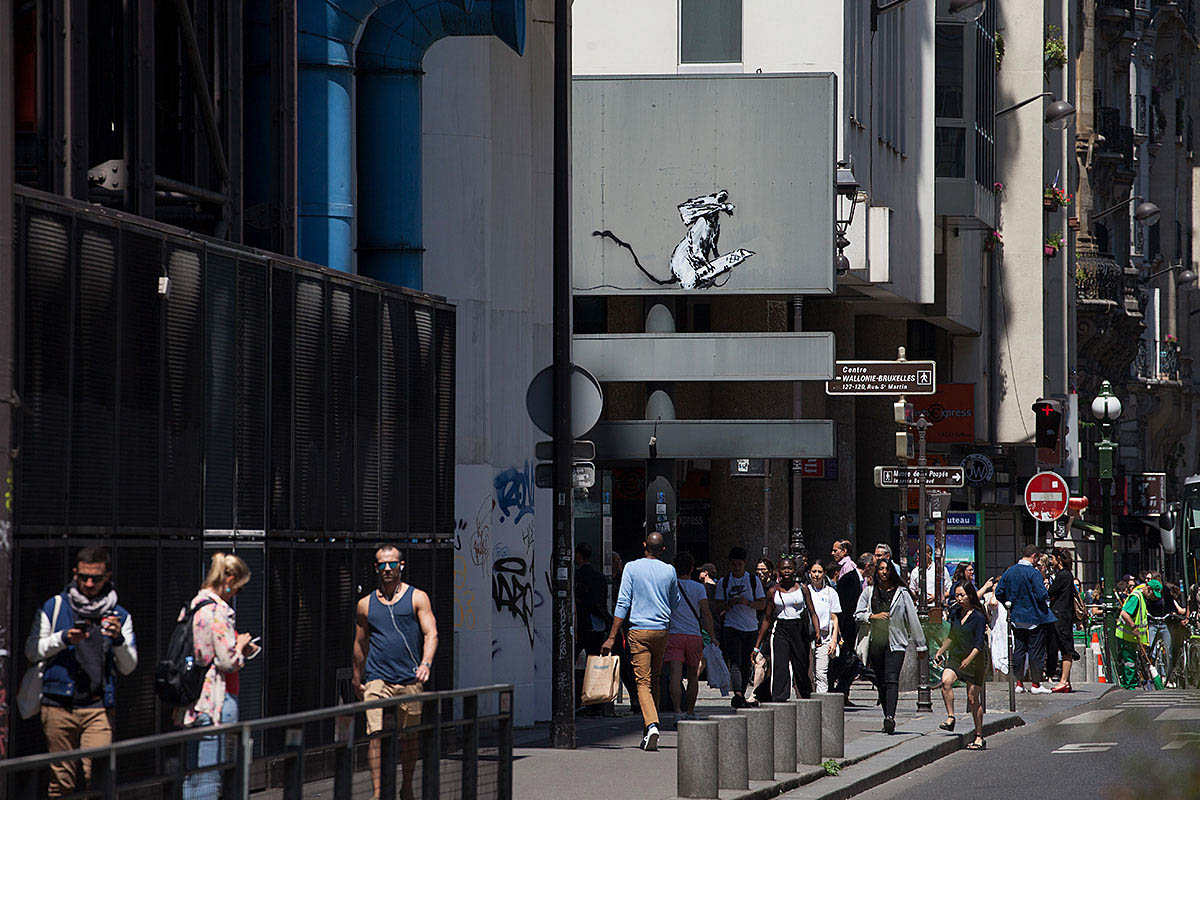
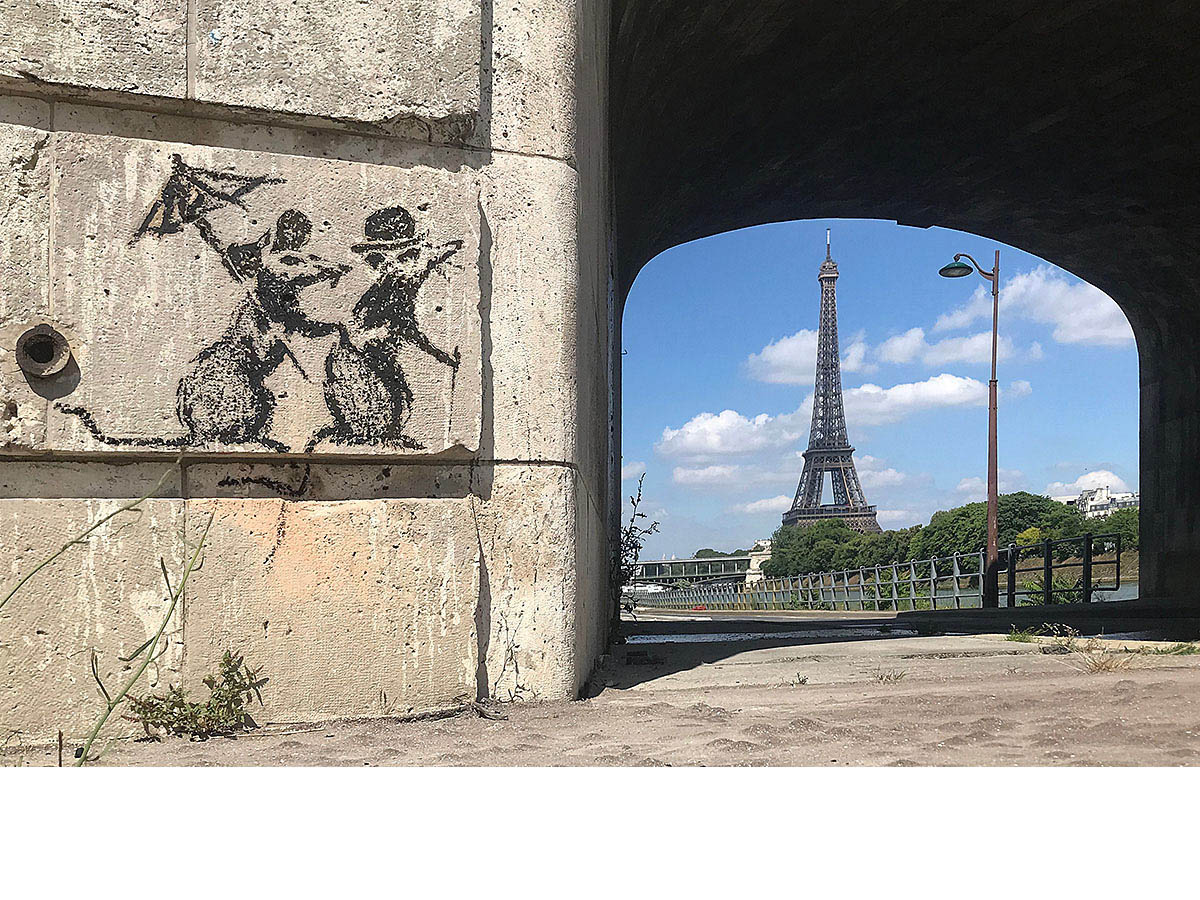
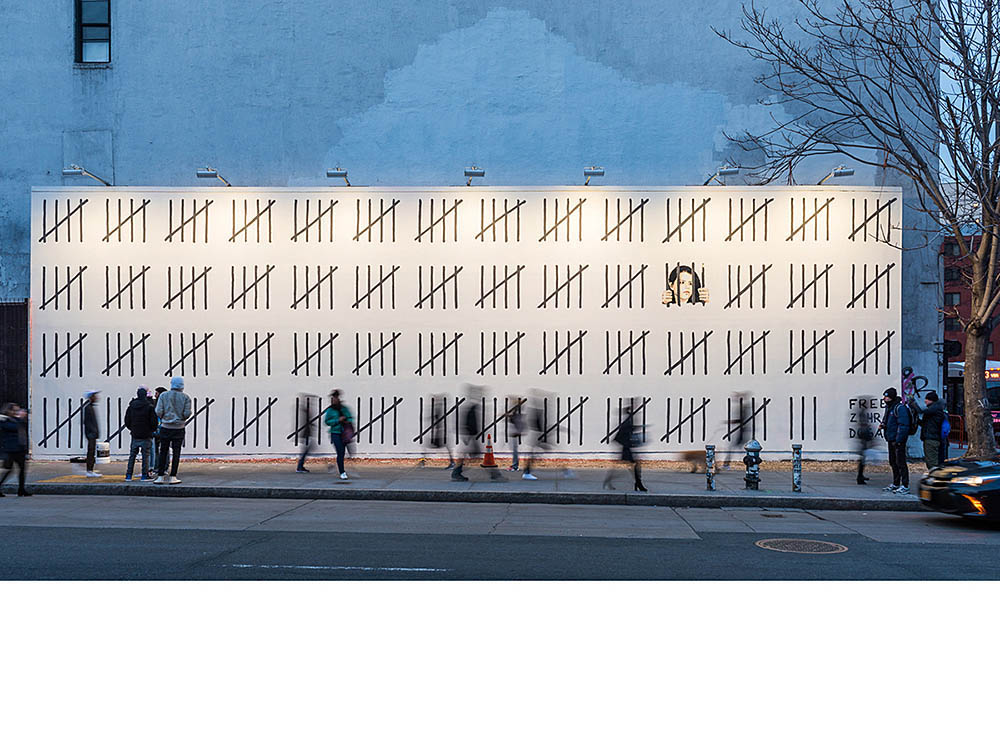
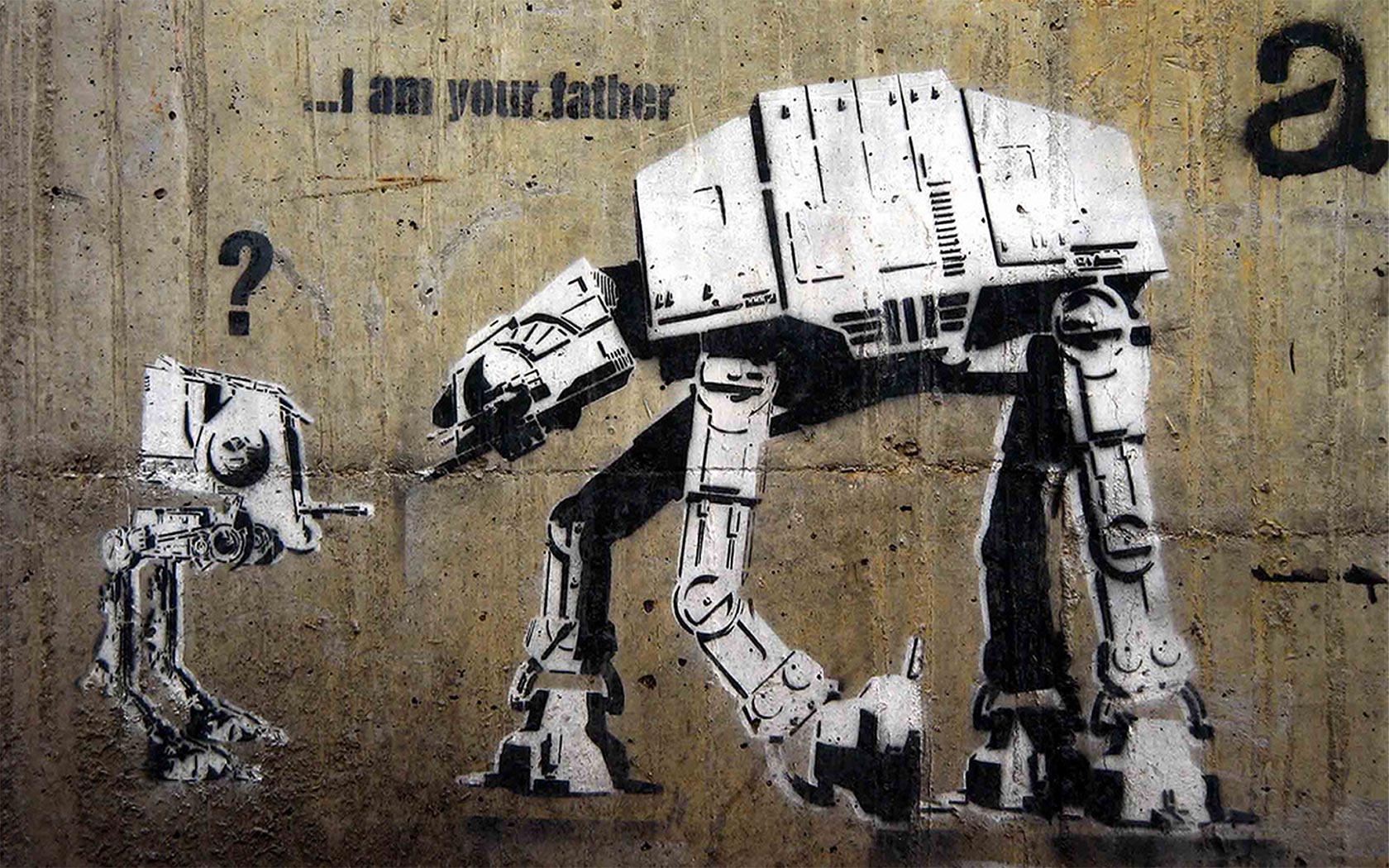
Picture Gallery: Banksy – Works, click on the photos to see them full sized














(Translated from the Spanish by Shauna Devlin)
– Banksy: Biography, Works and Exhibitions – – Alejandra de Argos –