David Hockney: 82 Portraits and 1 Still-life

David Hockney. Photo: Jean-Pierre Goncalves de Lima.
Hedonistic, rigorous, methodical, studious and a tireless worker are some of the hallmarks of David Hockney, one of the most popular visual artists of our time. Once again he returns to the Guggenheim in Bilbao, to present to us one of his latest projects. Hockney has spent two and a half years in his Los Angeles studio working compulsively to give shape to this unusual gallery of portraits.
In the spring of 2013, the tragic death in Bridlington of one of his most beloved collaborators accelerated his return to California and after a few months of inactivity he took up work again as a challenge to the existential crisis that the loss of his friend had produced. The portrait had always been a constant in his work and the return to it an important incentive. Work is what pushes me to keep going, only thus do I understand the meaning of life.
Hockney placed his models on a small, somewhat elevated stage, against a neutral background and after finding the right attitude, he marked the placement of the feet on the floor. The scheme was always the same, first to draw the model’s silhouette with charcoal and then immediately to begin painting in marathon sessions of 7 hours with the aim of finishing each portrait in three days, even fewer when his models lacked that time. The exhibition is arranged chronologically, all the works maintain a single format, the compositions are very similar, on a single stage, the models appear seated in the same chair and all the portraits are full-length, except that of the young Barringers, 16 and 17 July 2014, placed in a more forward position that prevents the complete view.
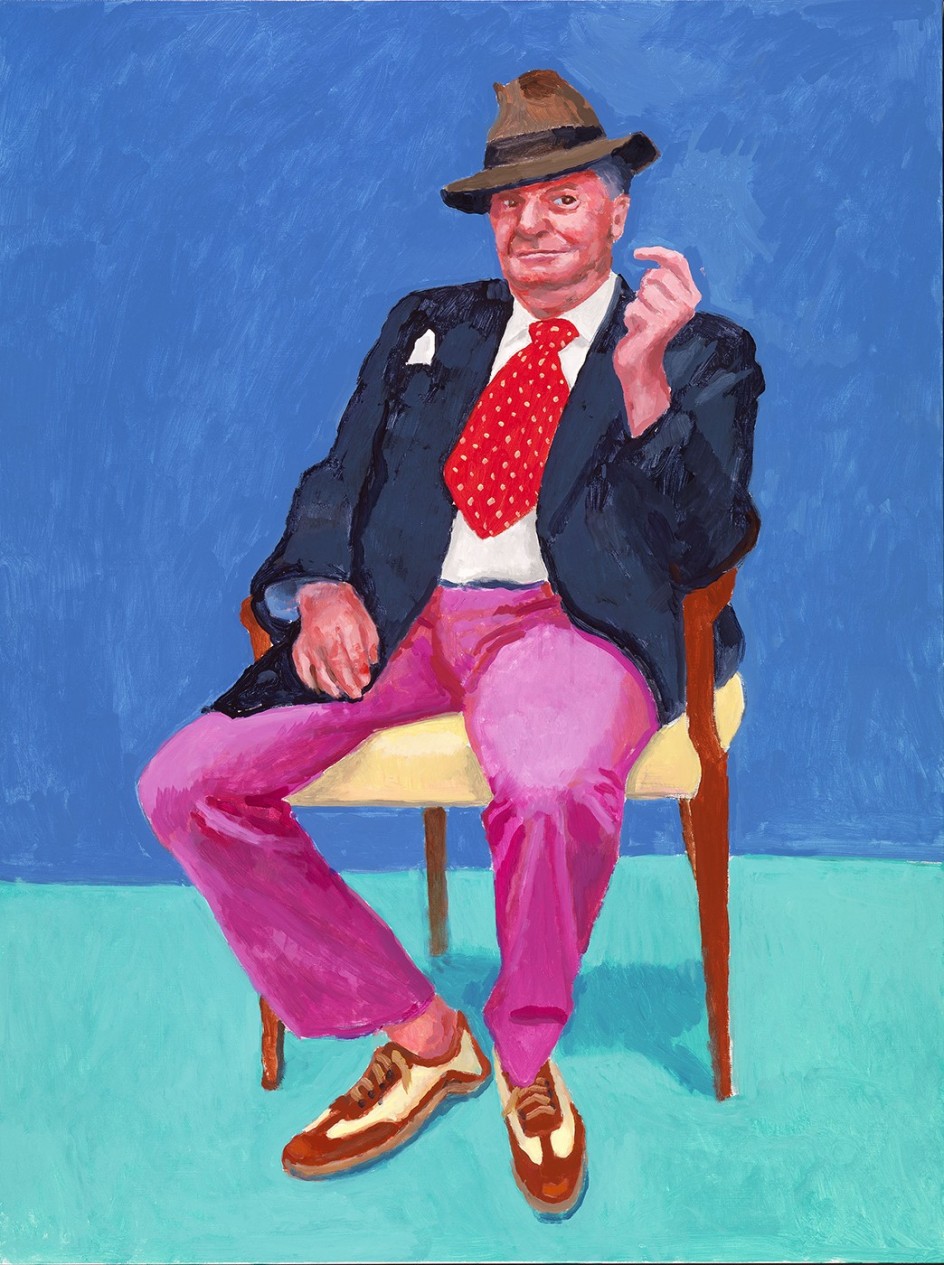
David Hockney. Barry Humphries (March 2015)
The show makes us think that we are facing an essay on the human body, where age, sex and personality configure a cartography that leaves the doors open to the observer who replaces the painter to analyze and compare some characters with others. Types who, with the exception of some figures from the art world, are complete unknowns to the public and who are left in a situation of vulnerability before the eye that observes them.
The use of acrylic paint and the intensity of a very small chromatic range, blue and green, against a most varied wardrobe, arouse a particular vibration in the retina that reveals the painter’s vitality and the energetic stroke of his brush.
Hockney‘s portraits swing between representation and revelation. There is always an emotional relationship with his models, an intimate exchange, the two observe each other for hours, he has chosen them and the more intimate the relationship, the more layers of paint are superimposed on the image as if each of them were an approach to the spirit of the sitter. He always says that, It is much easier to capture the likeness of someone you know. You visualize the most complex features and render them in a simplified way.
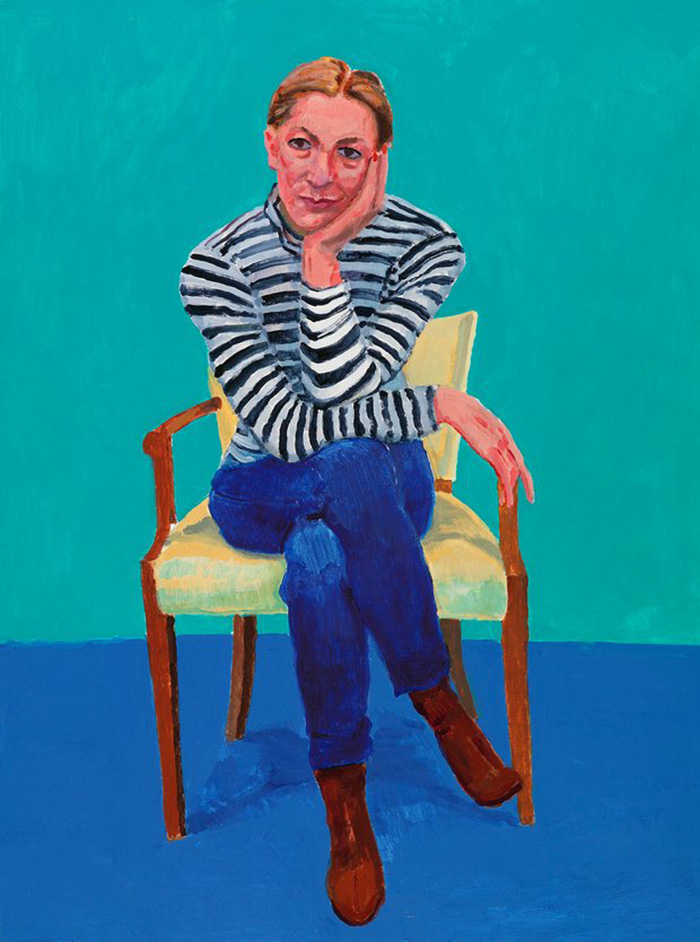
David Hockney. Edith Devaney (February 2016)
There are some very special portraits, one of them is the one that opens the show, JP Goncalves de Lima, 11, 12, 13 July 2013. It is a faceless portrait of a downcast man who hides his desperation behind his hands as an expression of unbearable pain. The model is one of his assistants and many have seen in him Hockney himself when he was still mourning his friend. It seems that Vincent van Gogh‘s famous painting, Sorrowing Old Man (‘At Eternity’s Gate’) was a reference for the composition. Another canvas that stands out is the portrait of the only child who appears in the series, Rufus Hale, 23, 24 and 25 November 2015, son of the English artist Tacita Dean, whose maturity and determination so fascinated the painter that he wanted to include him in his gallery. Bing McGivray, a great friend of Hockney, appears portrayed three times with various outfits and a very relaxed attitude, his complicit gaze makes the viewer think that he is an acquaintance who expects us to greet him. A separate matter are the portraits of his siblings, Margaret and John, whose personalities he knows perfectly and which is revealed in how he defines their features, and how he plays with the placement of the head, the posture of the body, the gesture of the hands and their clothing. The portrait of Frank Gehry, 24 and 25 February 2016, we can interpret as a nod to the museum that houses it and that turned Bilbao into an art metropolis. All the characters, in one way or another, attract like a magnet and provoke a reflection in search of something that is beyond mere appearance.
At the beginning of this article I spoke of David Hockney‘s methodical spirit, and there is no better example than the still life that completes the exhibition, Fruit on a Bench, 6, 7 and 8 March 2014. One of his models failed to show up and since he had scheduled to paint and did not want to do anything else, he resorted to the nearest thing, a still life that he blended into his gallery of portraits with the same color range.
I think it pertinent to recall the study that David Hockney carried out during 1999 to demonstrate the relationship between science and art, and the use that has been made of optics in painting since the Renaissance and very especially with the portrait. For a year Hockney experimented with the possibilities of the camera lucida in his portraits, which helped him to understand how many artists painted their models and in a way to discover some of the enigmas of the great masters, Secret Knowledge. But for the current exhibition his work has set aside optics, photography and the camera lucida, to focus on easel drawing and to find new forms of creative expression, in that experience of the everyday, which has never been an art of concessions in Hockney‘s work.
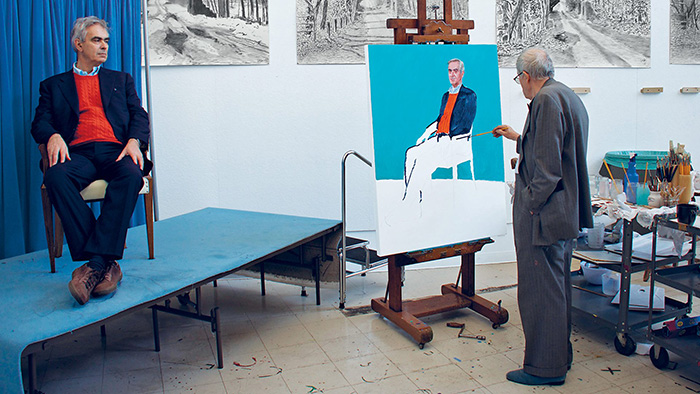
82 Portraits and 1 Still-life
David Hockney
Guggenheim. Bilbao
25 February 2018
– David Hockney: 82 Portraits and 1 Still-life – – Home page: Alejandra de Argos –