Picasso, the Sacred and the Profane
Burgos Cathedral hosts Picasso. Biblical Roots, the artist’s first monographic exhibition in a Spanish cathedral. Forty-four works, mostly from the collection of his grandson Bernard Ruiz-Picasso, reveal how Pablo Picasso (Malaga, 1881 – Mougins, 1973), although declaring himself an atheist, never stopped dialoguing with the Christian iconography he inherited from his Spanish childhood.
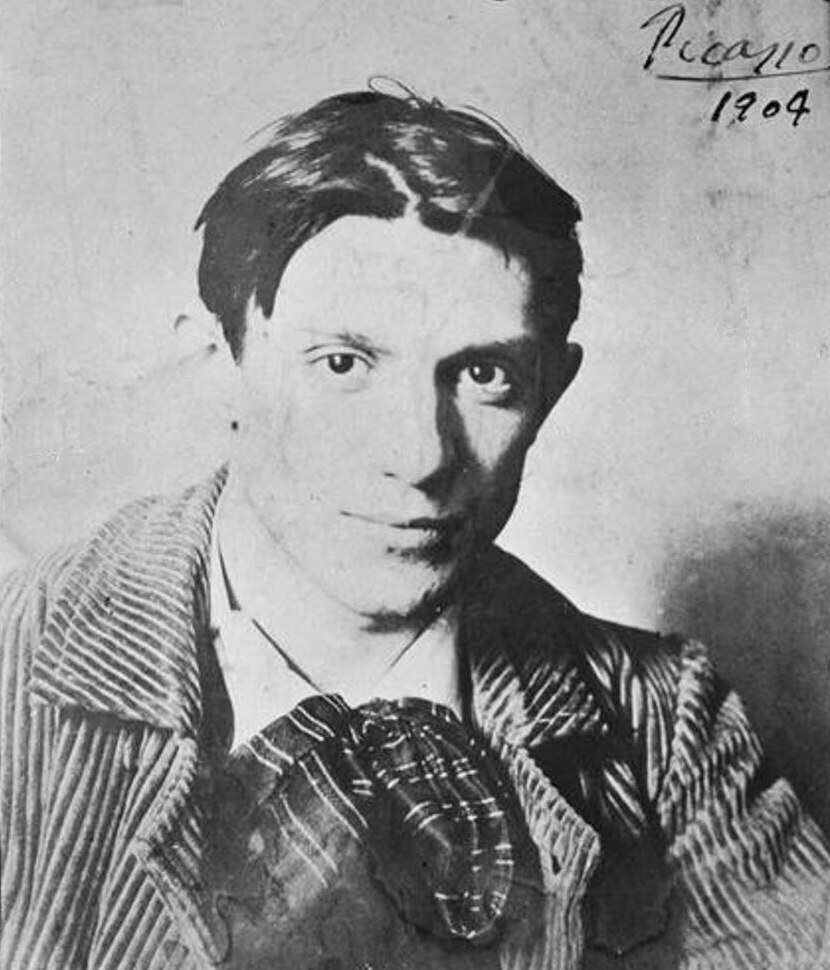
Pablo Picasso photographed by Ricard Canals i Llambi, Paris, 1904.
To all those who wish to delve into the multifaceted creativity of the figure of Pablo Picasso (Malaga, 1881 – Mougins, 1973), one of the “sacred monsters” of our art, I cannot help recommending that they visit the exhibition Picasso. Biblical Roots. More than forty works by the artist are spread across the Beato Valentin Palencia Hall of Burgos Cathedral. A show in which the imprint of Christian iconography lies beneath and, with it, the weight of our Western tradition and the roots of a Picasso who never stopped dialoguing with that cultural heritage, even though in his adult years he declared himself an atheist.
The most extraordinary thing about this visit, in which modernity and tradition intermingle, is to have the possibility, moreover, of touring one of the most sumptuous Spanish cathedrals of Gothic architecture, charged with religious symbolism and declared a World Heritage Site.
This religious symbolism is what emerges in the works of the undisputed genius of the 20th century present in the show, traversed by Christian signs such as the crucifixion, the pieta, sacrifice or the Virgin and Child. One of the central works of the exhibition, Maternity (1921), is a portrait of his wife Olga Khokhlova with their son Paulo in her arms, as an evocation of the biblical maternity of the Virgin Mary. Picasso manages to elevate an intimate and everyday image to an ideal prototype of the feminine, of love and of the sacred. The vast majority of the works come, precisely, from the grandson of Pablo and Olga, Bernard Ruiz-Picasso, through the private collection he shares with his wife, Almine Rech, at the Almine and Bernard Ruiz-Picasso Foundation for Art.
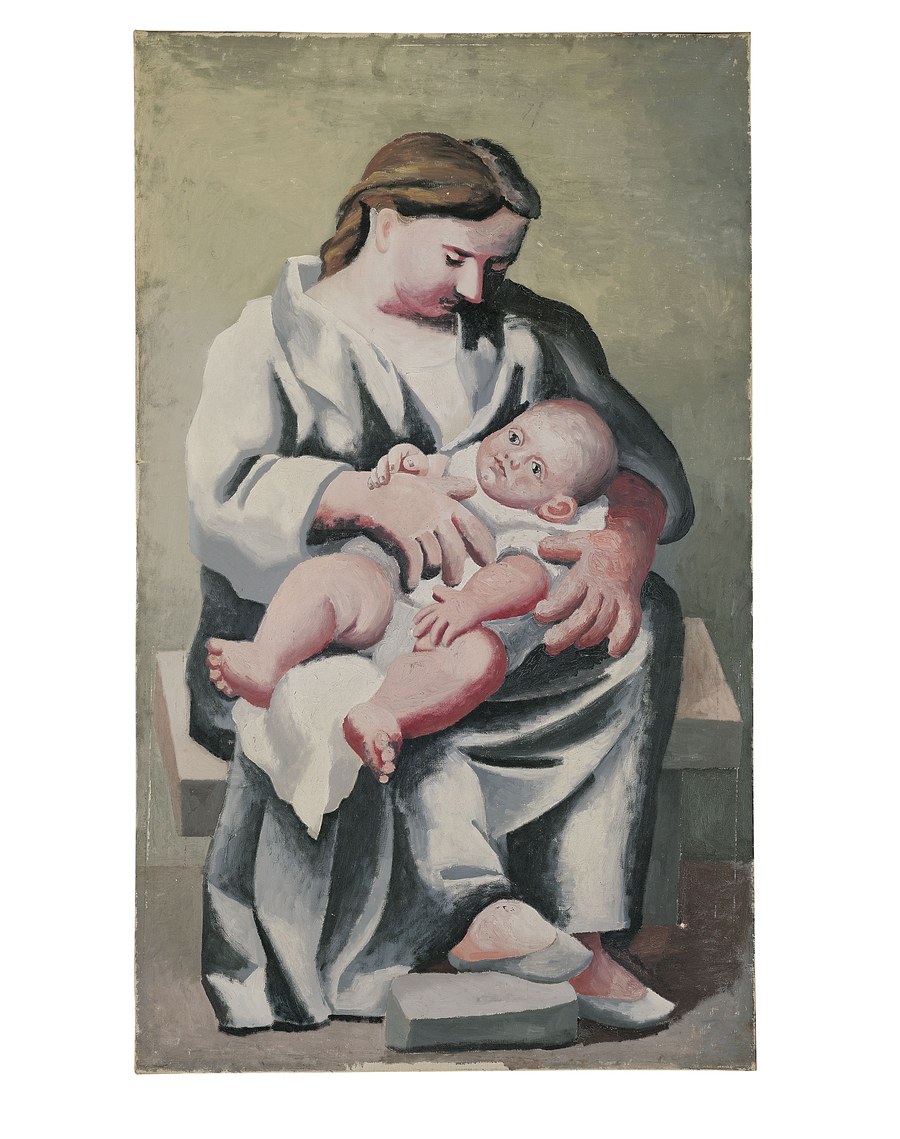
Pablo Picasso, Maternite (Maternity), Fontainebleau, summer 1921. Oil on canvas, 162 x 97 cm. Almine and Bernard Ruiz-Picasso Foundation for Art, Madrid.
The relationship between Picasso and Olga Khokhlova began in 1917, in Rome, while he was working for Sergei Diaghilev’s Ballets Russes and she was one of his dancers. Olga represented a world contrary to Picasso’s untamed character. The discipline, the elegance, the salons and the social life she transmitted fascinated him. They married in 1918 and, during those years, his painting became more classical. This harmony in the canvases, with the passage of time, wore away at the same time as the relationship between the two did. Olga appears increasingly rigid, more distant.
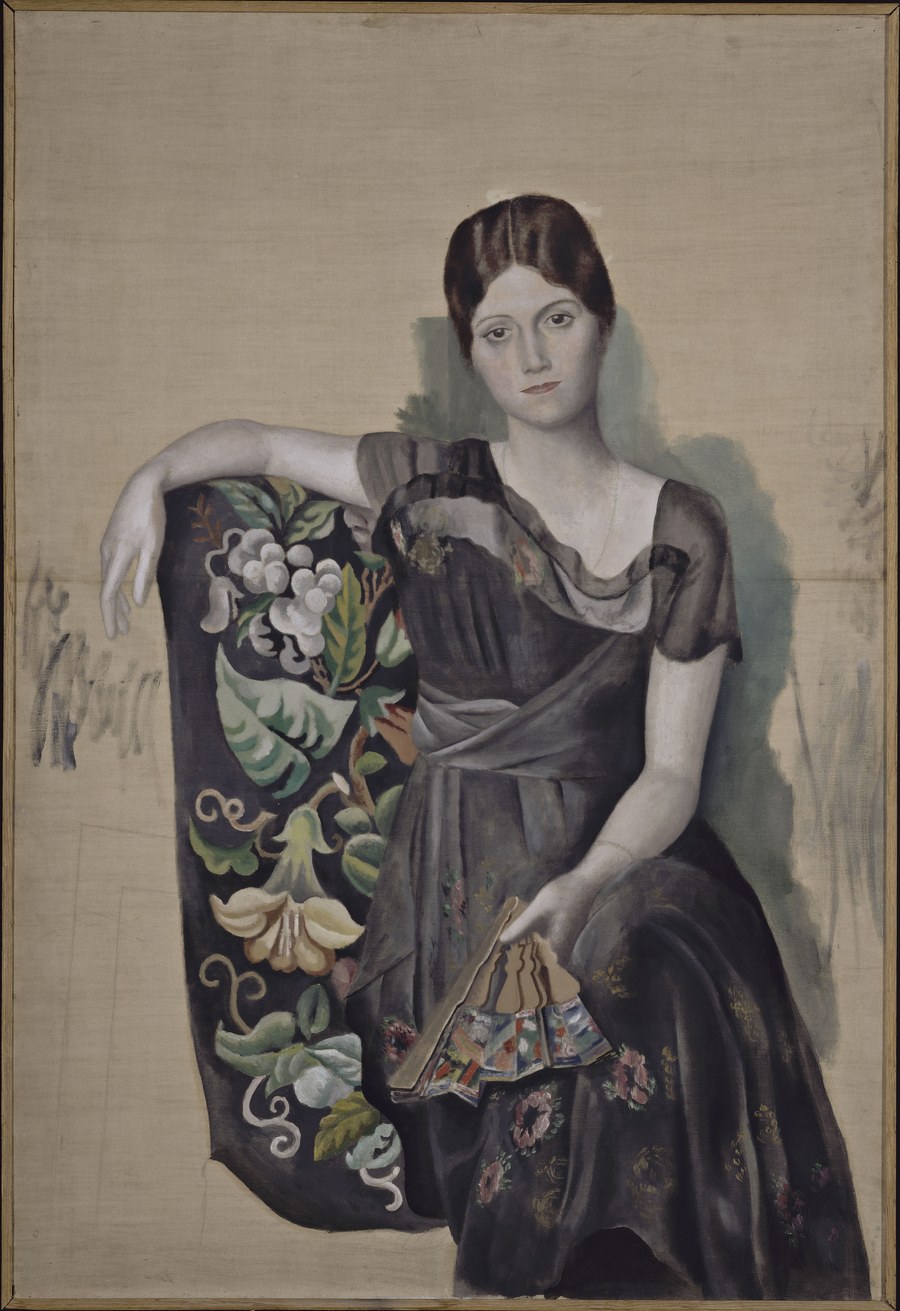
Pablo Picasso, Portrait d’Olga dans un fauteuil (Olga in an Armchair), 1917-18. Oil on canvas, 130 x 88.8 cm. Musee national Picasso-Paris.
Returning to the exhibition, the relationship with the sacred is something natural, since Picasso grew up in a deeply Catholic Spain, where religious images were part of the everyday landscape. The Virgins of Gosol, Alonso Cano or Murillo were part of that imaginary. Although his adult life unfolded largely in France, that visual memory never disappears.
The image of the crucifixion runs through Picasso’s work as a way of expressing pain. In 1901, the suicide of his friend Carlos Casagemas shakes him deeply and opens that somber creative phase that would be the “blue period” (1901-1904). That impact also revives a childhood grief that never quite closed: the death of his sister Conchita.
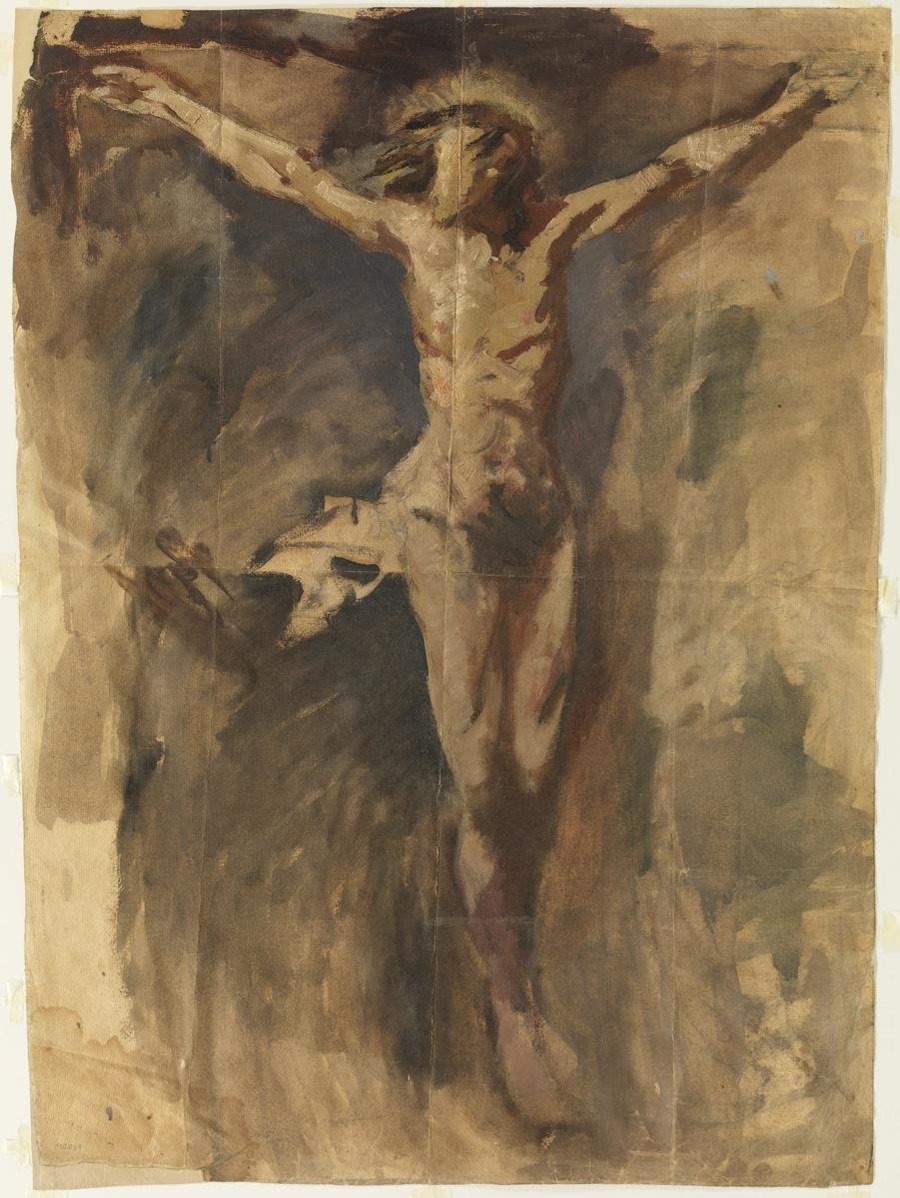
Pablo Picasso, Christ Crucified, Barcelona, 1896. Oil and charcoal on paper, 73.5 x 54.4 cm. Museu Picasso, Barcelona. Donation Pablo Picasso, 1970.
In this way, the exposed body, sacrifice and suffering lead Picasso scholars to see in the representations of Casagemas almost a modern Christ. Decades later, in Crucifixion (1932), that imaginary reaches a new intensity, not so much as a religious scene, but as a condensation of anguish, violence and transcendence. In many of his works, the figure of the crucified Christ appears deformed, intensifying human pain. That same language of torn bodies and extreme gestures reappears in Guernica (1937), where suffering ceases to be intimate to become a collective tragedy.
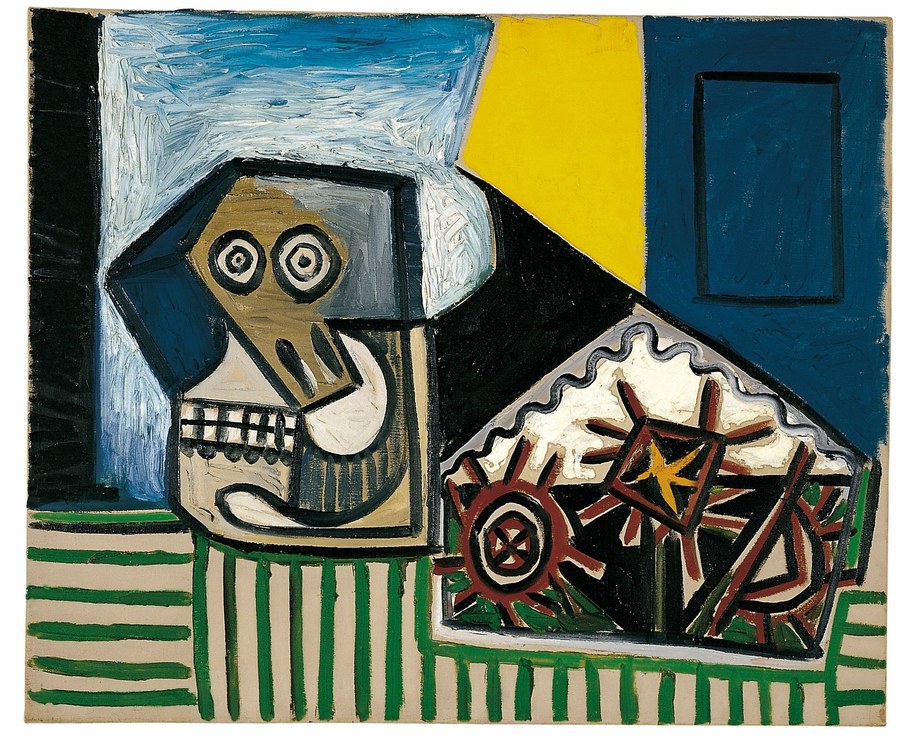
Pablo Picasso, Still Life with Skull and Three Sea Urchins, Paris, 6 January 1947. Oil on canvas, 60 x 72.5 cm. Museo Picasso Malaga, donation Christine Ruiz-Picasso.
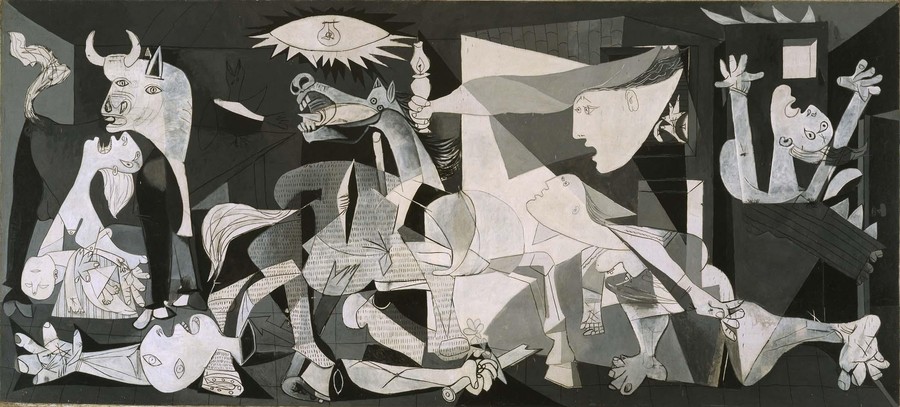
Pablo Picasso, Guernica, Paris, 1 May – 4 June 1937. Oil on canvas, 349.3 x 776.6 cm. Museo Nacional Centro de Arte Reina Sofia, Madrid.
The “rose period” (1904-1906) softened that gravity, introducing circus characters, harlequins and acrobats, announcing a rupture that is consummated in 1907 with Les Demoiselles d’Avignon, a key work in the history of Western art, developing cubism.
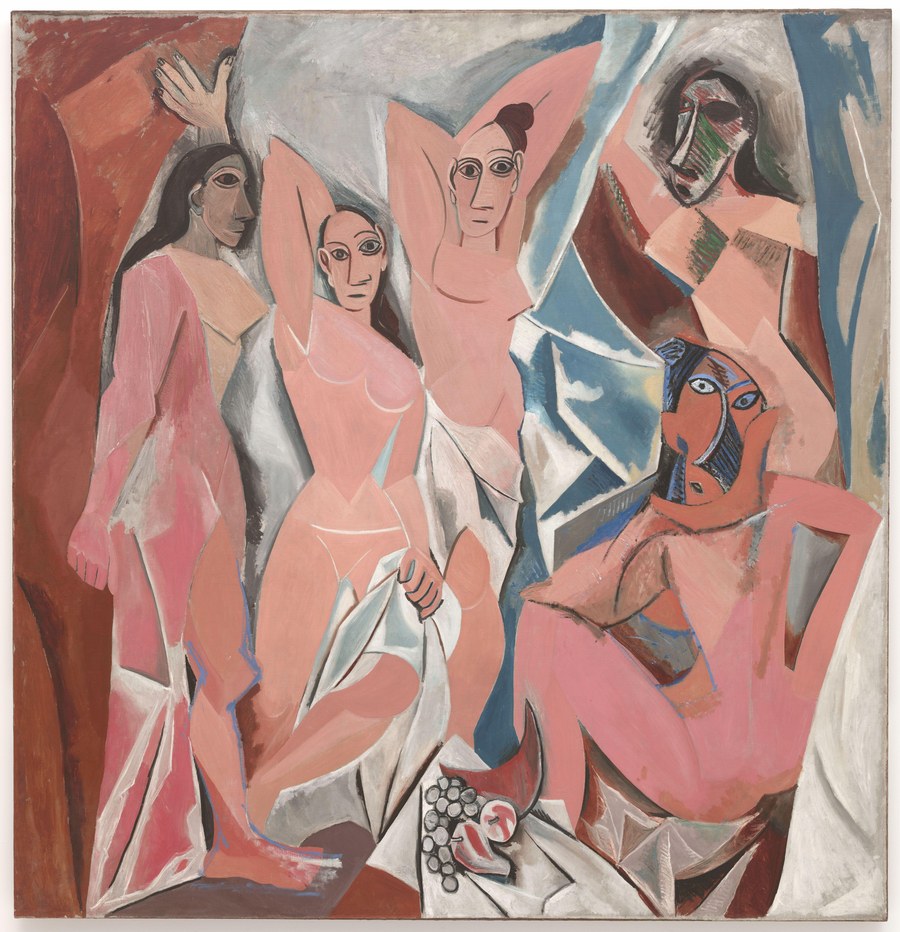
Pablo Picasso, Les Demoiselles d’Avignon, Paris, June-July 1907. Oil on canvas, 243.9 x 233.7 cm. Museum of Modern Art (MoMA), New York.
In conclusion, Picasso remains an inexhaustible artist because he refuses to be pigeonholed, and at the same time he revolutionized painting and changed our way of seeing it. The Burgos exhibition, by focusing on his relationship with Christian iconography, opens a new avenue of interpretation and of understanding tradition. The value lies in the fact that such a prominent and studied figure can keep surprising with new avenues of interpretation. His capacity to absorb and transform influences from the old masters, from Iberian art, from popular culture or from African art is what defines his modernity and defies any attempt to simplify the genius that Pablo Picasso was.
Picasso. Biblical Roots
Beato Valentin Palencia Hall, Burgos Cathedral
Plaza del Rey San Fernando, s/n. Burgos
Until 29 June 2026
– Picasso. Biblical Roots – – Alejandra de Argos –