

Carlos Garcia Gual Invites Us to Discover a “Grecia para Todos”
The Hellenist, recently inducted into the Royal Spanish Academy, proposes a journey of approach to classical Greek culture in his latest book. A text full of history and beauty, that hooks you from the first page.

Portrait of Carlos Garcia Gual. Photo: RAE. At nationalgeographic.com.es
From seat J of the Royal Spanish Academy, Carlos Garcia Gual turns his gaze back to his beloved Hellenic culture in his latest book, Grecia para Todos (Editorial Espasa). The writer and expert Hellenist, an adviser to publications of the stature of National Geographic, proposes in this volume an approach to the society from which Western culture emerged: ancient Greece. Recently arrived at the RAE (he took his seat in February 2019), with this publication Garcia Gual has a double purpose: to encourage the less versed to discover a truly fascinating culture, and to refresh the memory of those who were once interested in it. In principle, the book is aimed at the youngest; according to its author, that is its main objective and that of the publisher. But on the other hand, it also “serves for those people who have a certain vague idea of the Greek world and want to go deeper, because this book has precise ideas. It is an invitation to enter the Greek world and also an invitation to review the fundamentals.”
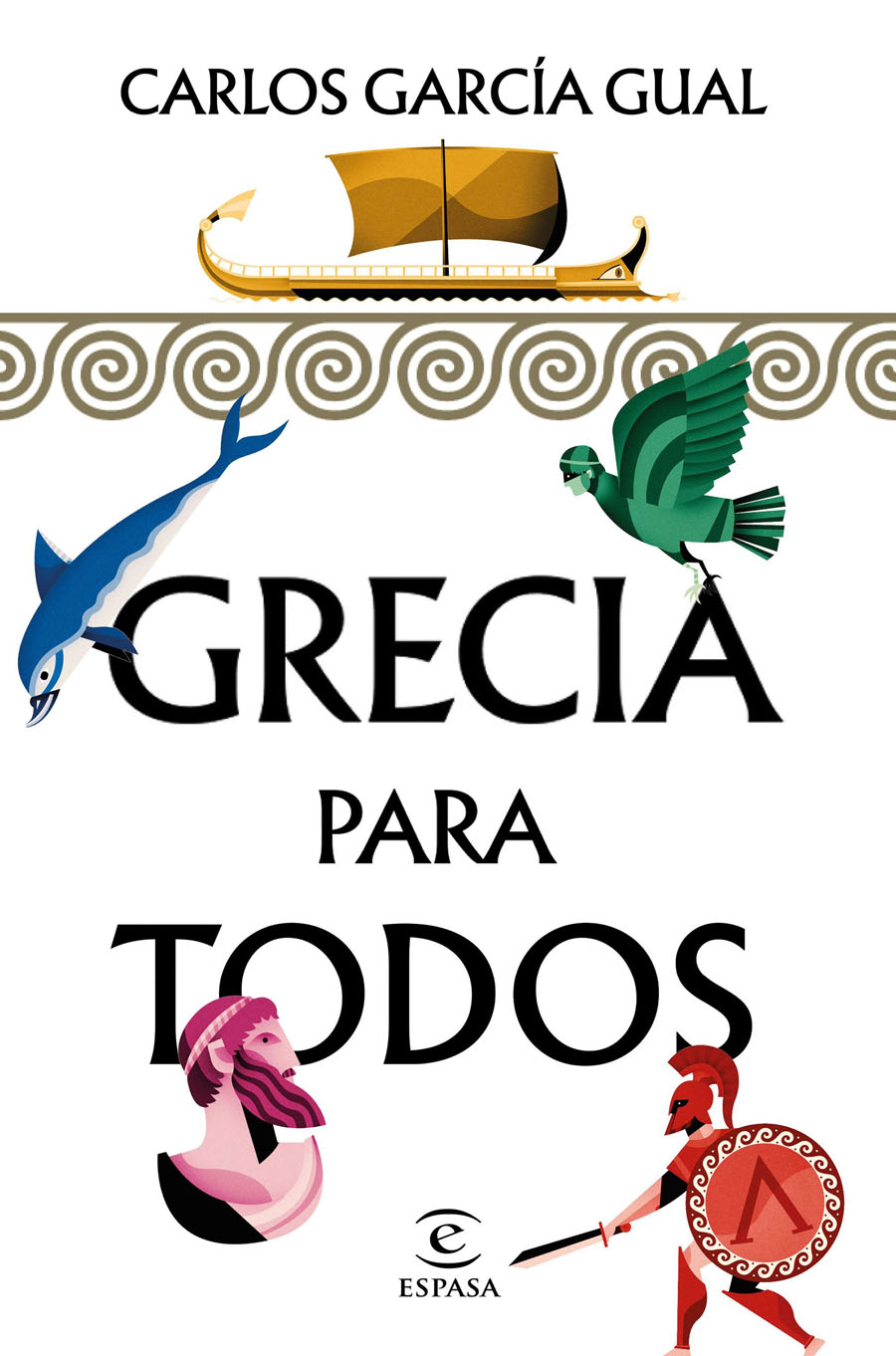
Cover of the book “Grecia para Todos”. Carlos Garcia Gual. Editorial Espasa, 2019
Through the pages of the book parade poets, statesmen, heroes, gods and philosophers, all of them part of the Western cultural heritage and fundamental to the development of the ideas that would later permeate the invading Roman Empire. According to Garcia Gual, Rome conquered Greece; but (the author paraphrases Horace) “conquered Greece captured its conquerors”. Concepts such as democracy, freedom or aesthetics would not be the same today if they had not been conceived and developed first by Hellenic society. Very especially, the author directs his pages to the adolescents and young people who today center their lives on the mobile phone screen; a sector very difficult to draw toward reading. For this reason, the writing of Grecia para todos becomes direct and fluid, far from complex styles or deep reflections. In its pages a fascinating journey begins on the shores of the Mediterranean, full of olive trees, sun, wine and capricious gods. The author’s intention is to open the door and show the way; it is then the reader’s task to continue it and seek new avenues of knowledge. Grecia para todos thus reveals itself as a book full of interest, perfect for those who want to discover the influence of Hellenic culture on today’s society, and for those who wish to recover (or continue) their passion for philosophy, history and classical art.
You may also like
 Antonio Garcia Villaran and “El arte de no tener talento”
 “Tiempo de magos”: The Prodigious Decade of 20th-Century Philosophy
 “Tus pasos en la escalera”. Waiting, as Told by Antonio Munoz Molina
 Nature Will Invade a Stadium in Klaus Littmann’s Next Intervention
 “La memoria esculpida”: Three Years of Conversations with Martin Chirino
 The COLECCIONA Encounters Visit the H.E.F. Collection of Juan Entrecanales